Hypnosis for hair pulling works on the two things that keep trichotillomania going: the automatic moments when your hand is already at your hair, and the stress or tension the pulling relieves. A hypnotherapist helps you notice the urge sooner, builds a calmer response to it, and gives your mind a different way to settle. Published studies, mostly small ones in children and teens, report fewer pulling episodes with hypnotherapy. It works best alongside behavioral therapy and, where needed, care from your doctor or therapist. At MindShift Hypnosis we offer personalized hypnotherapy and life coaching, in person and online, for people who want that kind of combined support.
TL;DR
- Trichotillomania is a hair-pulling disorder. Hypnosis targets the urge, the awareness gap and the stress behind it.
- Small studies and case reports in children and adolescents describe fewer pulling episodes after hypnotherapy, often within a handful of sessions.
- Behavioral treatment, especially habit reversal training, is the established first-line approach. Hypnosis fits next to it as a complement.
- Anxiety, depression, OCD and PTSD often travel with hair pulling, so a plan that addresses the whole picture matters.
- A session is guided relaxation and focused attention with suggestions tailored to you, and it can be done online.
Table of Contents
- What trichotillomania is, in plain terms
- Why hypnosis is used for hair pulling
- What the research shows
- Hypnosis next to habit reversal and CBT
- The conditions that often come with hair pulling
- What a session looks like
- Self-hypnosis audio versus working with a practitioner
- Children and teens
- Safety and who should be careful
- Insurance and cost
- Does hair pulling ever go away?
- Perspective
- Getting started with MindShift
- FAQ
- Sources
What trichotillomania is, in plain terms
Trichotillomania (often shortened to TTM) is a condition in which a person repeatedly pulls out their own hair, causing hair loss, and has tried and failed to cut back. The diagnostic criteria in the DSM-5, the manual clinicians use, also require significant distress or impairment. The pulling must not be explained by another medical condition or another mental disorder. It is classed as a body-focused repetitive behavior, a group that also includes skin picking.
It is more common than most people assume. A 2024 review puts prevalence at 0.5 to 3% of the population, with onset typically in late childhood or early adolescence. Adults who seek help are mostly women, at about four to one.
People describe two broad patterns. Focused pulling is deliberate: you pull to relieve tension or a sensation you can’t ignore. Automatic pulling happens while you read, drive or watch television, and you may realize only when you see hair in your hand. A 2022 comparison study measured both types, and that distinction matters for what hypnosis can do.
Why hypnosis is used for hair pulling
The 2021 dermatology review by Graubard and colleagues defines hypnosis as the intentional induction, deepening, maintenance and termination of a trance state for a specific purpose. In practice it is a state of focused attention and deep relaxation in which you are more open to suggestions for change. Medscape’s clinical overview describes it similarly: attention held on specific mental images for therapeutic purposes.
For hair pulling, that gives a practitioner three levers.
Awareness. Automatic pulling is mostly a gap in awareness. A 2022 review in PMC notes that hypnotherapy has been used to sensitize and alert patients to impending pulling. If you catch the urge one second earlier, you have a choice you didn’t have before.
Triggers. Stress, boredom, mirrors, certain times of day and certain places are common cues. Hypnosis lets you rehearse, in your imagination, meeting those cues without acting on them.
Self-soothing. Pulling often relieves something. A hypnotherapist can introduce a new way of calming the same feeling, such as a physical anchor, a breathing pattern or a mental image you can summon in seconds.
What the research shows
The research on hypnosis for trichotillomania is a body of small studies and case reports. They are worth knowing because they show what clinicians have tried and what patients reported.
| Study | Who | What was done | What was reported |
|---|---|---|---|
| Christenson, 1999 | 3 children | Hypnotherapy with relaxation and mental imagery, followed 12 to 18 months | Two reported complete resolution after 7 to 8 weeks, one after 16 weeks. A recurrence resolved after 3 weeks of retreatment |
| Iglesias, 2003 | 3 children | Direct hypnotic suggestion to notice impending pulling, plus parent contracts | Pulling extinguished in 7 visits or fewer, no relapse at follow-up of up to 6 months |
| Narimani, 2022 | 45 students aged 10 to 18 | 8 sessions of hypnotherapy versus 9 sessions of habit reversal | Hypnotherapy showed a larger reduction in focused (p=0.027) and automatic (p=0.026) pulling and a larger gain in self-esteem (p=0.024) |
| Narimani, 2023 | 45 students aged 10 to 18 | Aversion therapy versus hypnotherapy versus control | Both treatments lowered hair-pulling scores (p=0.013) and raised self-esteem (p=0.021) against control, with hypnotherapy ahead of aversion therapy |
The Graubard review adds that three pediatric trichotillomania patients responded well with no recurrence at 16 months. The pattern across these reports is consistent: awareness, imagery and a new response to the urge, usually delivered in a modest number of sessions.
Two details stand out. First, the Iglesias cases gave no explicit instruction to stop pulling. The suggestions focused on noticing the urge and on the person’s own choice. Second, the family mattered. In those cases the pulling had become entangled with a power struggle over the child’s hair, and parents agreed to step back from controlling it. Good hypnotherapy for younger clients includes the household, not only the child.
Hypnosis next to habit reversal and CBT
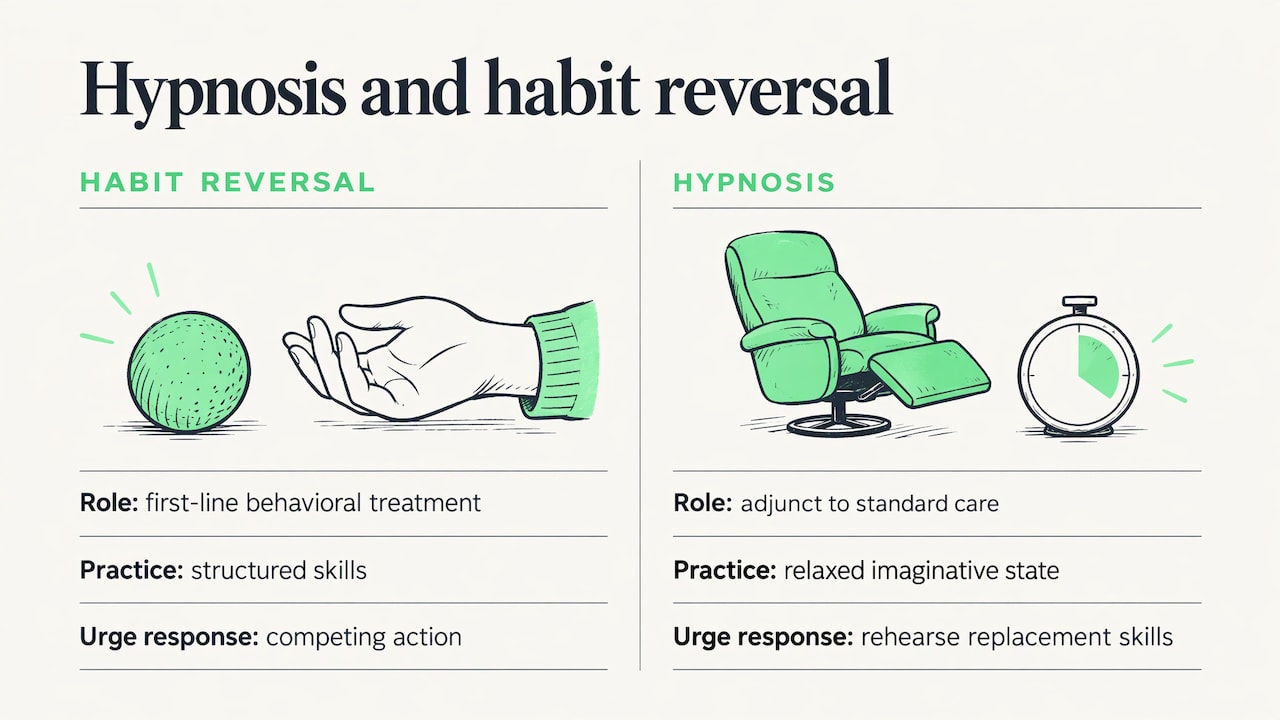
Behavioral treatment is the foundation of care for hair pulling. Medscape states that first-line treatment is behavioral treatment and intervention focused on affective regulation, and that no medication is approved for the condition. A recent state-of-the-art review of pediatric trichotillomania likewise identifies habit reversal training, a form of cognitive behavioral therapy, as the first-line treatment. Habit reversal teaches you to recognize the urge and substitute a competing action, such as clenching a fist or squeezing a stress ball.
Hypnosis and habit reversal share a core idea: awareness first, then a replacement behavior. That is why they combine so well. Habit reversal gives you a structured set of skills. Hypnosis helps you practice them in a relaxed, imaginative state and addresses the emotional load that drives the urge. The dermatology review frames mind-body therapies as adjuncts to standard care, and we agree with that framing: our work is designed to fit beside your therapist or physician, not replace them. We write about this in more depth in our piece on combining hypnotherapy with traditional healthcare.
The conditions that often come with hair pulling
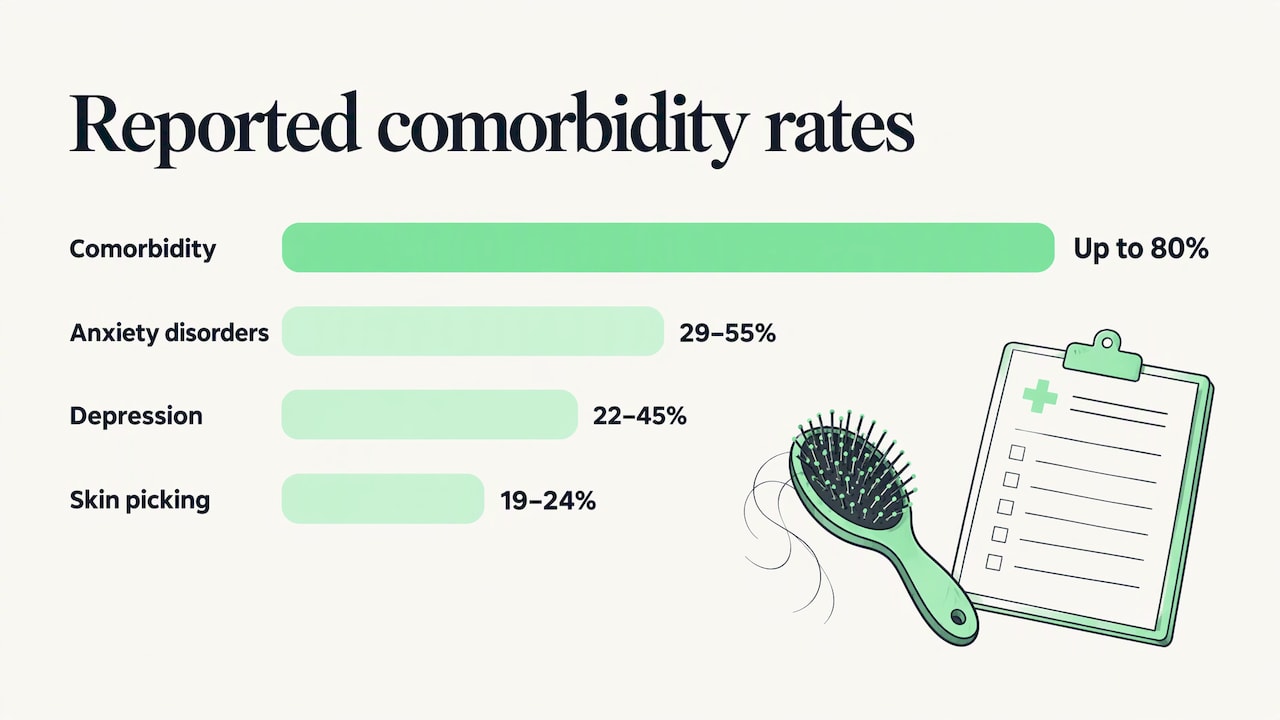
Hair pulling rarely arrives alone. A 2025 treatment update in Actas Dermo-Sifiliográficas reports comorbidity of up to 80%, most often major depressive disorder, social anxiety disorder, OCD, PTSD and ADHD. The 2024 MDPI review gives lifetime ranges of 29 to 55% for anxiety disorders and 22 to 45% for depression, with skin picking at 19 to 24%.
This changes what a good plan looks like. If pulling flares when anxiety spikes, working on the anxiety is part of working on the pulling. If it began after a frightening or painful period, trauma-informed support belongs in the plan. Our services include work on depression and anxiety, trauma and PTSD, and fears and phobias, so those threads can be addressed together instead of in separate silos.
One safety point deserves attention. Up to 20% of people with trichotillomania eat the hair they pull, a behavior called trichophagia, which can form hairballs in the digestive tract that may need surgical intervention. If you swallow hair and have stomach pain, nausea, vomiting or a feeling of fullness, see a physician promptly.
What a session looks like
A hypnotherapy session for hair pulling usually moves through these stages:
- Conversation. You describe when and where you pull, whether it is focused or automatic, what you feel just before, and what has helped or failed. Your history with anxiety, mood or trauma shapes the plan.
- Induction. Guided relaxation and focused attention bring you into a calm, absorbed state. You stay aware and in control throughout.
- Suggestion and imagery. The practitioner uses language and imagery matched to you: noticing the first flicker of the urge, picturing a trigger situation and handling it differently, or building a cue that brings calm.
- Return and debrief. You come back to full alertness and talk through what you noticed.
- Practice. You leave with a short routine, such as a breathing pattern or a hand position, to use between sessions.
The case reports describe short courses. Iglesias reported seven visits or fewer, and the Narimani comparison used eight sessions. Your own pace depends on how long the habit has been in place and what else is going on. A good provider reviews progress as you go instead of promising a fixed number.
Self-hypnosis audio versus working with a practitioner
Recorded sessions are easy to find, and some people use them to relax. The research above, though, describes hypnotherapy delivered by a practitioner who adjusts suggestions to the person. The dermatology review notes that hypnosis requires trained practitioners and careful subject selection because hypnotic susceptibility varies from person to person. A one-to-one session lets the work follow your triggers, your wording and your pace. That is the basis of our approach: a personalized plan built around you.
Children and teens
Most of the published hypnosis work on hair pulling involves young people, which makes sense given the usual age of onset. The authors of one adolescent case series suggest imaginative techniques may suit this age group because imagination is well developed. The same reasoning applies to the family’s role: parents who stay calm, avoid policing the hair, and support the practice get better conditions for change.
A 2022 review notes that in preschool children hair pulling is considered a habit disorder expected to disappear on its own, while older children and teens benefit from behavioral approaches, sometimes with medication, given how often other psychiatric conditions are present. Any child with visible hair loss should see a pediatrician first so that medical causes are checked.
Some children also have sensory differences that shape how they handle touch, texture and stress. If that sounds like your child, a practical guide to sensory processing help for kids can show what developmental support looks like alongside emotional work. Our page on family hypnosis explains how we involve parents and siblings.
Safety and who should be careful
The CAM Cancer Collaboration’s hypnotherapy page (updated November 2024) states that hypnotherapy is considered safe when delivered by trained professionals. Contraindications include acute psychosis, severe personality disorders and an inability to be hypnotized. Common side effects are mild: anxiety, dizziness, drowsiness, headache, insomnia and nausea. People with a history of trauma or abuse need special precautions, which is why we begin with a conversation about your history before any session.
Tell your hypnotherapist about any diagnosis and medication, and tell your physician or therapist that you are doing hypnosis. If you have a psychiatric diagnosis, your psychiatrist or psychologist should stay part of the plan. If pulling is accompanied by thoughts of self-harm, contact a mental health professional or call or text 988, the Suicide and Crisis Lifeline, right away.
Insurance and cost
Hypnotherapy is often paid out of pocket, and coverage varies by plan and by who provides it. We explain how the billing code works in our guide to hypnotherapy insurance in the U.S.. Habit reversal and CBT delivered by a licensed clinician are more often covered, so it is worth asking your plan about both.
Does hair pulling ever go away?
Yes, for many people it improves. The 2025 Actas update cites an epidemiological study of 10,169 adults in which about 24.9% of people with current or past trichotillomania experienced remission without medical treatment or psychotherapy. That figure shows that change is possible. It is also a reason to pursue support rather than wait: the people in that group had no structured help, and you can have it.
Expect a pattern, not a straight line. In Christenson’s reports, one child had a recurrence that resolved after three weeks of retreatment. Plan for stressful periods, keep your practice going, and treat a lapse as information about a trigger.
Perspective
When someone comes to us about hair pulling, they have usually tried willpower first. Willpower rarely works on a behavior that happens when you aren’t paying attention.
What we focus on is the moment before the hand moves. Hypnosis is a good tool for training that moment: you rehearse noticing the urge, you practice a calmer response, and you build a way to settle that doesn’t cost you your hair. Our approach combines hypnotherapy with life coaching, so the plan also covers the stress, the routines and the relationships around the habit.
We build every plan around the individual, and we work alongside a client’s physician or therapist. Hair pulling often sits next to anxiety, low mood or past trauma, and we treat those as part of the same picture. Sessions are available in person and online, which helps when pulling happens at home late at night, exactly where you want the new skill to live.
Rachael
Getting started with MindShift
If you are ready to work on hair pulling with a practitioner, our hypnotherapy and life coaching services include hypnosis only, hypnosis combined with life coaching, work on depression and anxiety, trauma and PTSD, fears and phobias, and online sessions. Individuals, couples and families can book, and we shape the plan to the person in front of us.

Bring a few notes to your first conversation: when you pull, where, what you feel beforehand, and what you have already tried. That is enough to start building a plan.
FAQ
Does hypnosis work for trichotillomania?
Published reports in children and adolescents describe fewer pulling episodes and, in some cases, full resolution after hypnotherapy, often within about 7 to 16 weeks. Two 2022 and 2023 comparison studies also found hypnotherapy lowered pulling scores and raised self-esteem. Results differ from person to person, and hypnosis is best used alongside behavioral therapy.
Can hypnosis stop hair pulling for good?
Some people in the case reports had no relapse at follow-up of six months to 18 months. Hair pulling can return in stressful periods, and short retreatment resolved a recurrence in one report. Ongoing practice of the new response and support for the stress behind the habit give the best chance of lasting change.
How many sessions does hair pulling hypnotherapy take?
The studies describe courses from a couple of sessions up to about eight. How many you need depends on how long you have pulled, whether it is focused or automatic, and any anxiety or mood concerns alongside it. Your practitioner should review progress as you go.
Is hypnosis safe for hair pulling?
Hypnotherapy is considered safe when delivered by trained professionals. Side effects are usually mild, such as drowsiness or headache. Tell your practitioner about any trauma history, psychiatric diagnosis or medication beforehand.
What mental health conditions are linked to trichotillomania?
Anxiety, depression, OCD, PTSD, ADHD and skin picking are the most common, and up to 80% of people with trichotillomania have another condition. A plan that addresses those conditions as well as the pulling tends to make more sense.
Sources
- Trichotillomania: What Do We Know So Far? (PMC, 2022)
- Stress and Skin: An Overview of Mind Body Therapies (PMC, 2021)
- Trichotillomania Treatment and Management (Medscape)
- A Review of Behavioral and Pharmacological Treatments for Trichotillomania (MDPI, 2024)
- Trichotillomania Treatment Update (Actas Dermo-Sifiliográficas, 2025)
- Treatment Strategies for Pediatric Trichotillomania (PMC)
- Comparing the Effect of Habit Reversal and Hypnotherapy (Narimani, 2022)
- Comparing the Effectiveness of Aversion Therapy and Hypnotherapy (Narimani, 2023)
- Hypnotherapy: an effective treatment modality for trichotillomania in children (Christenson, 1999)
- Hypnosis as a vehicle for choice and self-agency (Iglesias, 2003, PubMed)
- Hypnotherapy in Adolescents with Trichotillomania: Three Cases (2001)
- Hypnotherapy (CAM Cancer, 2024)