
ADHD coaching is a structured, forward-looking partnership in which a coach helps an adult build practical systems for time, organization, task initiation and follow-through. A coach does not diagnose or treat ADHD. The work is about what you do on a Tuesday afternoon, not about why you struggled in third grade. This guide covers how coaching works, how it differs from therapy and medication, what to look for in a coach, and how to get real results from sessions.
TL;DR
- ADHD coaching is practical and goal-driven. It builds daily systems for executive function, and it does not replace diagnosis, therapy or medication.
- The best care often combines medication when appropriate, ADHD-informed therapy for emotional and historical work, and coaching for the day-to-day mechanics.
- ADHD coaching is not regulated in the US, so check training specifically in ADHD, not just a general life coaching certificate.
- Coaching is rarely covered by insurance. Some people can use an HSA or FSA with a letter of medical necessity from a licensed clinician.
- A good coach adapts to your brain. A rigid, one-size-fits-all productivity method is a warning sign.
Table of Contents
- What ADHD coaching actually is
- Coaching, therapy and medication: who does what
- What a coaching engagement looks like
- How to choose an ADHD coach
- Paying for coaching
- Perspective: where hypnosis and life coaching fit
- Getting more out of every session
- When to see a clinician instead of, or before, a coach
- Working with us
- FAQ
- Sources
What ADHD coaching actually is
The Attention Deficit Disorder Association (ADDA) describes ADHD coaching as a collaborative, supportive, goal-oriented process. You and the coach identify your goals, then develop the skills, strategies and habits to reach them. Nothing is imposed. You set the agenda, and the coach asks questions, offers structure and keeps you honest about what you said you would do.
In practice, the topics tend to be concrete:
- Starting tasks you keep postponing, such as the email, the tax paperwork or the work project.
- Estimating how long things really take, and building a day around that number.
- Organizing paper, digital files, your calendar and your physical space.
- Prioritizing when everything feels equally urgent.
- Building routines that survive a bad week, not just a good one.
Understood summarizes it plainly: ADHD coaching is a type of life coaching focused on managing focus, time and organization, and coaches are not licensed mental health professionals who can diagnose or treat ADHD.
The three ingredients of effective coaching
A 2024 study that developed a manualized coaching intervention for adult ADHD describes three pillars. The first is life coaching for empowerment. The second is education about how the ADHD brain works, which helps reduce shame. The third is skills coaching, which develops conscious competence so you can keep up with daily goals.
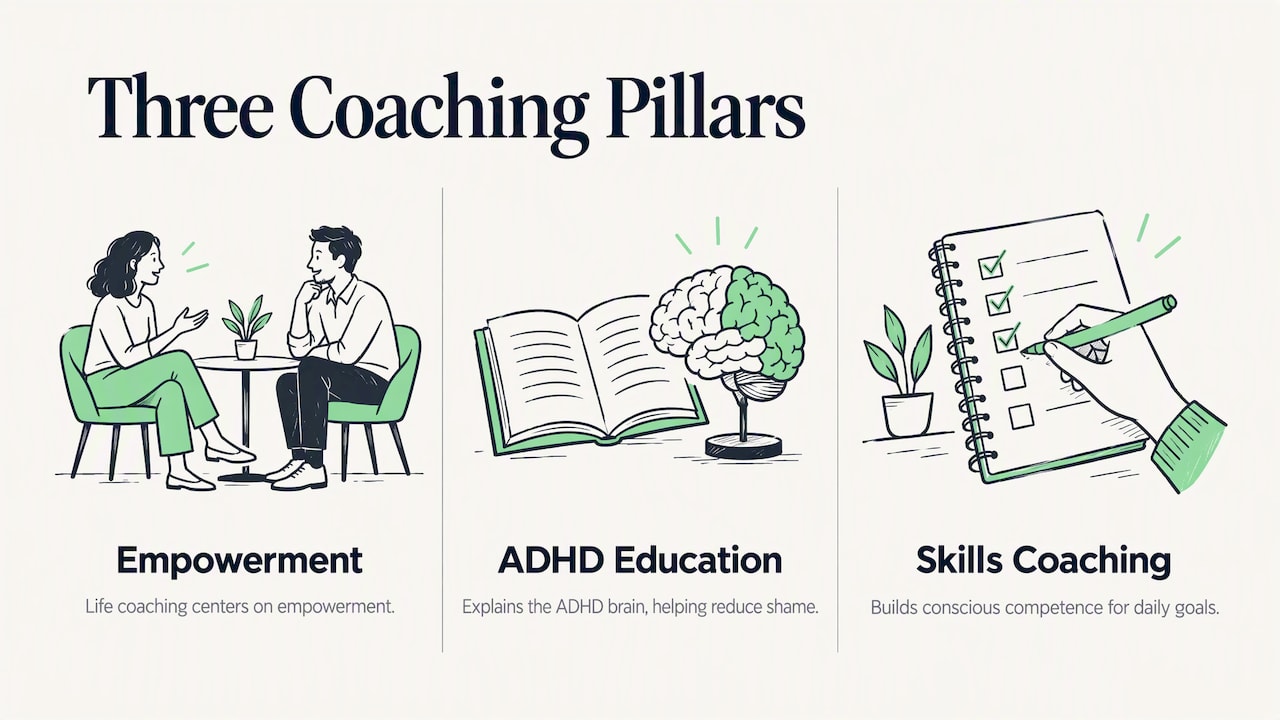
The shame piece matters more than it sounds. Many adults, especially those diagnosed late, have spent decades believing they are lazy or careless. A coach who explains why starting is hard, and then designs around it, changes how you treat yourself. That shift often does more than any app.
Coaching, therapy and medication: who does what
People often ask which one to choose. Usually the answer is that they do different jobs.
| Medication | ADHD-informed therapy | ADHD coaching | |
|---|---|---|---|
| Who provides it | Licensed prescriber | Licensed mental health clinician | Coach, not a licensed clinician |
| Focus | Symptom management | Emotions, history, co-occurring conditions | Daily systems and goals |
| Time orientation | Ongoing | Past and present | Present and future |
| Can diagnose or treat | Yes | Yes | No |
ADDA’s guidance on who does what notes that coaches are not trained in the medical model. They help you use your strengths to reach goals and develop executive skills such as planning, prioritization, organization and task initiation.
CHADD, a major US ADHD nonprofit, describes the ideal as a multimodal approach: medication when appropriate, supportive psychotherapy such as ADHD-focused CBT for emotional and historical processing, and specialized coaching for the pragmatic details of daily life. The roles do not overlap, and coordination between them is considered optimal.
A practical rule: if you suspect you have ADHD but have never been evaluated, start with a licensed clinician. If you are also dealing with deep depression, anxiety or trauma, bring that to a therapist or physician first or alongside coaching. Coaching works best when the foundation is already stable enough to build on.
Why structure matters even with medication
Good practice guidance from the Royal College of Psychiatrists in the UK says environmental changes and lifestyle supports such as structure, habit-building and delegating should be put in place before or alongside medication. This is a UK document, and US practice varies, but the logic carries over. A pill does not file your receipts. Coaching is where those supports get built and maintained.
What a coaching engagement looks like
Formats vary, but a typical engagement has a recognizable shape.
- Intake and goals. You describe what is not working and what you want instead. Good coaches push for specifics: not “be more organized,” but “open and answer mail within 48 hours.”
- Experiments. You try one small system for a week, such as a launch-pad shelf by the door or a fixed 15-minute morning review.
- Review. Next session, you look at what happened without judgment. What worked stays. What failed is data, not a verdict.
- Adjust and add. You change the system or stack a second one on top.
- Taper. As habits hold, sessions space out.
Between sessions, flexibility counts. NeuroDiversion notes that strong coaching arrangements often go beyond a 30 to 60 minute call, adding voice-note check-ins, email accountability or body-doubling sessions, and that a coach who insists on one rigid format may lack the flexibility ADHD work needs.
A worked example
Say you keep missing the deadline to submit expense reports. A generic fix is “set a reminder.” A coach works differently. You find that the real barrier is not forgetting, it is that the task feels huge and vague. So the first step becomes “photograph receipts into one folder the day you get them,” which takes 30 seconds. The report itself gets a 25-minute block with a coworker on a video call. Then you review: did the folder habit stick? That is coaching: small, specific, tested, adjusted.
If your physical environment is part of the problem, the environment itself can be redesigned. Lost keys, scattered chargers and overflowing junk drawers are classic friction points, and ideas like compact, labeled organization setups that reset in minutes show how a small, visible system can reduce the effort of putting things back.

How to choose an ADHD coach
Because ADHD coaching is not a regulated profession in the US, anyone can use the title. NeuroDiversion advises looking for credentials from ADHD-focused programs such as the Professional Association for ADHD Coaches (PAAC) or the ADD Coach Academy (ADDCA), rather than a general life coaching certificate alone. ADDA also publishes a guide to finding an ADHD coach that is worth reading before your first call.
Questions to ask in a consult call
- What training do you have specifically in ADHD? Ask for the program name and whether it was a full course or a weekend workshop.
- How do you work with clients who miss sessions or forget homework? You want a shrug-and-adjust answer, not a lecture about commitment.
- What happens between sessions? Look for options: text, voice notes, email, body-doubling.
- How do you coordinate with my doctor or therapist? A good coach is comfortable working alongside them.
- What is your policy on cancellations and packages? ADHD schedules are unpredictable, so find out before you pay.
- How will we know it is working? Ask for measurable markers, not vibes.
Does your coach need to have ADHD?
Not necessarily. Experienced practitioners quoted by NeuroDiversion say lived experience can be the quickest route to feeling understood, but it is not a requirement. The decisive factor is a collaborative, flexible partnership where the coach adapts to your brain instead of forcing you into a rigid productivity style.
Red flags
- Promises to “cure” or “fix” ADHD.
- Advice about starting, stopping or changing medication. That belongs to your prescriber.
- One fixed system for every client.
- Pressure to buy a long, expensive package before you have had a trial session.
- Shaming language about willpower.
Paying for coaching
Coaching is rarely covered by standard health insurance. ADDA notes that many people can use an HSA or FSA if they obtain a letter of medical necessity from a licensed clinician, so it is worth asking your provider whether they can support that paperwork. Check your plan administrator’s rules first, because acceptance varies.
Prices differ widely by coach, training and package structure. Rather than trusting a national average, ask for the fee, session length and what is included between sessions, then compare that to what you can sustain for at least three months. Consistency matters more than intensity.
Perspective: where hypnosis and life coaching fit
We are a hypnotherapy and life coaching practice, and we want to be clear about our lane. We are not a medical provider, we do not diagnose ADHD, and we do not tell anyone what to do about medication. Our approach is built on personalized plans, strategic planning and a safe, supportive setting, and we work alongside traditional healthcare, not in place of it. You can read how we think about that on our page about combining hypnotherapy with traditional healthcare.
Here is what we see when adults come to us with attention and follow-through struggles. The plan is rarely the problem. People know what they should do. The gap is between intention and action, and it is often wrapped in stress, self-criticism or avoidance. That is where we focus: concrete if-then plans, accountability, and calming the stress response that makes starting feel impossible. Our article on accountability coaching and hypnosis turning if-then plans into action walks through the method. If anxiety or low mood sits alongside attention challenges, our pages on hypnotherapy for depression and resilience coaching explain what that work involves.
Our advice if you are choosing: if you want a coach whose entire training is in ADHD, ask for those credentials and verify them. If you want a coach who builds a customized plan around your goals, stress and habits, and who is comfortable coordinating with your clinician, that is how we work. Either way, pick the person you feel safe being honest with, because coaching only works on what you are willing to say out loud.
— Rachael
Getting more out of every session
These habits make coaching dollars go further.
- Bring one real example per session. “I avoided the insurance call on Monday” teaches more than “I struggle with phone calls.”
- Shrink the action. If you did not do it, the step was too big. Halve it.
- Externalize everything. Visible calendars, timers, sticky notes and a single capture list beat memory every time.
- Use another person. Body-doubling, where someone works quietly next to you in person or on video, helps many people start.
- Track wins in writing. ADHD brains discount past success. A running list counters that.
- Match the task to your energy. Put hard thinking where your focus is strongest, not where the calendar has a gap.
If your work is the main pressure point, it can also help to clarify what you are good at and what roles suit you. Structured tools such as cognitive and personality assessments for coaching clients can give you and a coach a shared starting vocabulary, though they are not a diagnostic test for ADHD.
When to see a clinician instead of, or before, a coach
See a licensed professional first if any of these apply:
- You have never been evaluated and want to know whether you have ADHD. Ask a psychologist, psychiatrist or another qualified clinician.
- You are having thoughts of harming yourself. In the US, you can call or text 988, the Suicide and Crisis Lifeline, at any time.
- Mood, anxiety or substance use is making daily life unmanageable.
- You want to change or start medication. Only your prescriber can advise on that.
Coaching is a strong complement to all of those, but it is not a substitute.
Working with us
We offer life coaching, hypnosis-only sessions and combined hypnosis life coaching, for individuals, couples, families, groups and corporate teams, in person or online. If you want a customized plan for follow-through, stress and daily structure, take a look at our services or our online services. To see what a first session involves, read what to expect from hypnotherapy, and check our pricing page for current fees.
FAQ
What is ADHD coaching?
It is a collaborative, goal-oriented process where a coach helps you build strategies and habits for daily challenges such as time management, organization and follow-through. It is a form of life coaching, not a medical treatment. Coaches cannot diagnose or treat ADHD.
Is ADHD coaching worth it for adults?
It can be, particularly when you already know what you need to do but struggle to do it consistently. Research on specialized ADHD coaching reports benefit, though the field is still building its evidence base. It tends to work best alongside, not instead of, medical and therapeutic care.
Does insurance cover ADHD coaching?
Rarely. Some people can pay with an HSA or FSA if a licensed clinician provides a letter of medical necessity. Confirm with your plan administrator before you book.
How is ADHD coaching different from therapy?
Therapy addresses emotions, trauma and co-occurring conditions, and it is delivered by licensed clinicians. Coaching is forward-focused and practical, centered on what to do, when and how. Many adults benefit from both at once.
How do I know if a coach is qualified?
Ask about ADHD-specific training, such as programs recognized by PAAC or the ADD Coach Academy, and ask how they coordinate with your other providers. Because the field is unregulated, a general life coaching certificate alone does not tell you much about ADHD expertise.
Sources
- What ADHD Coaching Is (and Isn’t), ADDA
- What is an ADHD coach, Understood
- Development of a Manualized Coaching Intervention for Adult ADHD
- So Many Professionals! Who Does What?, ADDA
- Evidence-Based Coaching for Adults with ADHD, CHADD
- ADHD in adults: Good practice guidelines, Royal College of Psychiatrists
- Executive Function Coaches for Adults, NeuroDiversion
- ADHD Coaching: What Is It and How to Find an ADHD Coach, ADDA