
Resilience coaching is a short-term, practical coaching approach that helps people stay steady and perform under pressure by strengthening specific coping skills and recovery practices. It suits professionals facing chronic stress, anyone trying to prevent burnout, and coaches who want structured tools for clients. Research on combined approaches points to moderate, measurable improvements rather than an overnight fix, which makes consistent practice the real driver of results.
TL;DR:
- A 2018 review found a moderate pooled effect of 0.44 for combined cognitive behavioral and mindfulness interventions; programs delivered only digitally showed smaller effects.
- Digital interventions across 101 studies and 20,010 participants showed small favorable effects, but reviews also flagged varied results and reliance on small trials.
- Many programs run 8 to 12 weeks, set two or three goals, assign practice between sessions, and track progress with the same intake measure.
- Persistent low mood, resurfacing trauma, or thoughts of self harm call for therapy, so choose coaches who define scope and maintain a referral pathway.
Table of Contents
- What Resilience Coaching Is and How It Differs From Therapy
- Core Techniques and Tools Coaches and Clients Actually Use
- How a Resilience Coaching Engagement Typically Runs
- What the Research Says About Resilience Training
- How to Choose a Resilience Coach
- How We Approach Resilience Coaching at MindShift
- Getting Started With Resilience Coaching at MindShift
- FAQ
- Sources
What Resilience Coaching Is and How It Differs From Therapy
Resilience isn’t a trait some people have and others lack. The American Psychological Association frames it as a process: something built through connection, wellness habits, healthy thinking patterns, and a sense of meaning, not a fixed personality feature you’re born with or without.
That process framing matters because it shapes what coaching can and can’t do. Coaching targets skill-building and forward movement: goal-setting, accountability, and practice between sessions. Therapy addresses diagnosable mental health conditions and past trauma processing. The International Coaching Federation’s guidance on referrals is direct about this boundary: coaches are expected to recognize when a client’s needs sit outside coaching’s scope and make a referral rather than continue working alone.
In practice, resilience coaching draws on a few recurring frameworks:
- A multi-facet model that breaks resilience into measurable components like adaptability, optimism, and self-regulation.
- The ADAPTOR framework, which treats resilience as a dynamic interplay between a person’s reserve capacity and how they adapt to specific stressors.
- Structured assessment tools used at intake to establish a baseline before any skill work begins.
These models give coaches something concrete to measure, rather than relying on how a client feels in the moment.
Core Techniques and Tools Coaches and Clients Actually Use
Most resilience coaching draws from a handful of well-tested technique families rather than a single method. Combining them tends to outperform using any one in isolation.
- Cognitive reframing: identifying automatic thought patterns during stress and testing them against evidence, a core CBT-informed skill that a 2018 systematic review and meta-analysis linked to a moderate pooled effect when paired with mindfulness work.
- Nervous-system regulation: brief breathing or grounding exercises, often just a few minutes, practiced daily rather than only during a crisis.
- Strengths activation: naming personal values and strengths, then connecting daily decisions back to them so resilience has a concrete anchor instead of staying abstract.
- Pressure training: graded exposure to simulated high-stakes conditions, used mainly in performance contexts. A 2025 study on collegiate athletes found this kind of training increased mental toughness scores in a paired comparison, supporting its use as a practical tool for building composure under pressure.
- Micro-practices between sessions: short daily logs or check-ins that turn a single insight into a repeatable habit.
Emotional regulation work in particular benefits from brief, repeatable routines; our piece on emotional intelligence coaching walks through a brief breathing technique that fits into a workday without requiring a quiet room or extra time.
Pro Tip: Pick one micro-practice and repeat it at the same time each day for a while before adding another one; stacking too many new habits at once is the most common reason resilience plans stall.
How a Resilience Coaching Engagement Typically Runs
A resilience coaching engagement usually follows a predictable rhythm, which is part of what separates it from open-ended conversation.
- Intake and baseline assessment: a validated resilience measure or structured questionnaire establishes where a client starts, giving both the client and coach a reference point for progress later.
- Goal-setting: the client and coach agree on two or three specific, observable goals, such as reducing reactive decision-making under deadline pressure.
- Session structure: each session typically reviews the prior week, teaches or refines a tool, practices it live, and assigns a small home experiment before the next check-in.
- Program cadence: many engagements run 8 to 12 weeks, with early sessions focused on assessment and tool introduction and later sessions shifting toward independent application.
- Progress tracking: coaches revisit the baseline measure periodically, comparing it against the same instrument used at intake rather than switching tools mid-program, since that comparability is part of what the research on digital and in-person interventions relies on when judging whether a program worked.
Turning a session insight into a standing habit is often the hardest part of the process. Our notes on accountability coaching cover how if-then planning helps close that gap between what a client learns and what they actually do.
What the Research Says About Resilience Training
The evidence on resilience training is genuinely encouraging, though it comes with real caveats worth knowing before setting expectations.
A 2018 systematic review found a pooled effect size of 0.44 for interventions combining CBT and mindfulness techniques, a moderate effect by conventional standards, meaning measurable gains in resilience scores for the average participant across the studies reviewed. The same body of research found smaller effects for digital-only programs.
A large-scale review of digital interventions covering 101 studies and 20,010 participants found small favorable effects: an SMD of 0.31 for resilience factors and -0.24 for mental distress, roughly comparable to face-to-face formats. A separate meta-analysis of randomized trials reported a pooled SMD of 0.37 for resiliency training programs, while flagging significant heterogeneity and a reliance on small trials.
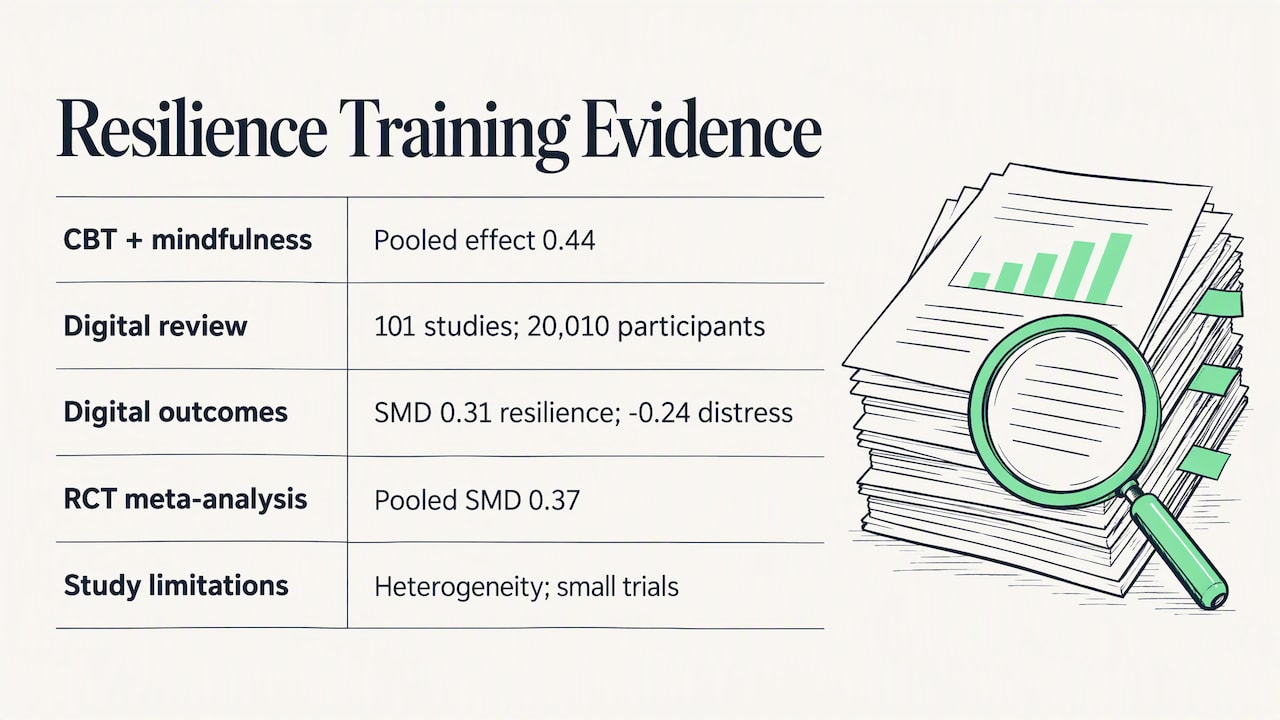
The honest takeaway: resilience training produces real, measurable benefits on average, but individual results vary, and the research base still leans on studies that are smaller and less consistent than researchers would like. That variability is exactly why tracking progress with a consistent measure, rather than going on impression alone, matters so much in practice.
How to Choose a Resilience Coach
Choosing a coach well starts with checking scope and method before checking chemistry.
- Confirm the coaching agreement states scope clearly, including what the coach will and won’t address.
- Ask whether the coach uses a formal assessment at intake and again later to track change.
- Ask about typical program length, how many sessions a reasonable outcome usually takes, and the pricing structure.
- Confirm the coach has a documented process for recognizing when an issue falls outside coaching’s scope.
On a discovery call, it’s reasonable to ask directly what training the coach has, which resilience measures they use, and what a typical 8 to 12 week program looks like session by session.
Not every concern belongs in a coaching conversation. Signs that therapy is the better fit include persistent low mood lasting weeks, trauma symptoms that resurface without warning, or thoughts of self-harm. ICF guidance on referrals is explicit that coaches should document these boundaries in the coaching agreement and have a referral pathway ready rather than improvising one later. Readers who need psychiatric support alongside coaching can find telehealth psychiatric care that handles evaluation and medication management.
Pro Tip: Ask any prospective coach what happens if your goals change mid-program; a good answer describes a clear process, not a shrug.
How We Approach Resilience Coaching at MindShift
We pair hypnotherapy with life coaching to address both conscious strategy and the automatic patterns running underneath it. A client building composure for high-pressure presentations, for instance, benefits from both a concrete reframing technique and hypnotherapy work on the reflexive anxiety response that shows up before they ever reach the podium.
Every plan we build starts from where that specific client stands, not a fixed script. Common goals we support include stress management, recovering from a difficult period, and steadying performance under pressure.
— Rachael
Getting Started With Resilience Coaching at MindShift
Building resilience works best with a plan shaped around your specific pressures, not a generic script. Our Hypnosis Life Coaching and related services combine hypnotherapy with structured coaching so you get both the mindset shift and the practical accountability tool in one engagement.
A first consultation typically starts with a conversation about what’s pulling on you right now, moves into a short assessment of where you’re starting from, and ends with a tailored plan for the sessions ahead.
- Choose Hypnosis Life Coaching for a combined approach to stress, performance, or burnout concerns.
- Choose Online Services if in-person sessions aren’t practical for your schedule or location.
- Choose Corporate and Group services if you’re building resilience across a team rather than for yourself alone.
Reach out through our services page to book a first consultation and talk through which option fits your situation.
FAQ
What does resilience coaching mean?
Resilience coaching is a structured, short-term coaching approach focused on building specific skills, such as cognitive reframing and nervous-system regulation, that help people adapt well under stress or adversity. It differs from therapy in that it targets forward skill-building rather than diagnosing or treating mental health conditions.
What are the 7 coaching questions?
There’s no single, universally agreed list of coaching questions; coaches use varying question sets depending on their training and model. Most resilience-focused frameworks include questions probing current stressors, personal strengths, past successful coping, and specific next steps.
How do I practice mental resilience on my own?
Daily micro-practices work best: a short breathing or grounding exercise, a brief log of what triggered stress and how you responded, and one small action tied to a core value. Consistency over a few weeks tends to matter more than the intensity of any single exercise.
What are 5 signs of poor resilience?
Common signs include difficulty recovering after setbacks, persistent rumination on problems, avoidance of challenges, a tendency to catastrophize stress, and feeling overwhelmed by changes others adapt to more easily. These patterns are worth discussing with a coach or, if persistent and severe, a licensed therapist.
Sources
- Road to resilience: a systematic review and meta-analysis of resilience training programmes and interventions
- Referring a Client to Therapy