Hypnosis can help with the tension, anxiety and avoidance that so often surround stuttering, and it works best as a companion to speech therapy, not a replacement for it. Stuttering itself is a neurological speech condition, and a cure for stuttering does not exist. What hypnotherapy and coaching can do is change how you feel in the moments before and during speaking, so the rest of your plan has a calmer person carrying it out. At MindShift Hypnosis, we build that support around the person, in person or online.
TL;DR
- Stuttering is a brain-based speech condition. It is not caused by nervousness, but stress and tension can make speaking harder.
- Hypnosis is used to reduce anxiety, build confidence and rehearse calm responses to hard speaking situations.
- Speech therapy with a qualified speech-language pathologist remains the first-line treatment, and hypnosis is a natural companion to it.
- Be wary of anyone who promises a cure or 100% success. Honest providers talk about goals, not guarantees.
- If a medication is part of your care, talk to your prescribing doctor before changing anything.
Table of Contents
- What hypnosis can realistically do for stuttering
- Is stuttering caused by anxiety?
- What the research shows
- Hypnosis alongside speech therapy
- What a session looks like
- Speakers, performers and professionals
- How to judge claims about stuttering hypnosis
- A note on medications
- Our perspective
- Working with MindShift
- FAQ
- Sources
What hypnosis can realistically do for stuttering
Most people who search for stuttering hypnosis want one of two things: fewer stuttered moments, or less dread around speaking. Hypnosis speaks mainly to the second. In clinical hypnosis, a trained practitioner guides you into a focused, relaxed state and uses suggestions and mental rehearsal to change how you respond to a situation. For a person who stutters, the situation is often a phone call, a meeting, a introduction, ordering food or reading aloud.
That matters because the emotional load of stuttering is real. Anticipating a difficult word, switching words to avoid it, skipping a conversation altogether: these habits shape daily life as much as the stuttered moments do. Research on behavioral treatment describes treating the anxiety and avoidance linked to stuttering as a legitimate therapeutic goal in its own right, even when the number of stuttered syllables does not change much.
So a fair way to frame hypnosis is this: it targets the tension, fear and confidence around speaking, and it can be added to the speech skills you learn elsewhere.
Is stuttering caused by anxiety?
No, and this is the single most useful thing to understand before choosing any approach.
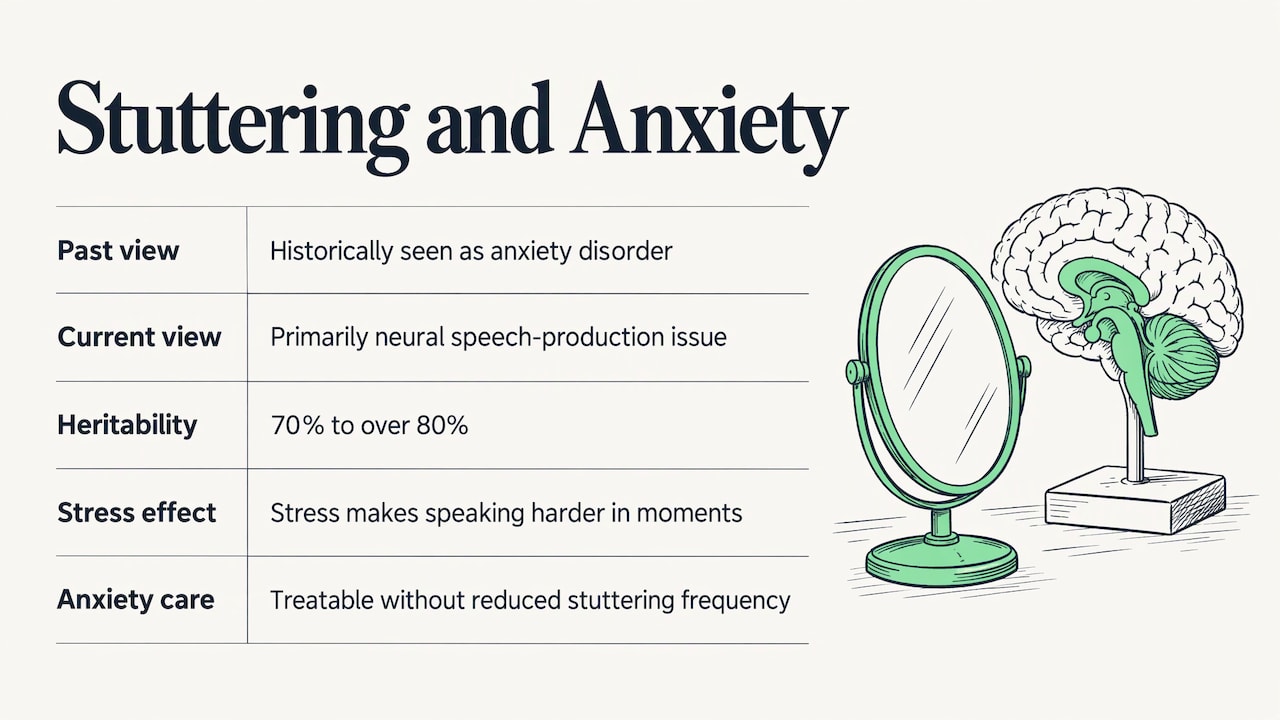
A 2017 clinical practice guideline reports heritability estimates for common stuttering of 70% to over 80% and links stuttering to structural and functional differences in the brain. A review in the journal literature adds that stuttering is primarily a neural speech-production problem, not the result of nervousness, stress or parenting. An older record in the American Psychological Association’s database notes that stuttering was historically viewed as an anxiety disorder, but that the evidence points to a genetically predisposed difference in speech motor control instead.
That does not make anxiety irrelevant. Stress, time pressure and fear of judgment can make speaking feel harder in the moment, and years of difficult speaking experiences can build real social anxiety. The same review notes that anxiety and avoidance can be treated even when stuttering frequency does not drop. That is the space where hypnosis and coaching do their work. If anxiety is a larger part of your life than speech alone, our hypnotherapy for anxiety page explains how we approach it.
What the research shows
The research on hypnosis and stuttering is small and mostly early-stage. Here is what the studies describe, in plain terms.
A single-case study on fluency practice. A 1997 study reported on a 29-year-old man with a severe stutter who attended 12 hypnosis sessions. He showed immediate improvement in fluency during sessions and steady gains on standardized reading. The practitioner taught anxiety management and self-hypnosis, used covert rehearsal of coping with stressful situations, and relied on post-hypnotic suggestion and directed practice to carry gains into everyday settings. The author discusses hypnosis as an adjunct to speech therapy. One person is not a trial, but the design shows how hypnosis is meant to be used: as practice and rehearsal support.
A preliminary study using hypnosis with exercises. A 2012 study of 59 clients combined hypnotherapy with daily diaphragmatic exercises over eight days. Clients’ ratings of their own stuttering frequency improved significantly, and 55 of 59 reported maintained improvement at a one-year follow-up. The hypnotherapy was used to ease anxiety, raise self-confidence and increase motivation, through induction, relaxation, ego-strengthening and post-hypnotic suggestions. The authors say controlled trials are needed before firm conclusions, and that it is unclear which component drove the result.
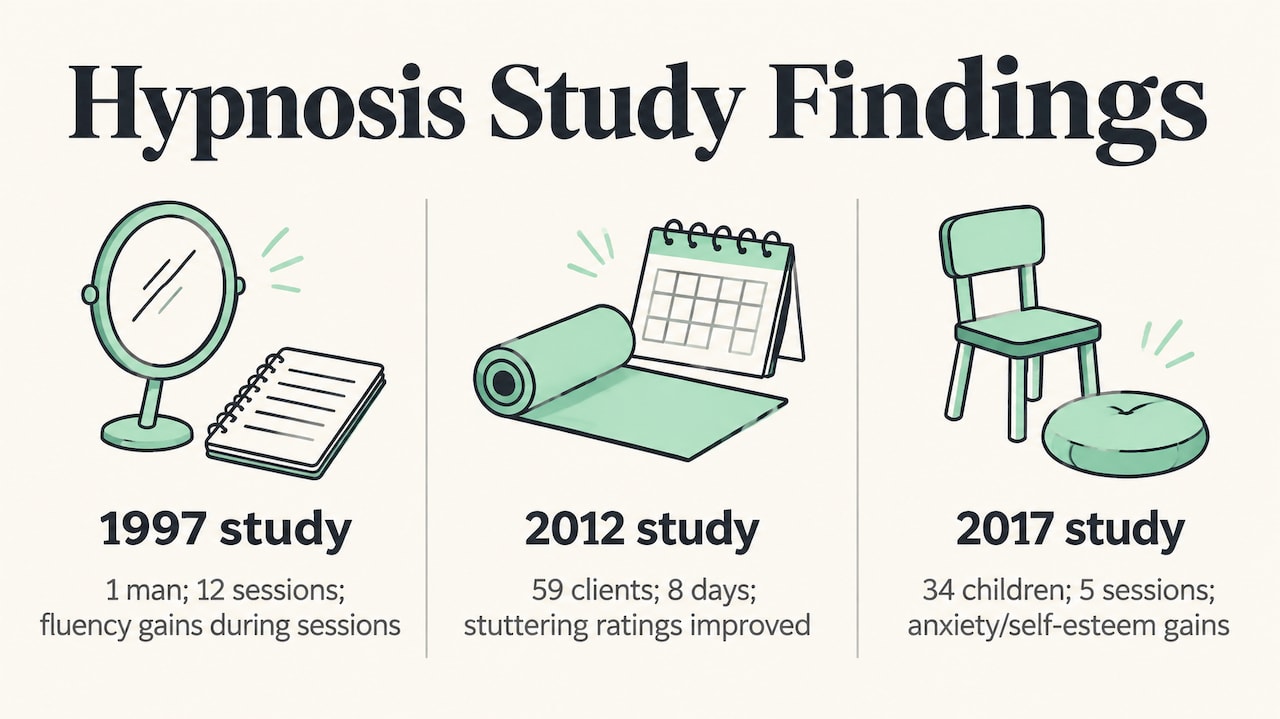
A study on anxiety and self-esteem in children. In a 2017 study of 34 children aged 8 to 12 in Shiraz, Iran, five sessions of hypnosis therapy significantly improved anxiety and self-esteem measures. This speaks to the emotional side of stuttering, which is where hypnosis is most often aimed.
Relaxation in speech settings. A review of relaxation in stuttering treatment notes that it can help speakers achieve greater fluency in specific situations. Relaxation is a core part of every hypnosis session, so this is directly relevant to what you would practice.
Taken together, the pattern is consistent: hypnosis is used for calm, confidence and rehearsal, and it sits alongside other skills instead of standing in for them.
Hypnosis alongside speech therapy
The American Speech-Language-Hearing Association (ASHA) explains that stuttering treatment is highly individualized. It rests on a thorough assessment of speech fluency, language, emotional and attitudinal factors and life impact. ASHA also notes that increasing fluency may not be the goal for every person, and may be only one part of a multidimensional approach with personalized goals.
The American Psychiatric Association’s patient guidance says speech therapy with a qualified speech-language pathologist remains the first-line treatment, especially for early childhood intervention, and that cognitive behavioral forms of psychotherapy show promise. A speech-language pathologist (SLP) is the licensed professional who assesses speech and teaches techniques for speaking.
That structure makes a clear division of labor:
- Your SLP teaches the speech techniques and tracks your fluency.
- Hypnosis and coaching help you stay calm enough to use those techniques when it counts, rehearse hard situations, and build the confidence to stop avoiding them.
It is the same idea behind how we combine hypnotherapy with traditional healthcare: our work is meant to fit around the care you already have, not compete with it. If you already see an SLP, tell us which techniques you are learning and what situations you find hardest. That gives us the exact scenes to rehearse.
Children and teens
Early intervention matters most for children, and the first step is an evaluation by a speech-language pathologist. Hypnosis for a child who stutters is something to discuss with that professional and the child’s pediatrician first.
What a session looks like
A hypnosis session is not a trance where you lose control. You stay aware and can speak, and you can end the session at any time. In the research above, the procedures were hypnotic induction, relaxation, ego-strengthening and post-hypnotic suggestions, and that is a good picture of the core elements.
For stuttering-related goals, a session plan often covers three things:
- Calming the body. Guided relaxation to release the jaw, throat, shoulder and chest tension many people carry before speaking.
- Rehearsing the real scene. Imagining a specific moment, such as a phone call to a pharmacy, from the first second to the last, and practicing a calm response.
- Anchoring a cue. A short phrase or breath you can use on your own, which is the idea behind self-hypnosis practice between sessions.
At MindShift, treatment plans are customized, and hypnotherapy can be paired with life coaching and strategic planning. That combination is useful here because the speaking situations that matter most to you (a job interview, a presentation, a family dinner) are goals as well as fears. Coaching turns them into a sequence you can work through step by step.
Sessions online or in person
We offer both online and in-person services. For many people who stutter, online sessions are a comfortable place to start, since the setting is your own home.
Speakers, performers and professionals
People who stutter are often performing under pressure: presenting to a team, auditioning, speaking at a wedding, or competing. Our work on sport hypnosis for peak performance uses the same mental skills of focus, relaxation and visualization that apply to a high-stakes speaking moment. Corporate teams can also work with us in a group setting. Details are on our services page.
How to judge claims about stuttering hypnosis
You will see recordings and programs that promise to eliminate stuttering for good. A few simple habits protect you.
- Treat “cure” and “100%” as a red flag. The Council of Hearing and Speech Advocates (CHSA) advises consumers to be wary of miracle cures and 100% success claims, and notes that treatments are not checked by the FDA.
- Look for evidence beyond reviews. ASHA advises looking for peer-reviewed, replicated research and cautions that testimonials and anecdotes alone are not enough.
- Check the practitioner’s code. The National Guild of Hypnotists’ ethics code requires members not to make false or exaggerated claims and, for a medical or mental condition, to work on written referral from a licensed professional unless state law provides otherwise.
A good practitioner talks about what you want to change, such as less dread on the phone, and builds a plan around it. We do not promise a cure for stuttering, and we encourage you to keep your speech-language pathologist in the loop.
A note on medications
If you take medication, keep your prescriber involved. Interdisciplinary consensus guidelines from the Stuttering Alliance for Research and Support (STARS) published in 2026 flagged that common dopamine-boosting medications for ADHD and depression may worsen stuttering symptoms in some patients. Do not start, stop or change a medication on your own. Raise it with your physician or psychiatrist. The same guidelines describe stuttering as a heterogeneous, brain-based condition and call for comprehensive diagnosis and interdisciplinary care. Hypnosis fits as one part of that team.
The American Psychiatric Association also notes that no medication is FDA-approved specifically to treat stuttering.
Our perspective
We meet many people who have spent years managing their speech by managing everything around it: the words they avoid, the calls they hand to someone else, the invitations they decline. The stutter is one part. The strain of bracing for it is another, and that second part is where we can help.
Our approach combines personalized hypnotherapy with life coaching. In practice that means we begin with your goals: the meeting, the toast, the phone call. We build a plan with you, then use hypnosis to practice calm, focused responses to those moments, and coaching to take the next real step.
We do not promise a cure, because none exists. We do believe that a person who feels safer speaking will speak more, and that is a change worth working toward. Alongside your speech-language pathologist, it can make the whole effort feel lighter.
Rachael
Working with MindShift
If stuttering has left you anxious about speaking, tense in key moments or avoiding situations you care about, our hypnotherapy and life coaching can be built around those exact situations. We work with individuals, couples, families, groups and corporate teams, in person or online, and we pair our work with the healthcare you already have. Browse the options on our services page, or see how hypnotherapy can address depression if low mood has come along with the struggle.
To get started, visit MindShift Hypnosis and tell us the speaking situations you most want to feel calm in.
FAQ
Can hypnosis help stuttering?
Hypnosis can help with the anxiety, tension and avoidance that surround stuttering, and it can be used to rehearse speaking situations. Studies are small and early, and a cure does not exist. It pairs well with speech therapy, which stays the first-line treatment.
Is there a known cure for stuttering?
No. Stuttering is a brain-based, heritable speech condition, and treatment aims at easier, more confident communication. ASHA describes treatment as individualized, with personalized goals, which may or may not center on fluency.
Can anxiety cause stuttering?
No. Research describes stuttering as a neural speech-production difference rather than a result of nervousness. Anxiety can make speaking feel harder, though, which is why calming techniques are a useful part of a broader plan.
How many hypnosis sessions would I need?
It depends on your goals and the situations you want to work on. In one published case, a man attended 12 sessions alongside practice in everyday settings. We shape a plan around you, and you can ask about it on our services page.
Sources
- The Pathogenesis, Assessment and Treatment of Speech Fluency Disorders (2017 guideline)
- Hypnotically Assisted Diaphragmatic Exercises in the Treatment of Stuttering
- Stuttering modification using hypnosis: an experimental single-case study
- Effect of Hypnosis Therapy on Anxiety and Self-esteem among children who stutter
- Stuttering and relaxation: applications
- Behavioral treatments for children and adults who stutter
- Stuttering and hypnosis: Processes of cortical control
- ASHA: Stuttering, Cluttering, and Fluency
- ASHA: Evaluating Procedures, Products, or Programs
- CHSA: Questions to Ask About a New Product or Treatment
- National Guild of Hypnotists Code of Ethics and Standards
- STARS Interdisciplinary Consensus Guidelines on Stuttering
- American Psychiatric Association: Communication Disorders