
Hypnosis for premature ejaculation (PE) works on the part of the problem that happens in your head: performance anxiety, a rushed mental habit, and the worry loop that starts before sex does. It is best used alongside a medical check-up, not instead of one. At MindShift Hypnosis we combine personalized hypnotherapy with life coaching, so you work on the anxiety, the pressure and the pattern together, in person or online.
This guide covers what the published reports say, what a session looks like, how hypnosis fits with the usual medical and behavioral options, and how to decide whether to try it.
TL;DR
- PE is common: the American Urological Association says it affects up to 1 in 3 US men aged 18 to 59, so you are not the only one asking.
- Hypnosis targets the mental side: anxiety, pressure, and the fast, tense pattern many men describe. Published clinical reports go back decades.
- Hypnosis is a good fit next to medical care and behavioral techniques. A first visit to a doctor rules out physical causes.
- Sessions are private and relaxed, and can be done online. Self-hypnosis audio is a way to practice between sessions.
- If the problem is new, sudden, or comes with pain, erection trouble or low mood, see a healthcare provider.
Table of Contents
- What counts as premature ejaculation
- Why the mind plays such a large role
- What the published reports say about hypnosis
- What a hypnotherapy session for PE involves
- How hypnosis fits with medical and behavioral options
- Is it safe, and when to see a doctor first
- Who tends to be a good fit
- How to get the most from sessions
- Our perspective
- Start with a private conversation
- FAQ
- Sources
What counts as premature ejaculation
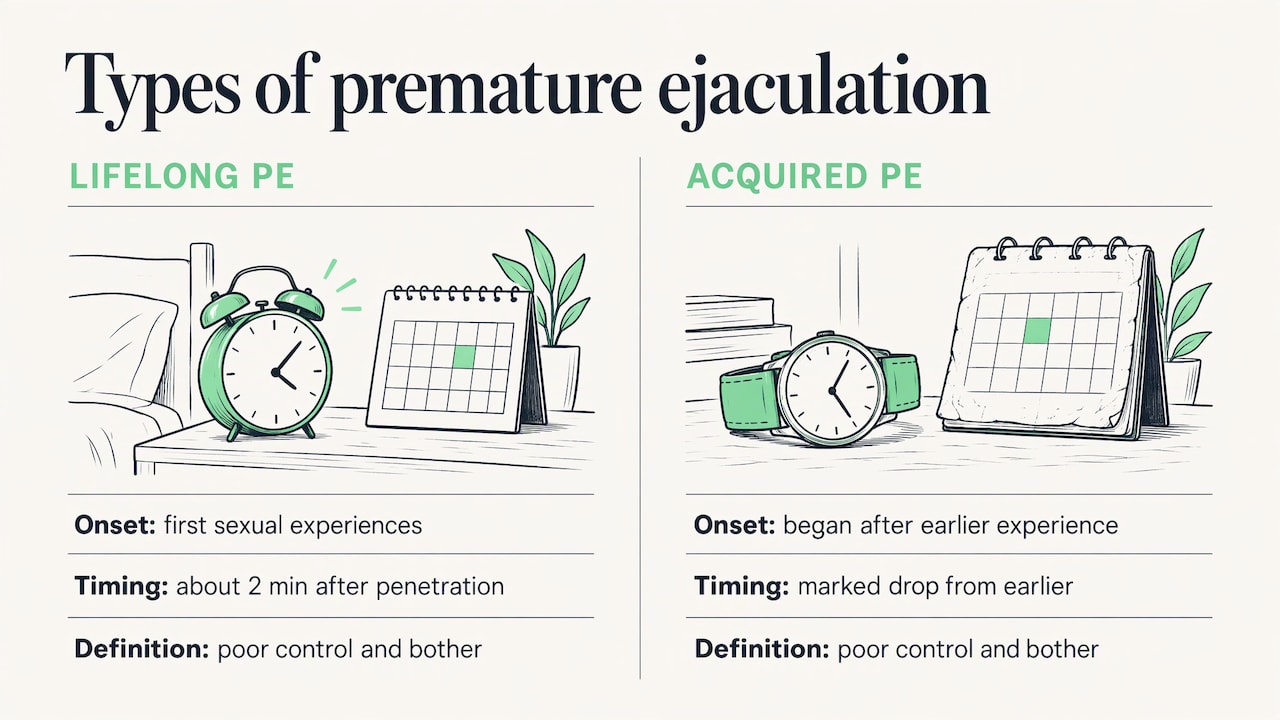
Before choosing any approach, it helps to know whether what you experience is PE in the clinical sense. The AUA/SMSNA guideline on ejaculatory disorders, published in 2020, defines lifelong PE as poor control over ejaculation, with bother, within about 2 minutes of penetration, present since a man’s first sexual experiences. Acquired PE is a marked drop in the time you last compared with your earlier experience, again with poor control and bother.
Two things matter in that definition. First, it is about control and distress, not just a stopwatch. Second, lifelong and acquired PE often have different stories. A man who has always finished quickly may have a learned, fast-arousal habit. A man for whom it began recently may be dealing with stress, a relationship change, or a medical issue that a provider should look at.
The same guideline says clinicians should take a medical, relationship and sexual history and do a focused physical exam. That is the right first stop for anyone, whatever approach comes next.
Why the mind plays such a large role
The Cleveland Clinic notes that when the cause is psychological, emotional or tied to the relationship, such as performance anxiety, depression, stress, guilt or a troubled relationship, help from a psychologist, psychiatrist or sex therapist is appropriate. MedlinePlus, from the U.S. National Library of Medicine, adds that chronic PE may be a sign of anxiety or depression, and that most men can learn to control ejaculation through education and simple techniques.
That is the loop many men recognize:
- You worry it will happen again.
- Your body tenses and your attention locks onto the sensations that signal the point of no return.
- Arousal speeds up.
- It happens again, and the worry gets stronger.
Hypnosis is built for exactly this kind of loop. It uses focused attention and deep relaxation to change how you respond to a situation, rather than just how you think about it. Anxiety, fear and trauma are core areas of our work, and they are the same ground PE often sits on.
What the published reports say about hypnosis
Hypnosis for sexual concerns has a long clinical history, and the reports are worth knowing in their own right.
Erickson’s approach. A 1978 paper describes Milton H. Erickson’s reorientation-into-the-future technique for premature ejaculation and primary orgastic dysfunction, with eight cases treated successfully using the procedure. Erickson was one of the best-known figures in clinical hypnosis, and his work still shapes modern practice.
The wristwatch technique. In their review of hypnosis in psychiatry, Kraft and Kraft describe a case approach attributed to Erickson in which post-hypnotic suggestions had a patient expect to take longer and longer, from 10, 15 and 20 minutes up to 26 minutes, while concentrating on a wristwatch. The point was to shift attention and expectation. The same review describes another clinician’s use of age regression with a 23-year-old patient, who kept adequate erections during intercourse for 2.5 years.
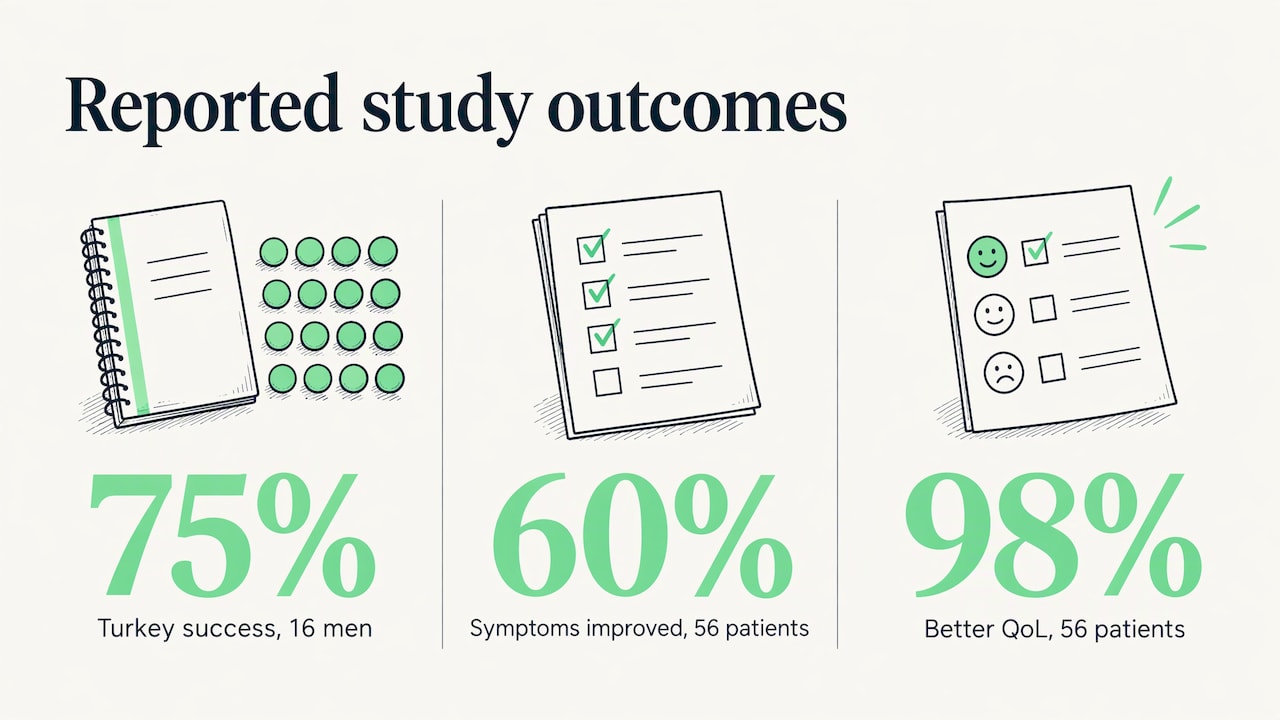
A small controlled study. A 1997 study from Turkey compared hypnotic suggestion and acupuncture with placebo in men with non-organic sexual dysfunction. In the hypnosis group of 16 men, 75% reported success. The study looked at male sexual dysfunction broadly rather than PE alone, so we mention it as part of the history of this work, not as a promise of a result.
A private-practice report. A French report on hypnosis for ejaculation problems described 56 patients. Sixty percent reported improvement or resolution of symptoms, and 98% reported a better quality of life.
That last number is worth pausing on. Even when the clock changes only a little, many men describe feeling calmer, more present and less ashamed. For a lot of couples, that shift is the real goal.
No hypnotherapist can promise a particular number of minutes, and we do not. What we can say is that hypnosis is a respected way to work on the anxiety and attention patterns around sex, and that people respond to it at different speeds.
What a hypnotherapy session for PE involves
Men are often more nervous about the conversation than the hypnosis, so here is the general shape of work like this. Specifics vary by practitioner and by person, and a customized plan is how we approach every client.
The first conversation
Expect questions about when the issue started, whether it has always been there or began recently, what your thoughts are in the moments before and during sex, and what you have already tried. Whether it is lifelong or acquired changes the plan. If anything suggests a physical cause, such as pain, erection difficulty, or a recent medication change, the sensible step is a medical visit alongside the sessions.
The hypnosis itself
Hypnosis is a state of relaxed, focused attention. You stay aware and in control. A typical session guides you into deep relaxation, then uses imagery and suggestion to rehearse calmer responses. In the published case work above, you can see the main ingredients: shifting attention away from the fear, changing expectations about time and control, and, in some cases, exploring where the pressure first came from.
Building skills you can use
Relaxation is a skill, and skills improve with practice. You may be given a short routine to use at home, such as slow breathing paired with a calm-down cue. Pairing hypnosis with life coaching lets us also address the strategy side: how you talk with your partner, how you approach intimacy, and what you want it to feel like.
Between sessions
Many men start with audio recordings. Free and paid tracks are widely available, and listening to one regularly is one way to practice the same relaxation. Recordings are general by nature. A personalized session lets the suggestions match your pattern, whether that is tension, pressure from a past experience, or fear of letting a partner down.
How hypnosis fits with medical and behavioral options
PE is usually managed with a combination of approaches, and hypnosis sits comfortably among them.
The Mayo Clinic lists behavioral techniques, medications and counseling as the common treatment options, and notes that behavioral treatment plus drug therapy might be the most effective. Its behavioral techniques include the pause-squeeze and stop-start methods, where stimulation is paused before the point of no return and resumed once arousal drops, as well as taking a break from intercourse to remove pressure.
These techniques ask something of your mind: noticing arousal early, staying relaxed enough to pause, and not panicking when you do. That is where hypnosis helps. A man who feels calm and present notices his arousal earlier and has an easier time using the techniques.
Counseling and mind-focused therapy also have research support in this area. A 2025 Andrology meta-analysis covering 15 randomized trials and 1,243 participants found that cognitive behavioral therapy combined with SSRIs produced better outcomes than SSRIs alone. That study looked at CBT, not hypnosis, but it points the same direction: addressing thoughts, anxiety and behavior alongside medical treatment is a sound way to work.
Some men also read up on the physical side, for example herbal supplements and blood flow, and bring those questions to their provider. If you take any medication or supplement, tell both your provider and your hypnotherapist.
We work with this combined approach in mind, and you can read more about combining hypnotherapy with traditional healthcare on our site.
Is it safe, and when to see a doctor first
Hypnosis is a relaxation-based process and is generally comfortable. The safety question is really about not missing something that needs medical attention. See a healthcare provider, such as your primary care doctor or a urologist, before or alongside sessions if:
- The change is recent or sudden.
- You also have trouble getting or keeping an erection.
- You have pain, burning, blood, or other urinary symptoms.
- You feel persistently low, hopeless or anxious about more than sex. MedlinePlus advises contacting a provider if the problem does not improve with self-management, and a psychiatrist or psychologist can help when depression or anxiety is involved.
If low mood or anxiety is part of your picture, our work on hypnotherapy for depression and hypnotherapy for anxiety is relevant too, and it is done in coordination with your healthcare team, not as a substitute for it.
Who tends to be a good fit
Hypnosis tends to suit men who:
- Notice that anxiety, self-monitoring or pressure drives the pattern.
- Want a private, one-on-one setting where they can talk freely.
- Are willing to practice a short routine between sessions.
- Want to pair it with medical care or behavioral techniques.
It also suits couples. PE rarely affects one person only, and relationship strain can feed the anxiety cycle. Our relationship hypnosis work is for individuals and couples who want to ease that tension and talk about intimacy more openly.
The mental skills involved are familiar from other areas. Men who use focus and calm to perform under pressure, for example in sport hypnosis for peak performance, are building the same ability to stay relaxed and present when the stakes feel high.
How to get the most from sessions
- Get a medical check first. It gives you a clear baseline and rules out physical causes.
- Be specific about the pattern. Tell your practitioner whether it is lifelong or recent, with a partner or alone, and what runs through your head.
- Practice daily. Ten minutes of relaxation practice does more than an occasional long one.
- Involve your partner if you can. Less secrecy often means less pressure.
- Use behavioral techniques alongside. The pause-squeeze and stop-start methods are widely used, and calm attention makes them easier.
- Measure what matters. Track confidence, enjoyment and how anxious you feel, not only minutes.
Our perspective
We have always believed that the mind and the body speak to each other, and sexual confidence is one of the clearest places that shows up. When a man tells us he is stuck in a loop of worry, we do not see a character flaw. We see a very learnable pattern.
What we offer is a combination: personalized hypnotherapy to calm the response and rehearse a different one, and life coaching to build a strategy around it, from how you talk with a partner to what you want intimacy to be. Every plan is customized, because the story behind PE is different for each person.
We also welcome working alongside your doctor. Hypnosis is at its best as part of a whole plan, with medical care where it is needed and mental skills where they make the difference. Sessions can be held in person or online, so you can start from a private, comfortable place.
Rachael
Start with a private conversation
If anxiety, pressure or a stubborn mental habit is part of your experience with PE, our hypnosis and life coaching services give you a calm, confidential place to work on it. We offer Hypnosis Only, Hypnosis Life Coaching, online sessions and more, tailored to your situation.

You can also explore related topics on our site, such as the history of hypnotherapy as a healing practice, to see how long this work has been part of clinical practice.
FAQ
Can hypnosis help with premature ejaculation?
Hypnosis can help with the anxiety, tension and attention patterns that often surround PE. Clinical reports going back to the 1970s describe its use for this purpose, and many men report feeling calmer and more in control. Results differ from person to person, and it works best alongside a medical check-up.
How many sessions does it take?
That depends on whether the pattern is lifelong or recent, how much anxiety is involved, and how regularly you practice. Many clients notice a shift in how relaxed they feel in the first few sessions. Your practitioner can outline a plan after hearing your history.
Can I use a hypnosis audio at home?
Yes, many men use recordings to practice relaxation between sessions. A personalized session adds suggestions that match your own pattern. It also gives you someone to talk through the situation with, which many men find the most helpful part.
Should I see a doctor first?
Yes, or at the same time. A provider can check for physical causes and discuss medication and behavioral options. The AUA/SMSNA guideline says clinicians should assess medical, relationship and sexual history, so a visit gives you a full picture to work from.
Can sessions be done online?
Yes. We offer both in-person and online sessions, which many men prefer for privacy and convenience. You only need a quiet room and a device with a stable connection.
Sources
- AUA/SMSNA Disorders of Ejaculation Guideline (2020)
- AUA, Sexual Health Is Health (2025)
- Cleveland Clinic, Premature Ejaculation
- MedlinePlus, Premature ejaculation
- Mayo Clinic, Premature ejaculation diagnosis and treatment
- Brief Hypnotherapy of Two Sexual Dysfunctions (1978)
- Kraft and Kraft, Hypnosis in the treatment of sexual disorders
- Acupuncture and hypnotic suggestions in the treatment of male sexual dysfunction (1997)
- Sexologies, hypnosis in premature ejaculation
- Andrology meta-analysis, CBT combined with SSRIs
- Herbal supplements and blood flow evidence