
Hypnosis can help you stop biting your nails by working on the automatic part of the habit: the urge, the trigger and the hand-to-mouth reflex that happens before you notice it. A hypnotherapist guides you into a deeply relaxed, focused state, then uses imagery, rehearsal and suggestions so that the old reflex is replaced with a calmer response. Cleveland Clinic notes that, in some cases, habit-reversal training or hypnotherapy can be effective for chronic nail biting. Below, we explain how a session runs, which techniques are involved, what the research says, and how to get the most from the process.
TL;DR
- Nail biting is classed as a body-focused repetitive behavior, and willpower alone rarely ends it. Hypnotherapy targets the trigger and the automatic reflex.
- A typical session combines relaxation, a trance state, imagery, pattern interruption, anchoring and post-hypnotic suggestions.
- Hypnosis pairs well with proven behavioral steps: trigger tracking, a replacement action, and keeping nails trimmed.
- The VA describes hypnosis as generally very safe. See a doctor if you have swelling, pain, bleeding or signs of infection around the nails.
- We offer hypnotherapy and life coaching in person and online, so you can work on this habit from home.
Table of Contents
- Why nail biting is hard to stop on your own
- How nail biting hypnosis works
- What happens in a session
- What the research says
- Is nail biting ADHD or OCD?
- Practical steps that make hypnosis work better
- A realistic timeline
- Who hypnosis suits best
- When to see a doctor
- Our perspective
- Work with us on nail biting
- FAQ
- Sources
Why nail biting is hard to stop on your own
Most people who bite their nails have tried to quit many times. They paint on bitter polish, set a reminder, promise themselves they will stop at the new year. It works for a week, then they find a hand at their mouth during a meeting, a film or a stressful phone call.
That is not a character flaw. The Anxiety and Depression Association of America identifies nail biting as a body-focused repetitive behavior (BFRB) and says evidence-based treatments for BFRBs fall under cognitive behavioral therapy, with habit-reversal training as one of its two primary interventions. Cleveland Clinic goes further: nail biting cannot be stopped simply by telling yourself to stop, and it recommends behavioral therapy, which may include habit-reversal training or hypnotherapy, alongside self-care such as meditation, journaling and yoga.
The same page adds that therapy can help release shame and negative emotions and build awareness of triggers and urges. That matters, because many nail biters feel embarrassed about their hands, and shame is itself a trigger.
What triggers the habit
Triggers usually fall into a few families:
- Stress and tension: deadlines, difficult conversations, waiting for news.
- Boredom or idle hands: scrolling, watching TV, driving, reading.
- Concentration: the habit shows up while you focus hard on something.
- Perfectionism with the nail itself: you notice a rough edge and “fix” it with your teeth.
The first job in any approach, hypnotic or not, is to learn which of these is yours. Hypnotherapy is built around that discovery, because the suggestions work best when they are matched to your actual trigger rather than a generic script.
How nail biting hypnosis works
Hypnosis is a state of focused attention and deep relaxation in which you stay aware and in control. The VA Whole Health Library describes hypnosis as using mental imagery and symbolism, and notes it can involve imagining desired behaviors and rehearsing them. That rehearsal is the heart of habit change: your mind practices a new response before you meet the real trigger.
The process generally moves through these stages.
1. Relaxation and induction
The therapist guides you through physical and mental relaxation, often by directing your attention progressively through parts of the body. Choosing Therapy describes this as the way you reach a trance state in which you are open to suggestions for change. Most people describe it as pleasant, similar to the drifting feeling before sleep, but with awareness intact.
2. Imagery and rehearsal
Once you are relaxed, you picture yourself in the situations where you usually bite: the desk, the car, the couch. You see the urge arrive and you see yourself responding differently, with your hands relaxed or occupied. Repeating this builds a new automatic path.
3. Specific techniques
According to the same Choosing Therapy overview, hypnosis for nail biting commonly includes three tools:
- Pattern interruption: you notice the trigger and do a competing physical action while repeating a positive statement.
- Anchoring: you imagine a calm, resourceful state and pair it with a small physical gesture, such as pressing thumb and finger together, that you can use later.
- Post-hypnotic suggestions: present-tense statements, for example about breathing and relaxing when the urge appears.
4. Reinforcement with recordings
The VA notes that hypnosis sessions are often recorded so a person can use them repeatedly, and that self-hypnosis can be a powerful approach on its own. In practice, a personalized recording from your own session lets you repeat the work at home, which is especially useful for a habit that fires dozens of times a day.
What happens in a session
Every practitioner works a little differently, but a nail biting session often follows this arc:
- Conversation. You talk through when you bite, how long you have done it, what you have tried, and how you feel about your hands. This is where triggers and emotional patterns come into view.
- Goal setting. You define what success looks like: no biting at all, biting only in private, or nails long enough to shape.
- Induction and deepening. Relaxation guides you into the trance state.
- Suggestions and rehearsal. Imagery, anchoring and interruption techniques are applied to your triggers.
- Return and debrief. You come back to full alertness, discuss what you noticed, and agree on a few simple practices for the coming days.
At MindShift, we build sessions around the person in the chair. Our approach combines personalized hypnotherapy with life coaching and strategic planning, so the work does not end when you open your eyes. You leave with a plan for the moments when the urge is strongest.
What the research says
The honest picture is that nail biting has more research behind behavioral therapy as a whole than behind hypnosis specifically, and hypnosis often works best as part of a behavioral package. Here is what the evidence shows.
A hypnobehavioral study. A multiple-baseline study published in 1980 gave three highly hypnotizable participants a package of hypnotic and behavioral procedures, including induction and deepening, motivation enhancement, time projection, self-reinforcement, coping self-instructions and post-hypnotic suggestion. All three showed immediate and dramatic increases in fingernail length. At three months, one showed a moderate reversal while two continued to make substantial progress. It is a small, early study, but it shows the structure that modern sessions still borrow: hypnosis plus practical behavior change.
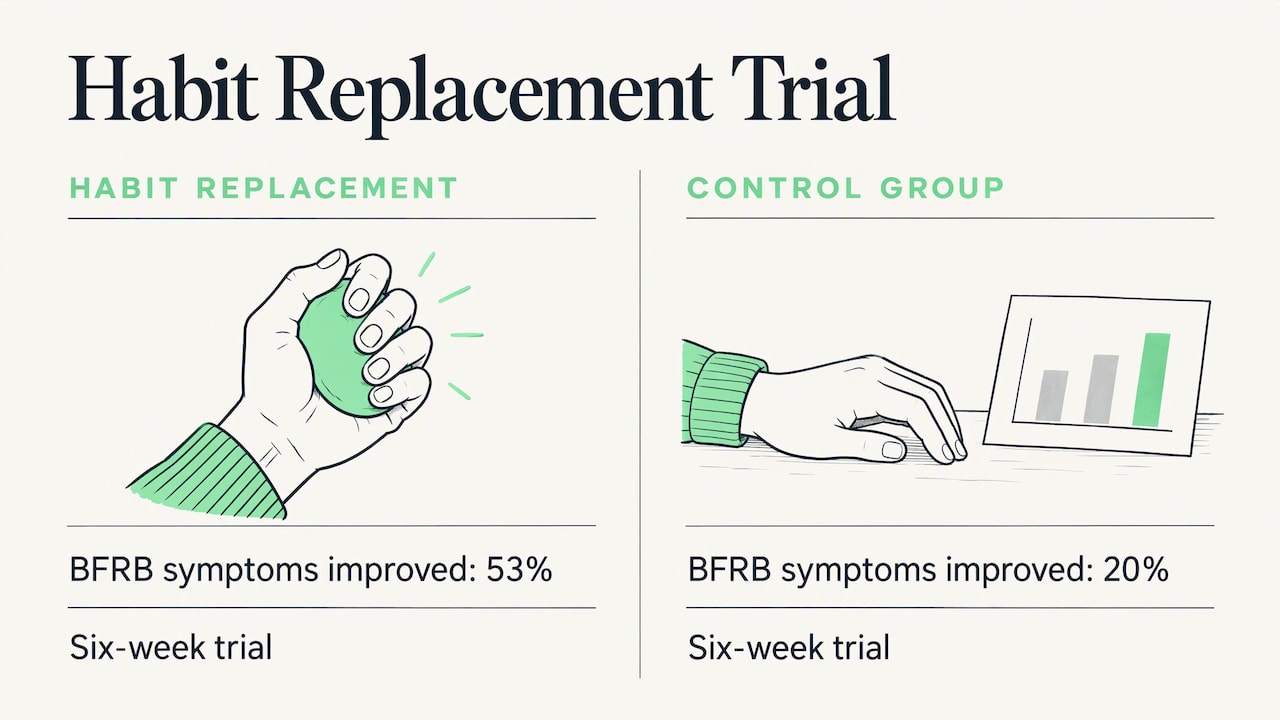
Habit replacement. In a six-week proof-of-concept trial summarized by ADDitude, habit replacement techniques improved BFRB symptoms in 53% of patients versus 20% in the control group, and people with nail biting benefited the most. Replacing the behavior with another action is exactly what pattern interruption does inside a hypnosis session.
First-line treatment. A 2022 review describes cognitive behavioral therapy and habit-reversal training as first-line treatments for onychophagia. This supports the approach of combining hypnotic rehearsal with behavioral strategies rather than relying on a single tool.
General hypnosis evidence. The VA states that hypnosis shows promise, while noting more research is needed in some areas. It also reports that hypnosis tends to be very safe according to a number of meta-analyses, with rare effects such as drowsiness, headache, dizziness or anxiety.
Is nail biting ADHD or OCD?
Neither, necessarily. Nail biting is a habit that many people have with no diagnosis at all. It can, however, show up alongside other conditions. A clinical review describes onychophagia as one of the body-focused repetitive behaviors that involve the nails and surrounding skin. ADDitude reports that BFRBs such as nail biting, skin picking and hair pulling are common with ADHD, and that many people with these behaviors feel compelled to perform them and are sometimes not even aware they are doing it.
The practical takeaway: if your biting feels compulsive, takes up a lot of time, or comes with other symptoms such as distress, intrusive thoughts or major difficulty focusing, a licensed mental health professional or your doctor can assess whether something else is going on. Hypnotherapy can then work alongside that care. We explain how in our guide to combining hypnotherapy with traditional healthcare.
Practical steps that make hypnosis work better
Hypnosis does its best work when your daily environment supports the change. UCLA Health recommends identifying triggers and using replacement behaviors such as a stress ball, fidget toy or gum, plus keeping nails trimmed and using bitter polish or barriers. Here is how to build that into a week.
Track your triggers for three days
Keep a note on your phone. Each time you catch a hand at your mouth, write the time, place and what you were feeling. Bring this to your session. It gives the hypnotherapist real material instead of guesses.
Choose one replacement action
Pick something that keeps your hands busy and is easy to carry: a smooth stone, a fidget ring, a stress ball. Your anchor gesture from the session can sit alongside it.

Make the nails less tempting
Trim them short and file the edges so there is nothing to catch on. A manicure can also give you a reason to protect the result.
Lower the stress baseline
Cleveland Clinic suggests pairing behavioral therapy with self-care like meditation, journaling and yoga. If nerves are the main trigger, learning to settle your system matters as much as managing the hands. Some readers also explore wider ways to calm your nerves naturally between sessions. Our own guide to stress relief hypnosis shows how a calming phrase can be used in the moment.
Listen to your recording daily
For the first few weeks, replay your session recording at a regular time, such as bedtime. Repetition is the point.
A realistic timeline
People differ, so we do not promise a fixed number of sessions or a guaranteed result. What we can describe is how progress often looks:
| Stage | What you may notice | What to do |
|---|---|---|
| First days | You catch the urge more often than before | Keep tracking, use your replacement action |
| First weeks | Fewer automatic bites, more moments of choice | Replay the recording, use your anchor gesture |
| Following weeks | Nails grow, the urge fades in familiar settings | Plan for stressful days in advance |
| Longer term | New triggers can appear in new situations | Return to the recording or book a follow-up |
Setbacks during high-stress periods are common, and they do not mean the work has failed. The 1980 study above even reported one participant with a moderate reversal at three months, which is why a plan for stressful periods belongs in the process from the start.
Who hypnosis suits best
Hypnosis tends to suit people who are motivated, willing to practice, and comfortable following guided imagery. If you are curious about what makes some people respond more than others, read our piece on why hypnosis isn’t for everyone. If you are unsure whether hypnosis fits your situation, a first conversation with a practitioner will tell you quickly.
When to see a doctor
Habit work is not a substitute for medical care when your nails or skin are damaged. Both of these sources agree on the signs:
- UCLA Health advises consulting a healthcare provider if you have recurring skin or nail infections, swelling, pain or bleeding around the nails, if you cannot stop after repeated attempts, or if the behavior limits your ability to function.
- Cleveland Clinic recommends medical treatment if biting is causing physical damage to the nail, cuticle or surrounding skin, or if there are signs of infection such as redness, pain or swelling.
A primary care doctor or dermatologist can treat the physical side while you work on the habit itself.
Our perspective
We see nail biting as a habit with an emotional engine and a physical track. The hands move before the mind has a say, so telling someone to “just stop” misses where the habit lives.
That is why we pair hypnotherapy with life coaching. In hypnosis, we help you rehearse a calmer response to your own triggers. In coaching, we turn that into a plan for your real week: the meetings, commutes and evenings where the urge shows up.
We also like to work with, not around, other care. If a doctor or therapist is involved, we welcome that, and our approach is designed to fit alongside it. Our sessions run in person and online, so you can do this work from wherever you feel most at ease.
Customized work matters most for a habit this personal. No two people bite for the same reason, and the plan should reflect that.
Rachael
Work with us on nail biting
If you want a plan built around your triggers, our hypnotherapy and life coaching sessions are designed to give you exactly that: a guided session, a recording to reinforce it, and a strategy for the moments that are hardest. You can see everything we offer, in person and online, on our services page.
If stress or anxiety sits behind the habit, we also work on that directly through our hypnotherapy for anxiety sessions. Wondering about cost or coverage? Our pricing page and our guide to hypnotherapy insurance in the U.S. are good places to start.
FAQ
Can I get hypnotized to stop biting my nails?
Yes, hypnotherapy is one option for chronic nail biting. Cleveland Clinic notes that, in some cases, habit-reversal training or hypnotherapy can be effective. Results are strongest when hypnosis is paired with practical steps like trigger tracking and a replacement action.
Does self-hypnosis or a recording work as well as a session?
Recordings are a useful way to repeat the work. The VA notes that hypnosis sessions are often recorded for repeated use and that self-hypnosis can be a powerful approach on its own. A personalized session adds a tailored plan for your specific triggers, and a recording made from it keeps that plan close at hand.
What does psychology say about nail biting?
Psychologists classify it as a body-focused repetitive behavior. ADAA says evidence-based treatments fall under cognitive behavioral therapy, including habit-reversal training. Cleveland Clinic also links nail biting to shame and negative emotions, so treatment that builds awareness of triggers and urges tends to help.
How can I stop nail biting if it feels like an addiction?
Start by accepting that willpower alone is rarely enough. Combine behavioral therapy, which may include habit-reversal training or hypnotherapy, with self-care such as meditation, journaling and yoga. If the habit feels compulsive or causes physical damage, talk with a doctor or licensed therapist as well.
Is hypnosis safe?
The VA reports that hypnosis tends to be very safe based on a number of meta-analyses. Rare effects include drowsiness, headache, dizziness or anxiety. If you have a medical or mental health condition, tell your practitioner and your doctor before you begin.
Sources
- Cleveland Clinic: 5 Tips on How To Stop Nail Biting
- VA Whole Health Library: Hypnosis
- Choosing Therapy: Hypnosis for Nail Biting
- Hypnobehavioral treatment of chronic nailbiting: a multiple-baseline study (1980)
- The Potential of N-Acetylcysteine for Treatment of Onychophagia (2022 review)
- ADDitude: Habit replacement and BFRBs
- ADDitude: Understanding BFRBs with ADHD
- Nail-Associated Body-Focused Repetitive Behaviors (PMC)
- UCLA Health: How biting your nails is affecting your health
- ADAA: Body-Focused Repetitive Behaviors