Life coaching for anxiety is a structured, goal-focused partnership that helps you manage worry, overthinking and avoidance so you can move toward the life you want. A coach works on the present and the future: what keeps you stuck, what you want instead, and the daily steps that get you there. At MindShift Hypnosis we combine life coaching with personalized hypnotherapy, so the plan you build is practiced at a deeper level of calm, not just discussed. This guide explains how the work runs, what the research shows, where coaching fits alongside medical and therapy care, and how to begin.
TL;DR
- Anxiety coaching is practical and forward-looking: you set a goal, map what anxiety blocks, and practice calming and exposure skills in small steps.
- In a randomized trial of 301 adults with depression or anxiety, coached treatment produced larger drops in anxiety scores than self-guided treatment.
- Coaches do not diagnose or treat medical conditions. Coaching works well next to care from a doctor or licensed therapist, and it never replaces it.
- If symptoms are severe or last two weeks or more, talk to a primary care provider. For suicidal distress, call or text 988.
- Our hypnosis-plus-coaching sessions are available in person and online, built around your own plan.
Table of Contents
- What life coaching for anxiety actually is
- What the research says about coaching and anxiety
- The techniques coaches use
- What a coach can and can’t do
- When to talk to a doctor or licensed professional first
- Coaching for health anxiety and overthinking
- How to start: a simple path
- Work with MindShift Hypnosis
- Our perspective
- FAQ
- Sources
What life coaching for anxiety actually is
Anxiety is more than ordinary nerves. The International Coaching Federation (ICF), the largest professional body for coaches, describes it in its guide on referring clients to therapy as excessive worry, nervousness or apprehension about real-life events, with intrusive thoughts on more days than not for at least six months. Symptoms can include restlessness, fatigue, trouble concentrating, irritability, muscle tension, a racing heart and disturbed sleep.
Coaching does not try to label or cure that pattern. It asks a different set of questions:
- What do you want to do that anxiety is getting in the way of?
- What does the worry say, and what do you do in response (avoid, over-prepare, seek reassurance)?
- What is one small step you can take this week, and what helps you stay steady while you take it?
That is why people come to coaching for specific, everyday goals: speaking up in meetings, driving on the highway, going to social events, sleeping through the night, or stopping the loop of “what if.” The coach holds the structure and the accountability. You hold the agenda.
What the research says about coaching and anxiety
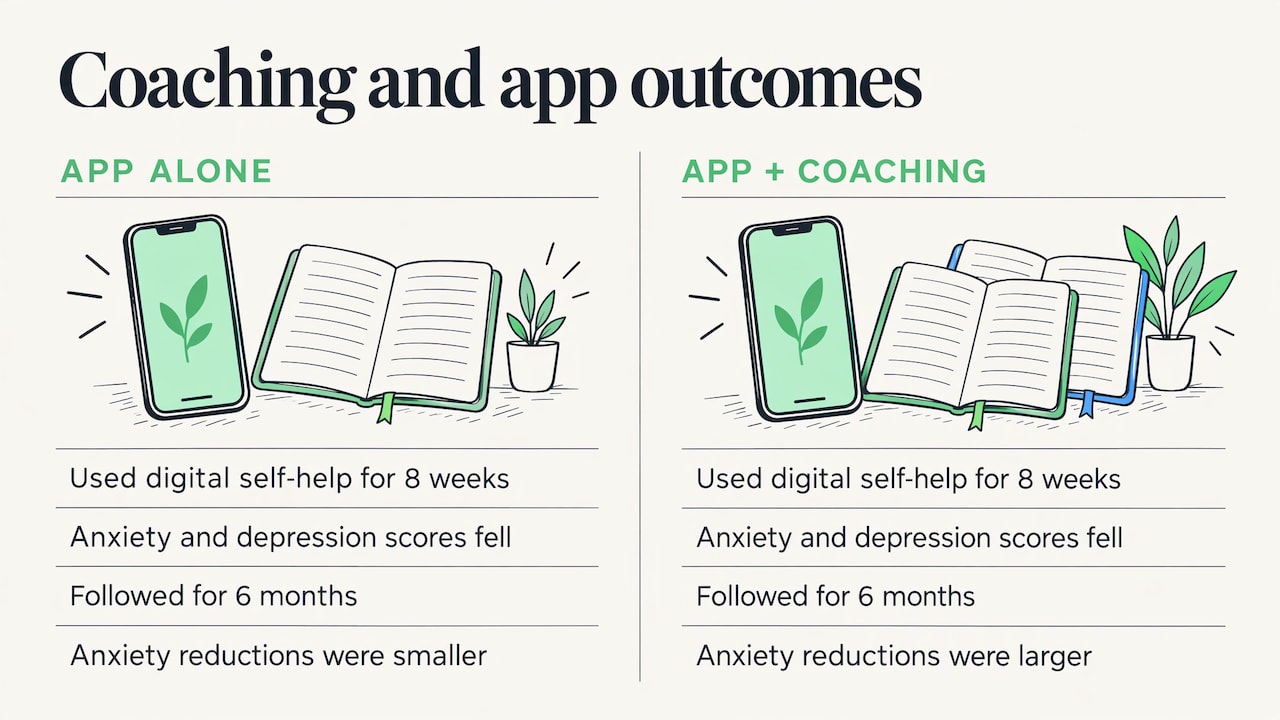
The best direct evidence comes from a factorial randomized controlled trial of 301 participants with depression or anxiety. Everyone used a digital self-help platform for 8 weeks and was followed for 6 months. Anxiety (GAD-7) and depression (PHQ-9) scores fell significantly in every group. The people who also received coaching had larger reductions in anxiety than those who used the app alone, and the researchers concluded that coaching was associated with stronger anxiety outcomes.
Two plain-language notes on that result. The GAD-7 is a seven-question anxiety questionnaire clinicians use to track severity. And the finding is about human support: having a person walk the plan with you made the difference compared with going it alone.
A peer-reviewed review of coaching and psychotherapy in health and wellness adds why. It points to research on anxiety reduction through social support, which it says would confirm the strength of a coaching alliance, the working relationship between coach and client. It also notes that people in therapy, including those taking anxiety medication, can work on goals with a coach at the same time.
The techniques coaches use
Good anxiety coaching uses a small set of skills, repeated until they become habits. Here are the ones with the clearest footing.
Spotting unhelpful thinking
The American Psychological Association explains that cognitive behavioral therapy (CBT) rests partly on the idea that unhelpful thinking and learned unhelpful behavior feed distress. Its strategies include recognizing and reevaluating thinking distortions, solving problems, facing fears rather than avoiding them, and learning to calm the mind and relax the body, with practice between sessions. Coaching borrows the everyday version of this: you catch the thought (“I’ll embarrass myself”), question it, and choose an action that fits your goal.
Step-by-step exposure to what you avoid
The ICF describes systematic desensitization for clients whose anxiety blocks a goal in three steps:
- Build a ladder. List the feared steps toward your goal and rate each from 1 to 10 for anxiety.
- Choose a relaxation skill. Deep breathing or grounding, used before, during and after each step.
- Climb one rung at a time. Each step can start as a visualization or a conversation, and you repeat it until you are ready for the next.
Here is a worked example. Say your goal is giving a short update at work and the idea scores 9. Your ladder might be: (2) rehearse aloud alone, (4) say it to a trusted friend, (5) record it on video, (6) share one comment in a small meeting, (8) give the update to the team. You practice slow breathing at each rung and move up only when the current one feels manageable. Where it goes wrong: jumping from a 3 to an 8 and concluding you failed. The ladder exists so the steps stay small enough to win.
Where hypnosis fits in our coaching
In our sessions the ladder and the calming skill are not just talked about. Our work combines modern hypnotherapy techniques with life coaching and strategic planning, so a relaxation response can be rehearsed in a focused, deeply relaxed state and then tied to the real situation on your ladder. Each plan is customized to the person, which matters because two clients with the same label of “anxiety” rarely avoid the same things. We offer this under our Depression & Anxiety service and our other offerings, and you can read more about hypnotherapy for anxiety in Riverside and Corona.
Building resilience between sessions
Anxiety eases when daily routines hold steady: sleep, movement, a few minutes of breathing, a planned next step. Our article on resilience coaching tools you can try today gives practical exercises to pair with your sessions.
What a coach can and can’t do
This is the part worth understanding before you book anyone, because it keeps you safe and gets you the right mix of support.
Coaching is not regulated in the United States. The Clinical Social Work Association stated in October 2026 that coaching is unregulated in every state, clinical social work is regulated in every state, and coaches cannot diagnose. A 2020 peer-reviewed analysis likewise notes that coaches have no uniform education, training or licensing requirements. In practice that means two things for you:
- A coach works on goals, not diagnoses. Cleveland Clinic lists diagnosing a condition and promising a cure as red flags for any life coach, and notes that coaches and therapists commonly refer clients to one another.
- Coaching and clinical care can run side by side. The ICF guide says a coach should stay within the coaching agreement and their competence, and, when something falls outside it, say so and talk through options, including therapy.
We agree with that standard. Our own approach includes integrating with traditional healthcare, and you can read how in our piece on combining hypnotherapy with traditional healthcare. If you are already seeing a doctor or therapist, tell us, and bring your coaching goals into that conversation too.
When to talk to a doctor or licensed professional first
Some situations call for a medical or mental health professional before, or alongside, any coaching:
- Symptoms that are severe or last two weeks or more. The National Institute of Mental Health (NIMH) advises seeking professional help for distressing symptoms lasting two weeks or longer, such as trouble sleeping, changes in appetite or weight, difficulty getting out of bed, trouble concentrating, loss of interest, or being unable to complete usual tasks. Start with a primary care provider, who can refer you to a psychologist, psychiatrist or clinical social worker.
- Thoughts of suicide. Call or text 988, or chat at 988lifeline.org, to reach the 988 Suicide & Crisis Lifeline, which is free, confidential and open 24 hours a day. In a life-threatening emergency, call 911.
- Physical symptoms you are worried about. For health anxiety, Cleveland Clinic says a medical evaluation should come first. If a physical cause is ruled out, therapy such as CBT and mindfulness are likely to help.
For context on clinical care, the Dartmouth-Hitchcock guideline for anxiety in adults (released January 2019) suggests lifestyle approaches such as exercise, yoga and mindfulness-based stress reduction for milder symptoms. For more bothersome or persistent symptoms it names CBT and medication as options, chosen by patient preference, and it recommends combined treatment in severe cases. It also advises against self-treating with marijuana, which it links to worse long-term outcomes. Those choices belong in a conversation with your prescriber.
Coaching for health anxiety and overthinking
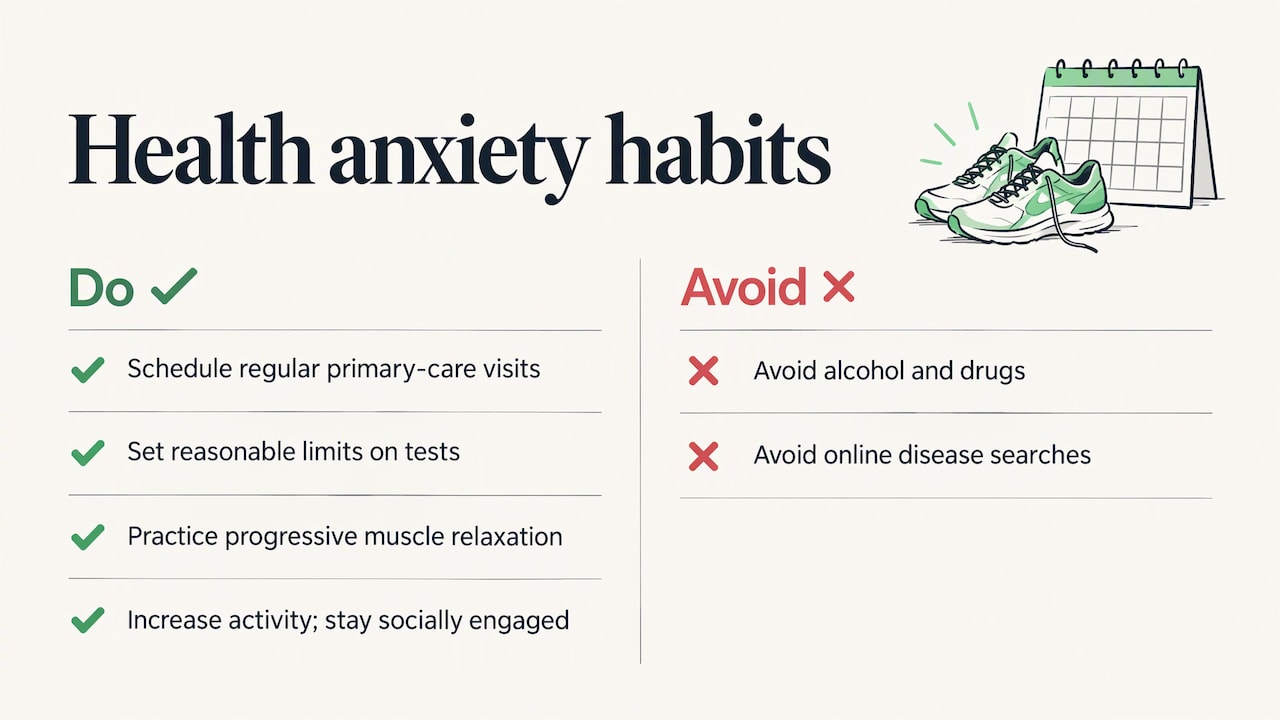
Health anxiety, the constant fear that a normal sensation signals serious illness, deserves its own mention. The Association for Behavioral and Cognitive Therapies describes CBT as the first-line psychological treatment, typically 12 to 20 sessions. Mayo Clinic lists supportive habits: regular visits with a primary care provider, reasonable limits on tests, progressive muscle relaxation, graduated physical activity, staying socially engaged, avoiding alcohol and drugs, and avoiding internet searches for possible diseases.
Those habits are exactly the kind of daily structure a coach can help you keep. If your anxiety is mostly overthinking, such as replaying conversations, rehearsing worst cases or struggling to decide, the ladder method above works the same way: name the thought, choose a calming skill, take the smallest real step.
How to start: a simple path
- Write your goal in one sentence. “I want to speak up in team meetings” beats “I want less anxiety.”
- Note what you avoid and what you do to cope. Include late-night scrolling, over-preparing and reassurance-seeking.
- Check in with your doctor if symptoms are heavy, physical or long-lasting. Share that you are planning to start coaching.
- Pick a format. We work in person and online, so distance is not a barrier.
- Build your ladder and your calming skill in the first sessions, then practice between sessions and adjust each week.
- Track one number. Rate your anxiety from 1 to 10 for your target situation weekly, and watch the trend.
If you want the same structure applied to follow-through, our article on accountability coaching and hypnosis shows how if-then plans turn intentions into action. If low mood travels with your anxiety, see our page on hypnotherapy for depression.
Work with MindShift Hypnosis
MindShift Hypnosis offers personalized hypnotherapy and life coaching for individuals, couples, families, groups and corporate teams, including a dedicated service for depression and anxiety and another for fears and phobias. Sessions run in person and online. Each plan is customized, and you can see the full list on our services page or review hypnotherapy pricing.
To begin, pick the goal you wrote in step one and bring it to your first session. We will build the plan around it.
Our perspective
Anxiety rarely shows up as one clean problem. It shows up as a skipped promotion, a strained marriage, a sleepless Sunday night. That is why we pair hypnotherapy with life coaching: coaching gives you the plan and the accountability, and hypnosis gives you a way to practice calm in a deeply relaxed, focused state.
We build every plan around the person in front of us, because a sports performer facing a big game, a parent carrying too much and a team lead dreading presentations do not need the same thing. We work with individuals, couples, families and groups, in a safe and supportive space, and we encourage clients to keep their doctor or therapist in the loop so everything pulls in the same direction.
The best results we hope for are simple: the thing you were avoiding becomes something you can do, and you know exactly which skills got you there.
Rachael
FAQ
Can a life coach help with anxiety?
Yes, with the goal-focused side of it. A coach helps you set targets, practice calming skills, face avoided situations in small steps and stay accountable. In a trial of 301 adults with depression or anxiety, adding coaching to a self-guided program was linked to larger anxiety reductions. A coach does not diagnose, so a medical or therapy visit is the right move for severe or lasting symptoms.
What is the difference between a life coach and a therapist for anxiety?
A licensed therapist is regulated in every state and can diagnose and treat anxiety disorders. A coach is not regulated and works on goals, habits and the future rather than diagnosis. Many people use both, and coaches and therapists commonly refer to each other.
How many sessions does anxiety coaching take?
There is no fixed number, because it depends on your goal and how often you practice between sessions. A typical shape is a few early sessions to build your ladder and calming skill, then regular check-ins as you climb. We tailor the plan to you, so ask us at your first session what pacing suits your goal.
Is hypnosis part of anxiety coaching at MindShift?
Yes. We combine personalized hypnotherapy with life coaching, so your calming skills and next steps are practiced in a relaxed, focused state. You can choose hypnosis only, life coaching only, or the two together.
When should I see a doctor instead of starting coaching?
See a primary care provider if distressing symptoms last two weeks or more, if sleep, appetite or daily functioning are affected, or if you have physical symptoms that worry you. If you are having thoughts of suicide, call or text 988 right away, or call 911 in an emergency.
Sources
- Comparison of the Effects of Coaching and Receipt of App Recommendations (PubMed)
- Referring a Client to Therapy, ICF research guide
- Coaching vs Psychotherapy in Health and Wellness (NCBI)
- What is Cognitive Behavioral Therapy? (APA)
- Systematic Desensitization: When Anxiety is the Obstacle (ICF)
- Clinical Social Work Association alert on coaching
- Where Life Coaching Ends and Therapy Begins (PubMed)
- What Is a Life Coach and Do I Need One? (Cleveland Clinic)
- Caring for Your Mental Health (NIMH)
- When Health Anxiety Takes Over Your Life (Cleveland Clinic)
- Clinical Practice Guideline: Management of Anxiety in Adults (Dartmouth-Hitchcock)
- Health Anxiety fact sheet (ABCT)
- Illness anxiety disorder: diagnosis and treatment (Mayo Clinic)