Most people in the United States pay roughly $100 to $250 for a single hypnotherapy session, and a full course of care usually lands between a few hundred dollars and about $3,000, depending on the issue, the number of sessions and where you live. USA Today’s consumer guide puts the average at about $100 to $250 for a session with a qualified medical professional. This guide shows what moves that number up or down, what a realistic total looks like for anxiety, smoking or pain, and when insurance may help.
TL;DR
- Expect about $100 to $250 per session in the U.S. Certified hypnotherapists often charge less than licensed psychologists or psychiatrists who use hypnosis.
- City, practitioner credentials, session length and the issue you are treating drive the price more than anything else.
- Most goals take several sessions, so plan for a course total, not one fee. Packages can lower the per-session rate.
- Insurance rarely pays for stand-alone hypnotherapy. It is more likely when a licensed clinician uses hypnosis inside covered treatment.
- Online sessions often cost less than in-person ones.
Table of Contents
- What does a hypnotherapy session cost in the U.S.?
- What makes one hypnotherapist cost more than another?
- Why does hypnotherapy seem expensive?
- How many sessions will you need, and what is the total?
- Is there a cheaper way to start?
- Will insurance pay for hypnotherapy?
- How to judge whether a price is fair
- Working with MindShift
- Frequently asked questions
- Sources
What does a hypnotherapy session cost in the U.S.?
The national figure most guides land on is $100 to $250 per session. The USA Today guide uses that range, and it also advises checking with your insurer before you start treatment.
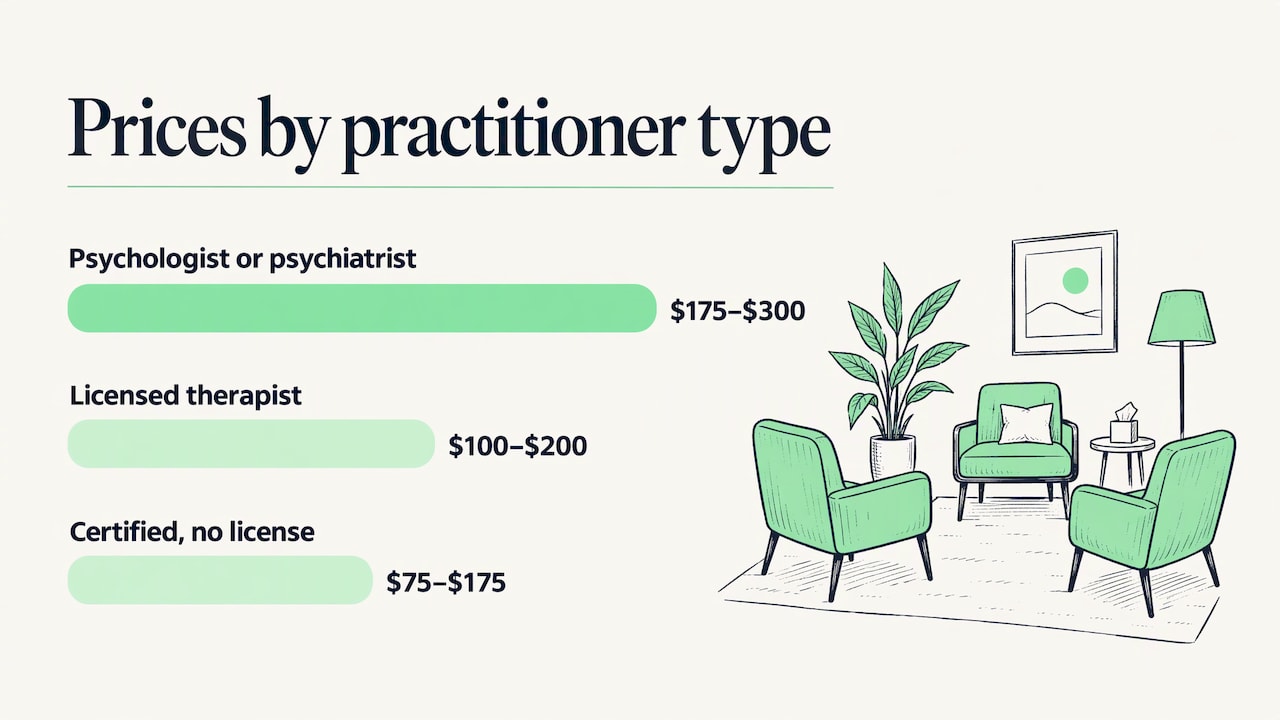
The spread is wide because “hypnotherapist” covers very different professionals. A 2026 pricing guide from Therapy Explained breaks the range down by credential:
| Type of practitioner | Typical price per session |
|---|---|
| Licensed psychologist or psychiatrist with hypnotherapy training | $175 to $300 |
| Licensed therapist who uses hypnosis | $100 to $200 |
| Certified hypnotherapist without an independent mental-health license | $75 to $175 |
Those are market ranges, not quotes. Any individual practice can sit above or below them, and that includes ours. Our current rates are on the MindShift pricing page.
Specialty matters too. LatestCost reports that general hypnotherapy for anxiety or stress runs about $100 to $200 per session, while medical hypnotherapy for pain management or chronic illness can reach $200 to $300 or more.
What makes one hypnotherapist cost more than another?
The same five or six factors explain nearly every price you will see.
Where the practice is located
Rent and local demand shape fees. Therapy Explained reports major metropolitan rates of $200 to $350 per hour, against $100 to $200 in mid-size and suburban areas. A practitioner in Manhattan or Los Angeles and one in a suburb of Riverside are not pricing the same room.
Training and experience
The International Hypnosis Association, in a guide for practitioners, lists experience and training, location, specialization, session length and format among the things that set a fee. Licensure matters most to the reader, because it decides whether the service can ever be billed to insurance.
Session length
Most sessions run 45 to 90 minutes, and longer sessions tend to cost more. A first appointment is often longer than the rest, because it covers your history, your goals and the first induction. Ask whether the intake is priced separately or folded into a package.
The issue you are treating
Depression, trauma and chronic pain usually involve more sessions and more specialized training than a single habit or a test-day fear. That shows up in both the per-session fee and the total.
Online or in person
Online sessions average 15% to 25% below in-person rates, according to the same 2026 guide. You also save the commute. We offer both formats, described on our services page.
Group or corporate format
Working with a couple, a family, a team or an organization is priced differently from one-on-one work, because the scope and preparation differ. We scope those engagements individually. Our corporate and group page explains how that work is organized.
Why does hypnotherapy seem expensive?
A single hour can feel pricey next to a copay. Part of the reason is that a private practitioner pays for things a copay hides: office or room rental, professional liability coverage, scheduling and website tools, and ongoing training. A fee covers the whole practice, not only the hour you sit in the chair.
The second reason is billing. Stand-alone hypnotherapy is usually self-pay, so you see the full price at once instead of a discounted, insurer-negotiated one. The third is preparation: a good practitioner builds a plan around you instead of reading a script, and that work happens before and between sessions.
How many sessions will you need, and what is the total?
The per-session fee is only half the math. Therapy Explained gives condition-based examples of 3 to 12 sessions, with course totals of roughly $300 to $3,000. The same guide says packages commonly cut the per-session rate by 10% to 25%, in exchange for paying upfront. It reports five-session packages at $600 to $900.
A HypnoNews guide that draws on clinical-trial protocols gives these typical session counts:
| Goal | Typical sessions | Estimated U.S. total |
|---|---|---|
| Anxiety | 6 to 10 | $600 to $3,000 |
| Procedural anxiety (a shot, a scan) | 1 to 3 | Lower, often one to three fees |
| Smoking cessation | 4 to 8 | $400 to $2,400 |
| IBS | 6 to 12 | $600 to $3,600 |
| Chronic pain | 4 to 10 | Depends on practitioner type |
| Depression | 8 to 16 | Depends on practitioner type |
The dollar totals in that guide use its own $100 to $300 per-session range. Treat them as planning ceilings, not predictions. Your actual number depends on your practitioner’s rate and how you respond.
A worked example
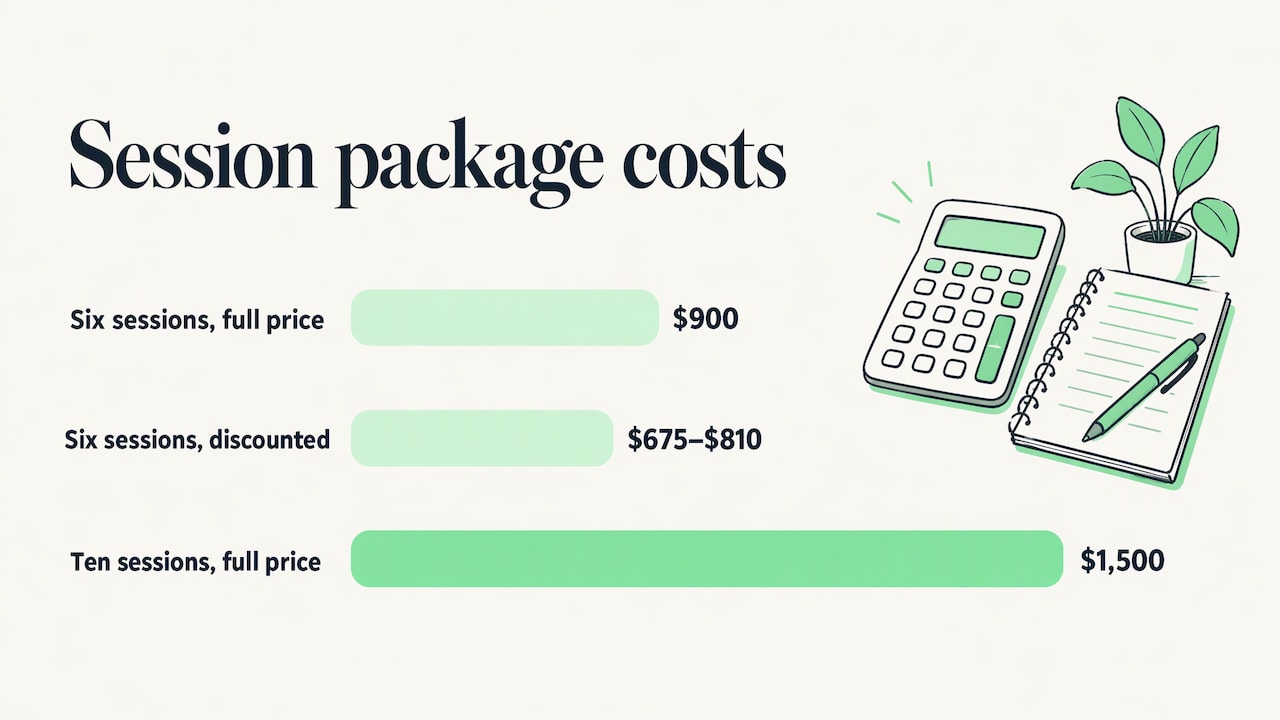
Say you want help with everyday anxiety and your practitioner charges $150 per session. Six sessions cost $900 at full price. A package discount in the 10% to 25% range would bring that to about $675 to $810. Add an online format and the number can drop again. If the plan stretches to ten sessions, the same math gives $1,500 at full price. Knowing this range before the first call lets you compare practices fairly.
Is there a cheaper way to start?
Yes, without cutting corners on quality:
- Start with a short, goal-specific plan. A narrow target such as a fear of needles or test nerves usually needs fewer sessions than a broad one. Our needle phobia hypnosis guide shows what a focused approach looks like.
- Choose online sessions. The reduction can be meaningful over a multi-week plan.
- Ask about packages. Prepaying often lowers the per-session rate.
- Check your benefits first. Even partial reimbursement changes the total (more on that below).
- Pay for fit, not only the lowest rate. A plan that is built around you tends to need fewer wasted sessions than a generic one.
Will insurance pay for hypnotherapy?
Sometimes, but not for stand-alone hypnotherapy from a non-clinical practitioner.
TherapyCostGuide explains the split. A licensed clinician may use hypnosis inside a billable psychotherapy or medical service. A non-clinical certified hypnotherapist generally cannot bill medical insurance, so those sessions are typically self-pay. Therapy Explained agrees: coverage is more likely when a licensed mental-health professional delivers hypnosis as part of psychotherapy for a covered diagnosis.
Policies do exist that recognize it in specific cases. One Minnesota medical policy treats hypnotherapy as medically necessary for chronic pain within comprehensive pain management, as an adjunct for anxiety, somatoform and adjustment disorders, or as stand-alone treatment for pre-procedural anxiety when a certified mental-health professional provides it. The same policy treats other uses, including smoking and obesity, as investigative. That document dates from 2014, and your plan’s terms and authorization rules will differ.
On Medicare, coverage depends on medical necessity, an eligible licensed provider, documentation and diagnosis coding. For covered outpatient mental-health services, Original Medicare Part B typically means the annual deductible followed by 20% of the Medicare-approved amount.
The practical steps are simple. Call the number on your insurance card, ask whether hypnosis is covered when delivered by your specific provider type, and ask about authorization. If you use a health savings or flexible spending account, ask your plan administrator whether the service qualifies. We explain the billing code question in more detail in our guide to hypnotherapy insurance and CPT 90880, and how hypnotherapy can work alongside your doctor’s care in our page on combining hypnotherapy with traditional healthcare.
How to judge whether a price is fair
A fee is fair when you understand what it buys. Before you book, get answers to these:
- What is the total plan, not just the first session? You want a likely number of sessions and the price of each.
- How long is each session, and how long is the intake?
- Is there a package rate, and what happens to unused sessions?
- What training does the practitioner have, and is any of it a clinical license? This decides whether insurance is even possible.
- Will the work be customized? Ask how your goals shape the plan.
- What happens between sessions? Practice, recordings or coaching tasks add value without adding appointments.
Safety belongs in this conversation too. Hypnosis for depression, trauma or PTSD should sit alongside care from your physician or a licensed mental-health professional. If you are in crisis or thinking about harming yourself, call or text 988, the Suicide and Crisis Lifeline, instead of booking a session.
Our view on hypnotherapy cost
We think the right question is not “what is the cheapest session?” but “what plan gets you to the change you came for?” A low per-session rate with a generic script and no plan can cost more in the end than a tailored course.
That is why we pair hypnotherapy with life coaching and strategic planning. Hypnosis works on the patterns underneath a fear, a habit or a stuck moment. Coaching turns the shift into daily action. Together they are designed to give each client a plan that fits their goals, instead of a fixed number of identical sessions.
We also believe money should never be a mystery. Tell us what you want to change, and we will explain how we would approach it, what format fits, and how many sessions are realistic to plan for. If you are working with a physician or therapist, we are glad to work alongside them.
Rachael
Working with MindShift
MindShift Hypnosis combines personalized hypnotherapy with life coaching for individuals, couples, families, groups and corporate teams, in person and online. We work on anxiety and depression, trauma, fears and phobias, relationship needs, and peak performance for athletes and performers. Each client gets a customized plan, not a script.
If you want to see how that looks for your goal, start with our services overview and check current rates on the pricing page.

If anxiety is what brings you here, our page on hypnotherapy for anxiety in Riverside and Corona explains how we approach it. For a depression-specific plan, see hypnotherapy for depression.
Frequently asked questions
How much does a typical hypnotherapy session cost?
Most U.S. sessions fall between about $100 and $250. Certified hypnotherapists tend to sit at the lower end, while licensed psychologists or psychiatrists who use hypnosis charge more. Big-city practices usually price above suburban and online ones.
Why is hypnotherapy so expensive?
The fee covers more than the hour you spend in session. It includes the practitioner’s training, intake and planning time, office or room costs, liability coverage and booking tools. Because stand-alone hypnotherapy is usually self-pay, you also see the full price rather than an insurer-negotiated one.
Will insurance pay for hypnosis?
It can, but usually only when a licensed clinician uses hypnosis within covered treatment for a diagnosis. A non-clinical hypnotherapist generally cannot bill medical insurance. Call your insurer before booking and ask about your specific provider type and any authorization requirements.
How many sessions will I need?
It depends on the goal. Short-term concerns such as procedural anxiety may take one to three sessions, while anxiety is commonly 6 to 10 sessions and depression 8 to 16 in the protocols that guide cites. Your practitioner should give you a likely range after the first appointment.
Are online hypnotherapy sessions cheaper?
Often, yes. One 2026 guide reports online sessions averaging 15% to 25% below in-person rates. You also skip travel time.
Sources
- USA Today: Is hypnosis real? How and why it works for some
- Therapy Explained: Hypnotherapy Cost, 2026 Pricing and Insurance Guide
- LatestCost: Average Cost of Hypnotherapy Services in the United States
- HypnoNews: How Many Hypnotherapy Sessions Do You Need?
- International Hypnosis Association: Setting Your Hypnosis Fees
- TherapyCostGuide: Hypnotherapy Cost, What to Expect to Pay
- Minnesota medical policy on hypnotherapy
- LegalClarity: Does Medicare Cover Hypnosis?