Habit change coaching is structured work with a coach to replace one automatic behavior with another: you clarify what you want, find the cue that triggers the old habit, plan exactly when the new one will happen, and get follow-up until it sticks. Willpower alone rarely carries that, because habits run on automatic circuits. At MindShift Hypnosis we pair life coaching with hypnotherapy, so the plan is built around you and the work reaches the automatic part of the habit too.
TL;DR
- Habit coaching turns a vague goal into a cue, a specific new behavior and a reward, then adds follow-up so the plan survives real life.
- Research found that forming a simple habit took anywhere from 18 to 254 days, so the support has to last longer than a few weeks.
- If-then planning is one of the best-supported tools: implementation intentions averaged d = 0.65 across 94 studies.
- Coaching handles what, when and how. When the real issue is anxiety, depression or trauma, it works best alongside a licensed mental health professional.
Table of Contents
- What habit change coaching actually is
- How long a new habit really takes
- The coaching process, step by step
- What the research says works
- Adapting the work to your situation
- Setbacks, pain and keeping the plan alive
- Where coaching ends and therapy begins
- Our perspective
- Start with a plan built for you
- FAQ
- Sources
What habit change coaching actually is
A habit coach is a partner for the practical side of change. You bring a target: stop stress-snacking at night, start a morning routine, quit scrolling in bed, be calmer with your kids, practice before a game. The coach helps you set clear objectives, spot the habits that help or hinder you, and turn them into an action plan.
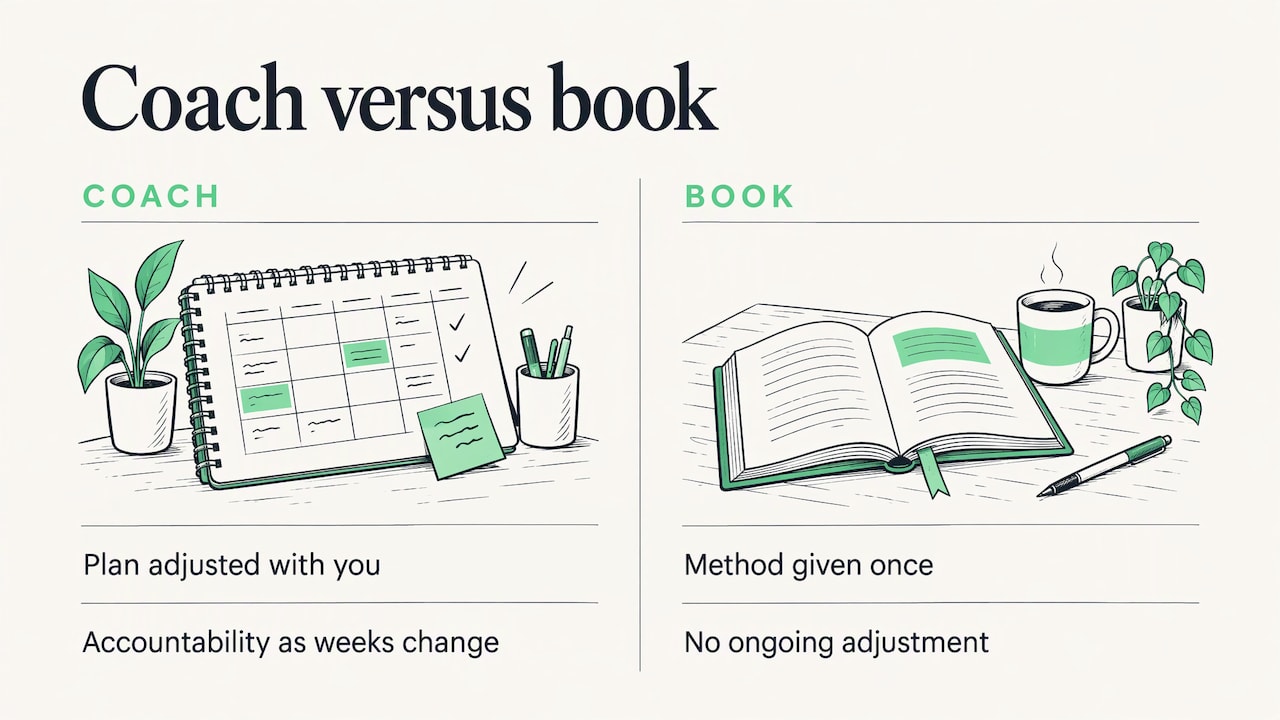
The difference from reading a habit book is accountability and adjustment. A book gives you the method once. A coach watches what happens when your week falls apart and changes the plan with you.
You may also see this called habit formation coaching. The work is the same: building a new routine, or dismantling an old one, one cue at a time.
The habit loop in plain words
Most habit coaching rests on a three-part loop described in Charles Duhigg’s The Power of Habit: a cue, a routine and a reward. The IDEA Health & Fitness Association describes this loop as the base for coaching new habits. Your phone buzzes (cue), you check it (routine), you get a small hit of novelty (reward). To change the habit, you keep the reward you actually want and change the routine that delivers it.
Why willpower is the wrong tool
A Harvard-affiliated Institute of Coaching resource by Siegfried Greif explains that, according to brain studies, habitual behavior is driven by unconscious activity in the basal ganglia rather than the frontal lobe, the area of deliberate decisions. That is why “just try harder” fails. The old cue has to be deactivated and a new one placed on top of it, with the new behavior strengthened by positive consequences.
How long a new habit really takes
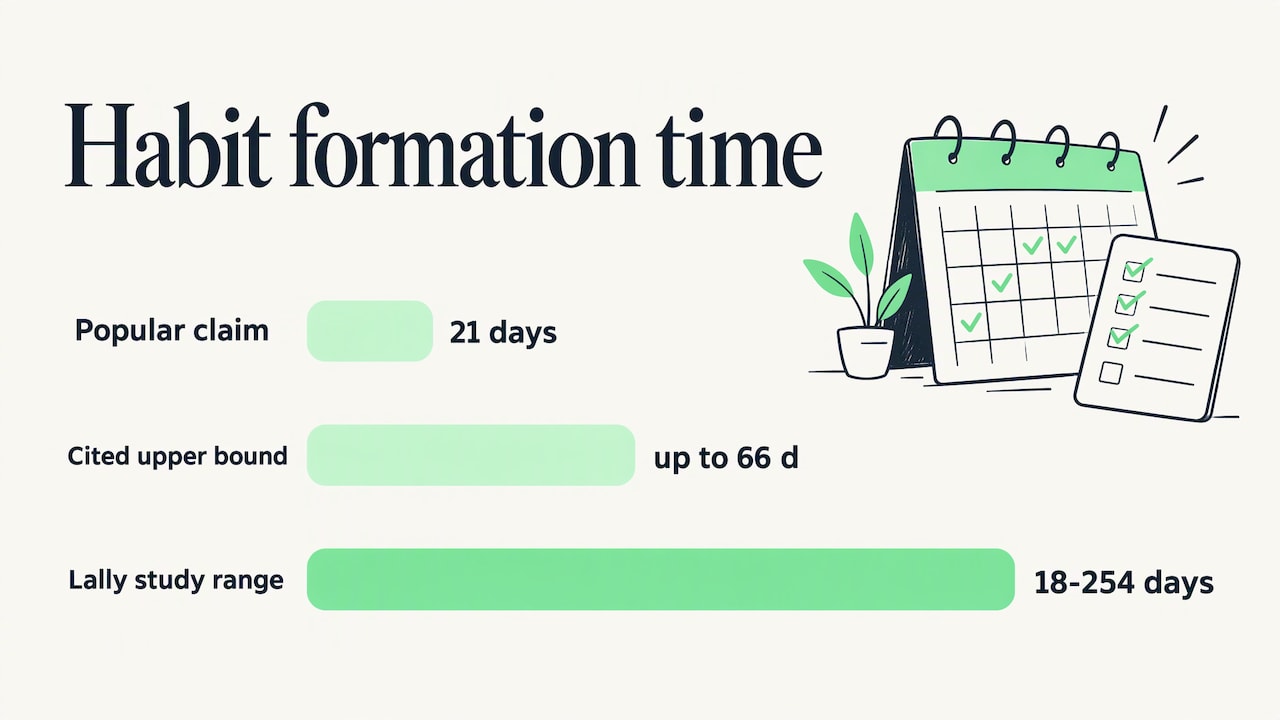
The popular claim is 21 days. The research does not back it. The IDEA article notes that habits do not reliably form in 21 days and that the time varies greatly, up to 66 days in the work it cites. Greif cites a 2010 study by Lally and colleagues in which people needed between 18 and 254 days to make a simple healthy behavior automatic, practiced on more than 95% of days.
What this means for you: plan on months, not weeks, and expect uneven progress. A college text on habits summarizing the same research adds that automaticity came faster for simple actions than elaborate ones and was not seriously disrupted by an occasional missed day. One slip is not failure. A good coach says that in week two, before you need to hear it.
The coaching process, step by step
Coaches differ in style, but the sequence below follows the structure published by Greif and the six-step approach from IDEA. At each step there is a place where people go wrong, and a place where a coach earns their fee.
1. Clarify the goal and the motivation
You define what you want and why. Goals work better when they are chunked into smaller outcomes: IDEA’s example is aiming for 5 pounds in the first month rather than 60 at once. The common mistake is a goal that is really a wish (“be healthier”). Our coaching starts here with a goals and beliefs worksheet, because beliefs about what you can change shape what you try.
2. Choose one to three behaviors
IDEA recommends the client select two to three goal-oriented behaviors and notes that focusing on one simple habit at a time may lead to greater change. People usually overload themselves in the first week. A coach’s job is to narrow the list.
3. Find the old cue and the real reward
You map when and where the habit fires: after dinner, in traffic, after a hard call. Then you ask what the habit gives you: relief, company, a break. Without that answer, the replacement behavior does not pay off and fades.
4. Anchor the new behavior to an existing routine
Nowack’s paper notes that Fogg and Nowack suggested one of the most potent triggers is pairing a new behavior with an existing habit. After you pour your coffee, you stretch for two minutes. The cue already exists, so you do not have to remember anything new.
5. Write the if-then plan
An if-then plan names the situation and the response: “If I feel the urge to check my phone in bed, then I put it on the charger across the room.” Linking the “if” to the “then” helps automate the response. Coaching adds a second layer: planning for the obstacles you can predict. Our page on accountability coaching and if-then plans goes deeper on this step.
6. Remove the disruptors
The environment often beats intention. IDEA’s fifth step is eliminating disruptors, such as the snacks on the counter or the notifications on the lock screen. People tend to skip this step because it feels like cheating. It is just design.
7. Follow up
Greif’s sequence ends with arranged follow-up, including phone or messaging check-ins and smartphone reminders. IDEA notes research showing that a simple text message is a powerful tool for behavior change. A 2022 peer-reviewed article reports that Harkin and colleagues found how often coaches monitored goals was associated with patients’ progress, especially when the contacts were recorded. This is the step that is hardest to do alone, since nobody is waiting for your report.
What the research says works
Not every technique carries equal weight. Here is how the main ones stack up in the sources.
| Technique | What the research reports |
|---|---|
| If-then (implementation) intentions | Medium-to-large average effect (d = 0.65) on goal achievement across 94 studies and more than 8,000 participants, per Nowack (2017) |
| Goal intentions alone | Explain about 28% of the variance in successful behavior change, per the same paper |
| SMART goals | Goal setting had a unique effect on health behaviors, strongest when goals were moderately difficult, set in front of others and shared by a group, per a 2022 PMC review |
| Coping plans for barriers | Coaches should help clients plan for expected barriers and acknowledge feelings about unsuccessful attempts, per the same review |
| Motivational interviewing | Rated evidence level A in primary care, associated with decreases in weight, blood pressure and alcohol use, per American Family Physician (2018) |
Two points follow. First, intending to change is only part of it; the plan for when and where is what moves behavior. Second, the group effect matters: goals shared with others do better, which is one reason coaching for couples, families and teams can work well.
Adapting the work to your situation
The mechanics stay the same; the context changes.
- Personal goals. Sleep, focus, routines, stopping a nervous habit. One person, one or two behaviors, regular check-ins.
- Couples. The habit is often a pattern between two people, such as how a hard conversation starts. Both partners agree on a cue and a replacement. See how couples communication coaching works.
- Families. Shared routines, like screen-free dinners, last when everyone helps choose them and everyone has a role.
- Workplace and teams. Habits like how a team handles feedback or stress. Our approach to emotional intelligence coaching at work pairs hypnosis with a simple three-breath reset.
- Performance. Athletes and performers build pre-performance routines. This is where sport hypnosis for peak performance fits.
If attention and organization are the sticking point, our guide to ADHD coaching for adults covers that case.
Setbacks, pain and keeping the plan alive
A setback is data, not a verdict. Good coaching asks what the cue was, what the plan missed and what to change. When a physical condition limits what you can do, the goals themselves need to be realistic for your body. If chronic pain is part of the picture, a resource on chronic pain treatment planning shows how setting goals and handling setbacks work alongside your medical care.
Where coaching ends and therapy begins
Habit coaching is a wellness model. The ADHD organization CHADD describes it as addressing what, when and how, but rarely why, and says coaches are not trained to treat psychiatric, emotional or interpersonal problems unless they are also licensed mental health professionals. The American College of Lifestyle Medicine draws the line this way: coaches focus on the present and future, using strengths and action steps, while licensed professionals look at the present and past to understand the “why”. The same article notes that coaching can be a pathway into behavioral health care for people wary of therapy.
A peer-reviewed review of coaching and psychotherapy adds that clients and coaches may discover that some issues are best addressed with mental health diagnostic and therapeutic skills.
In practice:
- If you have ongoing depression, panic, trauma symptoms or thoughts of harming yourself, see a licensed mental health professional or your doctor. In an emergency in the US, call or text 988, the Suicide & Crisis Lifeline, or call 911.
- If you already have a clinician, tell them you are working with a coach so the plans fit together.
- If you are ready to act on your plan but need structure, coaching is a good fit. CHADD describes readiness as admitting there is a problem, wanting change and sticking with the strategies.
We work with this in mind: our services include combining hypnotherapy with traditional healthcare. For anxiety-related habits, see life coaching for anxiety.
Our perspective
Most people who come to us do not lack information. They know they should sleep, move, speak calmly, stop the loop. What is missing is a plan built for their life and someone to adjust it with them.
That is why we combine hypnotherapy with life coaching. Coaching gives you the structure: the goal, the cue, the if-then plan, the check-in. Hypnosis works with the part of you where the habit lives, the part that does not respond to being told to try harder. We build a customized treatment plan for each person, couple, family or team, rather than handing everyone the same routine.
We also care about the whole picture. Where a client is working with a doctor or therapist, we see our work as part of that team, not a replacement for it. Change that holds tends to come from a plan that fits your life and support that lasts longer than the first burst of motivation.
Rachael
Start with a plan built for you
MindShift Hypnosis offers hypnosis only, life coaching, and hypnosis life coaching combined, in person and online, for individuals, couples, families, groups and corporate teams. Sessions can focus on fears and phobias, depression and anxiety, trauma, relationship needs or performance.
See our services and book the session that matches the habit you want to change.
FAQ
What is the 3-3-3 rule for habits?
It is a simple framework: three daily non-negotiable actions, three minutes of effort on low-motivation days, and three small wins to reflect on each night. The Herzing University description cites research that simple actions became automatic faster than elaborate ones. A coach can help you choose which three actions matter most.
How long does it take to form a habit?
It varies widely. Research cited by the Institute of Coaching found a range of 18 to 254 days for a simple healthy behavior, and an average plateau near 66 days in other work. Plan for months and expect some missed days.
Is habit coaching the same as life coaching or therapy?
Habit coaching is a focused form of life coaching centered on specific behaviors. Therapy is delivered by licensed professionals who address emotional and psychiatric conditions. The ACLM article notes coaches do not diagnose or treat conditions. The two can work side by side.
How does a coach help me stay on track between sessions?
Through follow-up: check-ins by phone or text, reminders and reviewing what happened when the plan met real life. A 2022 review found that frequent goal monitoring was linked to better behavioral progress. Our online services make regular contact easy wherever you live.
What should I be ready for before I start?
Be ready to name a specific change, spend time on strategies and keep using them. NIDDK describes the preparation stage as having decided to change, set specific goals and begun getting ready to act. You do not need to have every step figured out.
Sources
- Rigorous Implementation of Behavior Changes, Institute of Coaching (Greif, 2019)
- The 6-Step Approach for Creating New Habits, IDEA Health & Fitness Association
- Facilitating Successful Behavior Change, Nowack (2017)
- Concepts from behavioral theories can guide clinicians, PMC (2022)
- Counseling Patients in Primary Care, American Family Physician (2018)
- Coaching, CHADD
- A Coach Approach to Facilitating Behavior Change, ACLM (2022)
- Coaching vs Psychotherapy in Health and Wellness, PMC (2013)
- The 3-3-3 Rule for Habits, Herzing University
- Changing Your Habits for Better Health, NIDDK