Golf hypnosis is mental training done in a relaxed, focused state. A hypnotherapist guides you to rehearse your pre-shot routine, calm pressure responses and picture the shot you want. It does not change your swing mechanics by itself. It helps you practice the part of golf that happens between your ears, and the research below suggests it can help with focus, confidence and the yips when it sits alongside regular practice and good coaching.
This guide covers what happens in a session, what studies on putting, tournament pressure and the yips have found, a routine you can try on the range, and how to decide whether one-on-one work is right for you.
TL;DR
- Golf hypnosis uses guided relaxation and imagery to rehearse routines, steady your attention and respond better to pressure.
- A small putting study found all 5 competitive players improved their putting and flow scores during the hypnosis phase.
- A published case series described a golfer with the yips who was almost free of symptoms five years after combined behavioral therapy and hypnosis.
- It works best next to real practice and lessons, not in place of them. Pick one specific goal and track it.
- Persistent or worsening yips symptoms deserve an assessment by a qualified golf instructor and a health professional.
Table of Contents
- What golf hypnosis actually is
- What happens in a golf hypnosis session
- What the research says about golf performance
- Hypnosis for golf yips
- A simple pre-shot routine you can practice today
- How to decide if golf hypnosis is a fit
- Working with MindShift on your golf game
- FAQ
- Sources
What golf hypnosis actually is
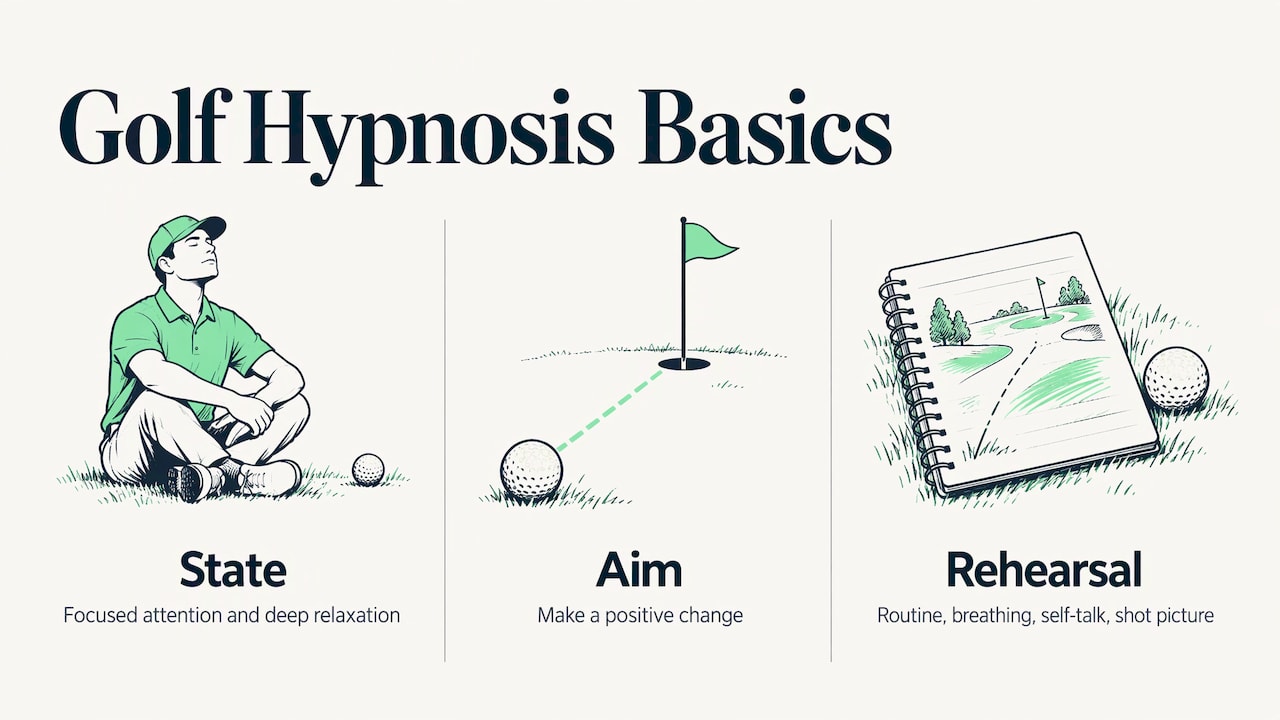
Hypnosis is a state of focused attention and deep relaxation, used with the intention of making a positive change. In golf, that means training your mind the way you train your hands. You settle into a calm state, then rehearse the things that tend to fall apart under stress: your routine, your breathing, your self-talk, your picture of the shot.
Most golfers know the gap between the range and the first tee. The swing that felt automatic on a Tuesday afternoon gets tight on the 16th hole of a club championship. The technique has not changed. What changed is attention, tension and the thoughts running in your head. Hypnosis aims at that gap.
It is also not what stage shows suggest. You are not asleep, and you are not controlled. You stay aware and can come out of it whenever you want. The guided state is a way to practice mental skills with fewer distractions.
What happens in a golf hypnosis session
Sessions vary by practitioner, but a typical golf-focused session follows a clear pattern.
- A conversation about your game. You describe where it breaks down: first-tee nerves, three-putts when it matters, a swing thought that will not quiet down, or a shot you have started to dread.
- One specific goal. Good work starts narrow, such as “stay calm over putts inside six feet” rather than “play better golf.”
- Induction. You are guided into a relaxed, absorbed state with breathing and verbal cues.
- Rehearsal. You mentally run through your pre-shot routine, imagine the shot in detail, and practice a calm response to the situations that usually rattle you.
- A cue to take with you. Many golfers leave with a simple trigger, such as a breath, a hand movement or a phrase, that brings the same calm back on the course.
- Practice between sessions. You usually get a short audio or script to repeat, and you bring it to the range.
At MindShift, sport hypnosis for peak performance is built around that kind of individualized plan. You can read how we approach it on our sport hypnosis for peak performance page.
What the research says about golf performance
Golf hypnosis has a modest but interesting research base. Most of it is small studies and case reports, so read the findings as promising signals rather than guarantees.
Putting and flow
A study of five competitive golfers tested hypnotic induction, regression and trigger-control procedures. According to the study on hypnosis, flow states and golf putting, all five increased their mean putting performance and flow scores from baseline to the intervention phase, with no overlapping data points between phases. Each participant also said the intervention helped keep them relaxed, confident and focused. Three reported less concern about performing and more control over their putting stroke.
Five players is a small group, but the pattern was consistent across every one of them.
Pressure at the highest level
A case study of a senior PGA Tour golfer used an intervention combining hypnosis, regression imagery, trigger control and a pre-shot routine. His mean stroke average decreased from baseline to after the intervention. The qualitative findings suggest the approach may help golfers regulate the emotions, thoughts and perceptions tied to clutch moments.
Emotions, flow and sleep
A Psychology Today piece on hypnosis for sleep and golf explains that hypnosis lets golfers turn down negative emotions and turn up positive ones while the mind relaxes, which may help them reach a flow state. It also describes a golfer who used hypnotic tools in his game:
- He visualized the swing changes his coach suggested before each shot.
- He ran a mental checklist confirming that each muscle involved in the swing was prepared.
- He used a hand signal to enter a calm state between shots.
- On the greens, he set up behind the ball, waggled the putter slowly while picturing the ball dropping at the right speed and line, took two practice strokes and repeated a short phrase about seeing the ball fall in the hole. He reported that his putts went in much more often.
That is one golfer’s account, not a controlled trial, but it shows how practical the tools are. Nothing in it replaces the coach. It makes the coach’s work easier to carry onto the course.
Hypnosis for golf yips
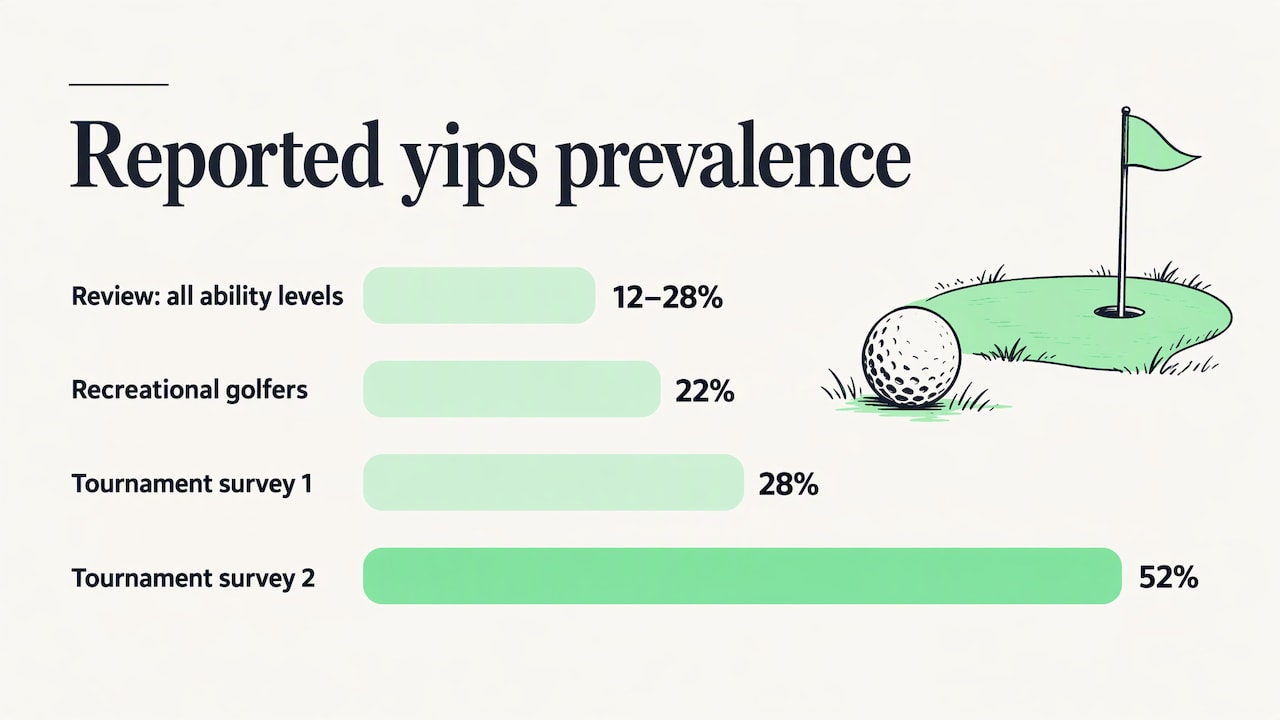
The yips are the sudden loss of fluid motor control, usually on short putts or chips: twitches, jerks, freezing or a stroke that will not go where you intend. They are common. A review by Mullen, Kingston and Madill reported the yips affecting between 12% and 28% of players, across ability levels, and tending to afflict serious performers. A Dutch survey of 234 recreational golfers found a yips prevalence of 22%. Tournament-player surveys summarized in a 2025 Frontiers review put self-reported rates higher, at 28% in one survey and 52% in another.
If you have the yips, you are in large company.
Why the cause is not always the same
The same Frontiers review notes that the yips have been described in different ways: as physical symptoms (a type of dystonia), as psychological symptoms (choking under pressure), or as a mix of both. That matters because it points to a team approach. A golf instructor can look at your technique, a health professional can address physical concerns, and mental training can address the anxiety, anticipation and thought patterns that feed the problem.
A published case with hypnosis
One of the most detailed accounts comes from a 2023 case series by Tibben and colleagues. It followed four advanced-skill athletes with suspected task-specific dystonia, including a golfer with the yips. They received eight sessions of combined behavioral therapy and hypnosis over 16 weeks. After treatment, all four returned to their original high level of performance without further symptoms, and the golfer was almost free of yips symptoms five years later.
The golfer’s protocol is worth knowing in outline:
- Eight sessions of 90 minutes across 16 weeks.
- Education about what the yips are, shaping of the movement, hypnosis and relapse prevention.
- No golf until after the sixth session.
- After the seventh session, he reported playing two rounds free from any yips symptoms.
It is a case series of four people, so it cannot tell you what will happen for you. It does show that hypnosis can be a structured part of a serious plan for the yips, with a clear start, middle and relapse-prevention stage.
When to get the yips checked
Treat hypnosis as one complementary mental practice, not a stand-alone cure, and avoid assuming one explanation for your symptoms. If the yips persist, get worse or worry you, have a qualified golf instructor assess your technique and a relevant health professional, such as your physician or a neurologist, assess any physical concern. Hypnotherapy works well alongside that care. We explain how we coordinate with other providers on our page about combining hypnotherapy with traditional healthcare.
A simple pre-shot routine you can practice today
You do not need a hypnotherapist to start building the habit of a calm, repeatable routine. This is a general-purpose version built on the same ingredients the studies used: relaxation, imagery, a trigger and a set sequence. Practice it first on the range or putting green, then take it to the course.
- Pick one goal. For example: “one smooth, committed putting stroke inside six feet.”
- Take one slow breath out. Let your shoulders and grip pressure drop. This is your trigger.
- See the shot. Stand behind the ball and picture the line, the speed and the ball dropping or landing where you want.
- Run a quick body check. Feet, hips, shoulders, hands. Each one ready, nothing gripping.
- Use one short phrase. Something like “smooth and committed.” Say it silently as you take your practice strokes.
- Step in and go. Set a limit: once you step in, you hit within a few seconds. Do not re-think.
- Reset after the shot. Whatever happened, take the same slow breath before walking on. Good or bad, the breath closes the shot.
Do this on every practice putt for a week and the sequence becomes automatic. Hypnosis sessions deepen that process, because rehearsing in a relaxed state makes the response easier to call up when your pulse is up.
If pressure feels like a bigger issue than golf alone, our stress relief hypnosis page offers a calming phrase you can try, and our hypnotherapy for anxiety in Riverside and Corona page explains how we work with anxiety in person.
Our perspective
Golfers come to us saying the same thing: “I can do it on the range, but not when it counts.” We do not hear that as a swing problem. We hear it as a skill that has not yet been trained under the conditions where it is needed.
That is where hypnosis and coaching fit. In a session we help you drop into a calm, focused state and rehearse the exact moment that tightens you up: the three-footer for the match, the tee shot over water, the putt you have missed four times this month. We pair that with coaching and a plan, so the work does not end when the session does. You leave with a routine, a cue and a way to track what is changing.
We believe the strongest results come from an individualized approach. Two golfers with the same symptom can have very different stories. One is carrying pressure from a bad round. Another has a fear of being judged by their group. Another is dealing with stress from work that shows up on the green. Our hypnotherapy and life coaching are built around you, not a script, and we are glad to work alongside your instructor and your doctor.
If you are a competitive player, a weekend golfer who wants more enjoyment, or someone frustrated by the yips, we would like to help you play the way you practice.
Rachael
How to decide if golf hypnosis is a fit
The sensible way to try it is the way you would try any new piece of training: define it, measure it, give it a fair run.
- Choose one specific goal. “Reduce first-tee tension” is easier to assess than “lower my handicap.”
- Look at the provider and the method. Ask what a session involves, how many sessions are typical, and how they work with your coach or doctor.
- Decide what you will watch. Track one process measure, such as how often you complete your full routine, or how many putts inside six feet you hold your stroke on, next to how confident and comfortable you feel.
- Repeat the check over several practice rounds. One good day tells you little.
- Keep your practice steady. Change one thing at a time, so you know what is helping.
- Listen to yourself. If something does not feel right, say so and adjust the plan.
Feeling calm during a session is a good start, and the real measure is how you handle pressure on the course. That is why we pair every session with a rehearsal plan and practice between visits. Hypnosis is one way to practice your response to pressure, and it works best alongside practicing golf itself.
Who tends to benefit
Golfers who report any of the following are good candidates for this kind of mental training:
- Tension on the first tee or in a competitive round.
- A routine that disappears when the score matters.
- Dwelling on the last bad shot.
- Growing dread of a particular shot, such as short putts or a specific hole.
- Yips symptoms, alongside an assessment from the right professionals.
If your issue overlaps with motivation or follow-through, our pages on motivation hypnosis and accountability coaching explain how we help turn intentions into a repeatable plan.
Working with MindShift on your golf game
We combine personalized hypnotherapy with life coaching, so your sessions cover both the in-the-moment mental skills and the bigger picture: your goals, your schedule, your habits and the stress you carry onto the course. We offer sport hypnosis for peak performance and also work with performers in other fields. Sessions are available in person and online, so you can work with us from anywhere in the United States.
The first step is a conversation about your game and what you want to change.
See how we work on our services page, read about sport hypnosis for peak performance, or check our hypnotherapy pricing page. If you play on a team, a league or a corporate outing, we also run corporate and group sessions.
FAQ
Does hypnosis really work for golf?
Research on golf hypnosis is small but encouraging. In one study of five competitive golfers, all five improved their putting and flow scores during the hypnosis phase, and a case study of a senior PGA Tour golfer showed a lower stroke average after a hypnosis-based intervention. Results vary from player to player, and hypnosis does its best work alongside practice and coaching.
Can hypnosis help with the yips?
It can be part of a plan. A published case series described a golfer who received combined behavioral therapy and hypnosis over eight sessions and was almost free of yips symptoms five years later. Because the yips can have physical and psychological contributors, it is wise to also have a golf instructor look at your technique and a health professional look at any physical concerns, especially if symptoms persist or get worse.
How many sessions will I need?
That depends on your goal and your history. A narrow goal, like a calmer first tee, may need fewer sessions than a long-standing issue like the yips. In the published yips case, the plan was eight sessions over 16 weeks. We build a customized plan with you after hearing about your game.
Will hypnosis change my swing?
No. Your instructor handles mechanics. Hypnosis helps you rehearse the changes your coach suggests, keep your routine consistent and stay calm so those changes hold up on the course.
Can I do golf hypnosis online?
Yes. We offer online sessions as well as in-person work, so you can rehearse your routine from home and bring the same cues to the course.
Sources
- The Effects of Hypnosis on Flow States and Golf-Putting Performance
- Clutch-Based Hypnotic Intervention to Improve Golf Performance
- Using Hypnosis to Improve Sleep and Golf Performance, Psychology Today
- Yielding to internal performance stress? The yips in golf: a review
- The Dutch Yips Study: Results of a Survey Among Golfers
- The yips: an investigation of the causes and treatments, Frontiers in Sports and Active Living
- Is Behavioural Therapy a New Treatment Option for Task-Specific Dystonia in Athletes?