Forgiveness hypnosis is hypnotherapy aimed at the weight you carry after a hurt: resentment toward someone else, guilt toward yourself, or regret that replays on a loop. In a guided session, a practitioner helps you settle into focused attention, then works with you on a goal you chose, such as softening the grip of an old memory or building a kinder view of your own choices. It does not ask you to excuse what happened, reconcile with anyone, or forget. At MindShift Hypnosis, we pair personalized hypnotherapy with life coaching, so the inner work in a session connects to practical steps in your life afterward.
TL;DR
- Forgiveness hypnosis uses focused attention and goal-directed suggestion to help you release resentment, guilt, or regret. You stay aware and in control throughout.
- Forgiveness is a choice about how you carry a hurt. It does not mean approving of what happened or restoring a relationship.
- Research on forgiveness work is encouraging. Studies of forgiveness therapy and compassionate reframing show less negative emotion and better wellbeing, and a controlled 2011 study of a hypnosis-based procedure found less intense negative emotion about stressful memories.
- A guided session with a practitioner gives you structure and support that is hard to build alone, especially with painful or traumatic memories.
- Our approach combines hypnotherapy with life coaching and customized plans, in person or online, for individuals, couples, families, and groups.
Table of Contents
- What forgiveness hypnosis actually is
- What forgiveness is, and what it is not
- What the research says
- What happens in a forgiveness hypnosis session
- Who forgiveness hypnosis can help
- Starting safely, especially with painful memories
- Making the work stick
- Work with MindShift Hypnosis
- Our perspective
- FAQ
- Sources
What forgiveness hypnosis actually is
Hypnosis is not sleep and not mind control. The American Society of Clinical Hypnosis (ASCH) reproduces the American Psychological Association’s Division 30 definition: hypnosis involves focused attention with reduced peripheral awareness and an enhanced capacity to respond to suggestion. In plain terms, you are relaxed, concentrated, and open to ideas you have already agreed to explore.
Forgiveness hypnosis points that state at a specific target. Common ones include:
- Forgiving yourself. A decision you regret, a relationship you ended, a season of life when you did not cope well, or the quiet guilt of starting to feel better after a loss.
- Letting go of resentment toward someone else. A betrayal, a parent’s harshness, a partner’s broken promise, a coworker’s credit-taking.
- Releasing regret. Chapters you cannot rewrite but keep rereading.
The approach rests on a simple observation. Most people already know, intellectually, that holding on is costing them. The knowing does not change the feeling. Hypnosis is used to work at the level of feeling and imagery, where the stuck part lives, rather than arguing with yourself in words.
What forgiveness is, and what it is not
Many people avoid forgiveness work because they think it means saying the hurt was fine. It does not. Forgiveness, as researchers use the term, is a change in your own inner response: less bitterness and rumination, more room for calm and, sometimes, compassion. You can forgive and still set firm boundaries. You can forgive and never speak to the person again. You can forgive yourself and still take responsibility for what you did.
That distinction matters for how a session is designed. A good session never pushes you toward a conclusion you have not reached. It works with your pace and your goal. If you are not ready to forgive someone, a useful first goal might be smaller: sleeping without replaying the argument, or being able to say their name without your chest tightening.
Why replaying the hurt keeps it alive
A 2022 peer-reviewed study by Witvliet, Blank, and Gall with 180 participants compared two ways of thinking about an offense. Compassionate reappraisal was associated with more forgiveness and empathy, less negative emotion, and better sleep-related outcomes than offense rumination. That study tested reappraisal, not hypnosis. It is useful here because it explains what a forgiveness session is trying to move you toward: from repeating the offense to seeing it, and yourself, from a steadier and kinder angle.
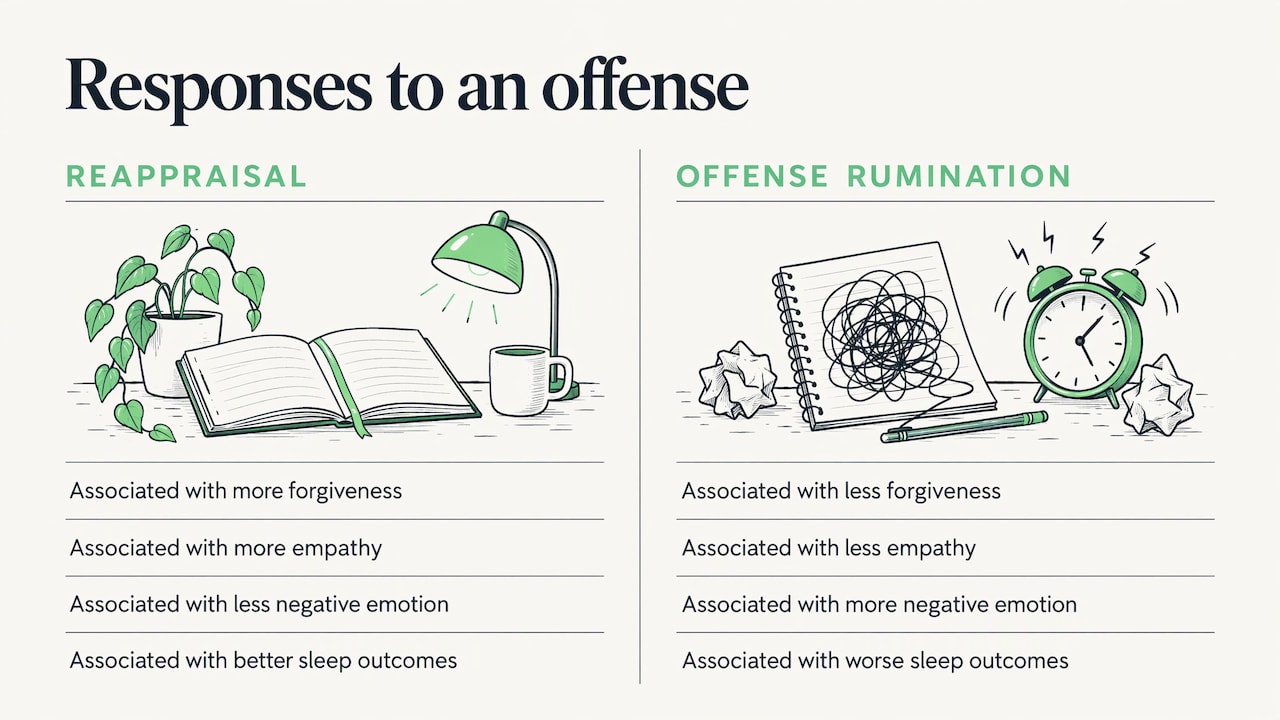
Hypnosis is one way to practice that shift. Instead of trying to think your way to compassion, you rehearse the new perspective while relaxed and focused, which many people find easier than doing it in the middle of a stressful day.
What the research says
Honest framing helps here: the research on forgiveness work is stronger than the research on hypnosis for forgiveness in particular, and the two should not be confused. Here is what each body of work shows.
Hypnosis-based procedures and stressful memories
A 2011 study in the journal Stress and Health tested a set of procedures involving hypnosis, neuro-linguistic programming, and timeline therapy, with 32 people in the treatment group and 32 controls. The treatment group reported reduced intensity of negative emotions about stressful memories, while the control group showed no significant change. Reducing the emotional charge of a memory is close to what many people want when they say they cannot forgive: the memory stays, but it stops running the show.
Forgiveness therapy more broadly
Several controlled studies looked at forgiveness therapy, a structured counseling approach, rather than hypnosis:
- In a study of 20 women who had left emotionally abusive marriages, those randomly assigned to forgiveness therapy showed greater improvement in depression, anxiety, and posttraumatic stress symptoms than the comparison group (Reed and Enright, 2006).
- In a 2004 trial, 14 residential patients in substance-use treatment completed 12 individual sessions. The forgiveness-therapy group improved on several emotional and forgiveness measures, with most benefits still significant at four months.
- A 2020 study by Eaton and Ferrari used a guided-imagery exercise with 24 university participants. The authors reported increased self-forgiveness and a relationship between that state and parasympathetic tone, the body’s calming branch of the nervous system.
These studies are small and none is a hypnosis trial, so read them as a signal that structured, guided work on forgiveness helps, not as a promise of a particular result. What they have in common with hypnotherapy is guided imagery, a clear goal, and a person walking you through it.
What this means for you
If you are deciding whether to try it, the practical reading is this. Forgiveness-focused work has a reasonable evidence base. Hypnosis is a recognized way to deliver focused, imagery-based work. Results vary from person to person, and nobody can promise you a particular outcome in a set number of sessions. What you can expect is a structured way to work on something you have been unable to shift by willpower alone.
What happens in a forgiveness hypnosis session
Every practitioner works a little differently, but a typical session follows a recognizable arc. For a fuller walkthrough of the format, see what to expect from hypnotherapy.
- Conversation first. You talk through what you are carrying and what you would like to be different. A clear, personal goal shapes everything that follows. “Stop feeling sick when I think of my brother” is a better goal than “forgive everyone.”
- Induction. You are guided into a relaxed, focused state, usually with breathing, imagery, and calm suggestions. ASCH notes that hypnosis requires consent and willingness and that people generally recall much of the experience and retain control over what they say.
- The work itself. Depending on your goal, this might involve picturing the situation from a distance, imagining a wiser version of yourself speaking to the person you were then, or reframing the story you tell about it. The aim is a calmer emotional response, not a rewritten history.
- Return and reflection. You come back to full alertness, talk about what came up, and decide what to practice before the next session.
The Academy of Applied Myofunctional Hypnosis explains that therapeutic hypnosis is distinct from stage hypnosis and that hypnosis cannot be induced against a person’s will. You are not asked to do or say anything you do not want to.
Why guided sessions beat going it alone
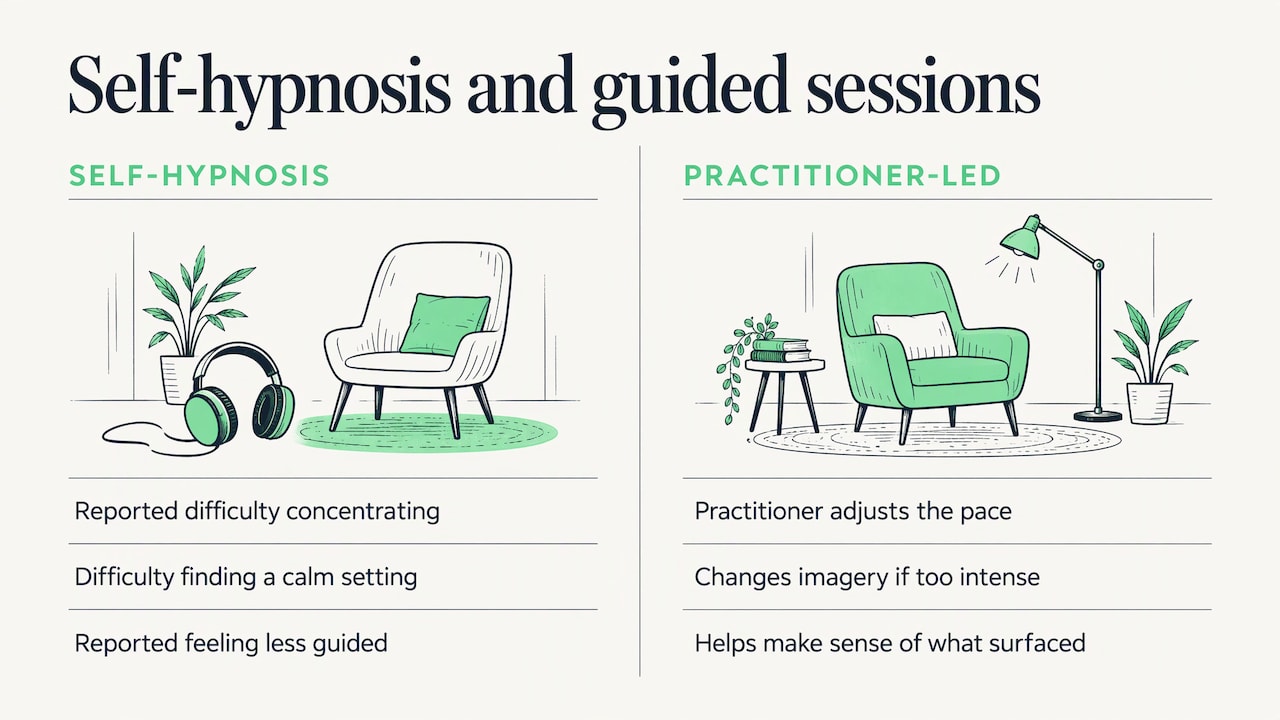
Self-hypnosis recordings and apps are widely used, and ASCH notes that some clinicians teach self-hypnosis to build independence and confidence, sometimes with recordings of clinician-guided sessions. Even so, a 2023 qualitative study of self-hypnosis found that participants reported difficulty concentrating, finding a calm setting, and feeling less guided than with recorded or therapist-led hypnosis.
That matters more with forgiveness than with, say, general relaxation. Emotional memories can surface unexpectedly. Having a practitioner who adjusts the pace, changes the imagery when something feels too intense, and helps you make sense of what came up is the difference between an exercise and a process. It is also why we build each plan around the person rather than a script.
Who forgiveness hypnosis can help
The themes show up in many parts of life, and the work looks different in each.
Individuals
Self-blame after a mistake, a divorce, a career setback, or a loss is the most common starting point. If your regret is tangled up with loss, our page on hypnosis for grief explains how sessions handle that. If low mood or anxiety has built up around old hurts, the hypnotherapy for depression page covers that side.
Couples
Resentment is one of the quietest threats to a relationship. Each partner can carry their own list of old grievances, and no apology seems to settle it. Sessions can help each person work on their own response so that conversations stop restarting the same fight. Our pages on relationship hypnosis and hypnotherapy for couples go deeper.
Families
Family hurts are long-running and often unspoken: a parent’s harsh words, a sibling’s betrayal, an estrangement. Forgiveness work here is often less about reconciliation than about no longer being controlled by the history. See family hypnosis for how this works with relatives.
Teams and performers
Resentment after a restructuring, a public mistake, or a lost game drains focus. Athletes and performers often replay a single error long after the event. Letting go of it is part of performing well, and it fits with our sports and performer hypnosis and our corporate and group work.
Starting safely, especially with painful memories
Forgiveness work can touch real pain. A few points keep it safe and productive.
- Choose a trained practitioner. The Academy of Applied Myofunctional Hypnosis recommends that medical hypnosis come from a licensed doctor or mental-health practitioner with an advanced degree and additional clinical-hypnosis training, and notes that people remain aware of their surroundings during hypnosis.
- Say what you are not ready for. You choose the goal and the pace. Starting with a smaller aim, such as less rumination at night, is a perfectly good plan.
- Memory is not erased. ASCH notes most people recall much of a hypnosis experience, and that a clinician may sometimes suggest non-recall when an experience could be traumatic or difficult to manage. That is a clinical decision made with you, not something done to you.
- Trauma and PTSD deserve extra care. If your hurt involves abuse, violence, or symptoms such as flashbacks, tell your practitioner at the start and keep your doctor or therapist informed. We offer hypnosis for trauma and PTSD and work to integrate hypnotherapy with traditional healthcare, as described in our page on combining hypnotherapy with traditional healthcare.
- If you are in crisis. If you are having thoughts of harming yourself, call or text 988, the Suicide and Crisis Lifeline in the United States, or call 911 in an emergency. Hypnosis is not a substitute for urgent care.
Making the work stick
A session can shift something, but forgiveness is also lived. This is where pairing hypnotherapy with life coaching earns its place. Typical follow-through might include:
- Noticing the situations that reopen the wound and planning how you will respond.
- Deciding what boundary, if any, you need with the person involved.
- Practicing the compassionate reframing the 2022 research points to, rather than replaying the offense.
- Choosing one small action that reflects who you want to be now, such as a letter you never send, a conversation you have, or a habit you start.
This is the part many people skip when they use a recording alone. A customized plan keeps the inner shift and the outer change moving together.
Work with MindShift Hypnosis
We combine personalized hypnotherapy with life coaching for individuals, couples, families, groups, and corporate teams, in person and online. Each plan is customized to your goal, whether that is forgiving yourself, putting down a resentment, or being able to move on from a regret. You can see everything we offer on our services page, or review hypnotherapy pricing before you book.
If you already know what you want to let go of, start with that one thing. A single clear goal is enough to begin.
Our perspective
Most people who come to us about forgiveness do not want a lecture on why they should let go. They have heard it. They want the feeling to change, and they have not been able to do that by trying harder.
We believe that is exactly where hypnosis and coaching work well together. Hypnotherapy works at the level of feeling and imagery, where the stuck part lives. Coaching then turns the shift into daily choices: the boundary you set, the conversation you have, the story you tell about your own past.
We build every plan around the person, not a script, because forgiving a parent is not the same work as forgiving yourself for a decision, and a couple’s resentment is not a team’s. Our approach is individualized, holistic, and delivered in a safe, supportive setting, with the pace set by you.
Forgiveness is not forgetting, and it is not approval. It is the freedom to carry your story without being carried by it.
Rachael
FAQ
Does forgiveness hypnosis make me forgive someone?
No. Hypnosis cannot be induced against your will, and ASCH stresses that it requires consent and willingness. A session works toward a goal you set, which may be less anger, less rumination, or readiness to move on, not a forced conclusion.
How many sessions does it take?
It depends on what you are carrying and what you want to change. A recent regret may need less time than a long-standing family wound. We customize the plan to your goal and review it as you go.
Can I do forgiveness hypnosis online?
Yes. We offer online services as well as in-person sessions. Online sessions work best in a quiet, private space where you will not be interrupted, which helps with the concentration challenges people report when practicing alone.
Is forgiveness hypnosis safe if I have trauma?
It can be approached carefully with the right support. Tell your practitioner about the trauma at the start, go at your own pace, and keep your doctor or therapist informed. Our trauma and PTSD work is designed to fit alongside traditional healthcare.
Do I have to forgive the person to move on?
Not necessarily. Many people find that letting go of the emotional charge matters more than any act of forgiveness. You decide what the end point looks like, including whether the relationship continues.
Sources
- ASCH, Questions and Answers on hypnosis
- Academy of Applied Myofunctional Hypnosis, For Clients
- Witvliet, Blank, and Gall, 2022, compassionate reappraisal and rumination
- Stress and Health, 2011, alternatives to simply forgiving and forgetting
- ERIC, Reed and Enright, 2006, effects of forgiveness therapy
- APA PsycNET, Lin et al., 2004, forgiveness therapy trial
- Eaton and Ferrari, 2020, heart rate variability and self-forgiveness
- Practicing self-hypnosis, 2023 qualitative study