Hypnosis can help with a fear of heights. In a session, a trained practitioner guides you into a deeply relaxed, focused state. Then they use suggestions and imagery to calm your body’s alarm response and change how you think about being up high. It is not a cure-all and it is not magic. It works best as one part of a plan that also includes gradual, real-world practice. Below, we explain how the process works, what a session feels like, how many sessions people typically plan for, and where the research is strong and where it is thinner.
TL;DR
- Fear of heights (acrophobia) is a specific phobia, not a character flaw, and it is treatable.
- Hypnosis may help you feel physically calm by picturing a comfortable place, then reframing how you see the feared situation, according to the Merck Manual.
- Exposure therapy has the strongest research base for specific phobias, and hypnosis can sit inside it as a relaxation tool.
- Plan on a short course. One session may be enough for a simple phobia, and three or four is a common average for hypnotherapy in general.
- Choose a trained, credentialed practitioner and stay in the driver’s seat: you remain in control throughout.
Table of Contents
- What a fear of heights actually is
- Why some people develop it
- How hypnosis works for a fear of heights
- What a session looks like
- How many sessions to plan for
- What the research says
- Hypnosis compared with exposure therapy and CBT
- Making hypnosis work: what you do between sessions
- Choosing a hypnotherapist for a phobia
- Work on your fear of heights with us
- Our perspective
- FAQ
- Sources
What a fear of heights actually is
Most people feel a little uneasy at a cliff edge or on a glass balcony. A phobia is different. People with acrophobia may fear that something bad, such as falling, will happen, and they feel a strong urge to get away from the high place, as Cleveland Clinic describes it. The fear is out of proportion to the actual risk, and it starts shaping your choices: skipping the observation deck, turning down a hotel room above the third floor, white-knuckling a parking garage ramp.
A 2020 peer-reviewed review in Frontiers in Neurology separates ordinary visual height intolerance from acrophobia. It also describes how anxiety drives the stiff, cautious movement and avoidance people show at heights. That matters for treatment, because anxiety is exactly what hypnosis targets.
Fear of heights is not the same as vertigo
People often say “vertigo” when they mean fear of heights. Vertigo is a strong sensation that you or your surroundings are moving when you are actually still. A patient guide from Brain & Spine Foundation notes that using the word for a fear of heights or falling is inaccurate. If you get true spinning or dizziness spells, including at ground level, see a physician first. That is a medical question, not a hypnosis question.
Why some people develop it
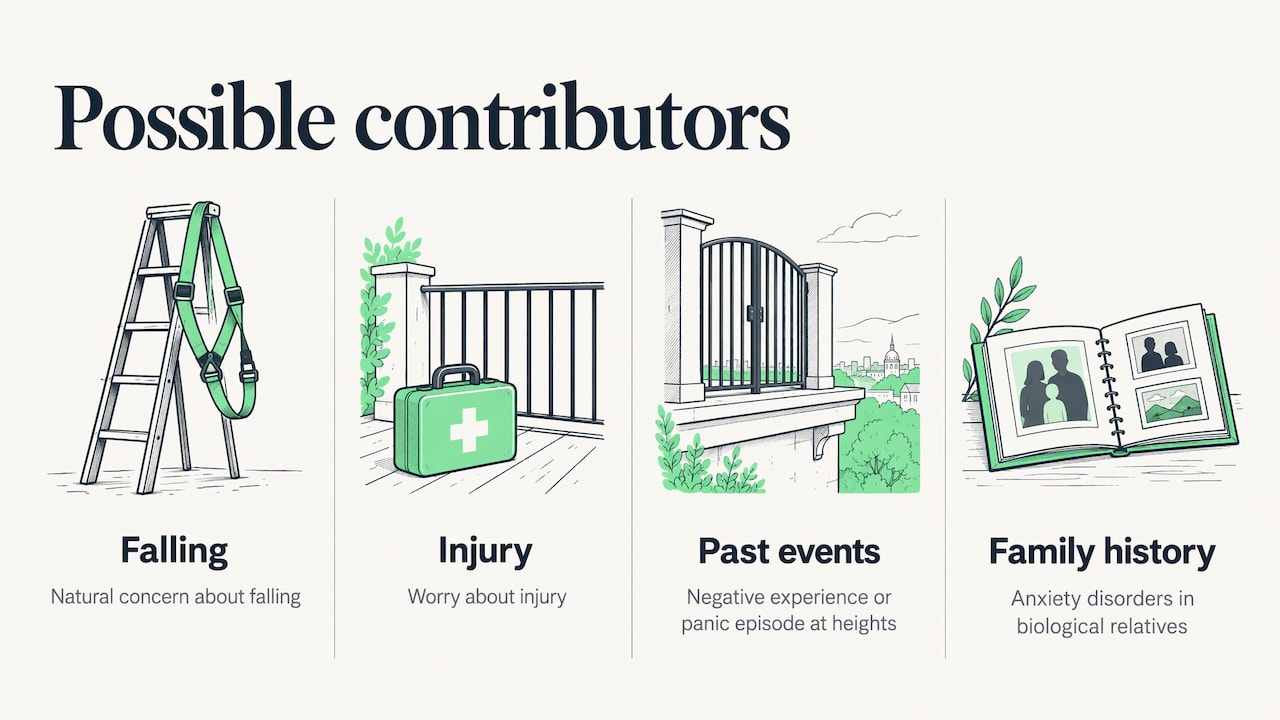
There is no single known cause. Cleveland Clinic lists several possible contributors: a natural concern about falling, worry about injury, a negative or traumatic experience involving heights, a panic episode in a high place, and a family history of anxiety disorders.
The National Institute of Mental Health classes fear of heights as a specific phobia. It says genetic and environmental factors can both play a part, including traumatic exposure, distress in new situations during childhood, and anxiety or other mental disorders in biological relatives.
In practice, this means two people with the same fear can have very different stories. One remembers a frightening moment on a ladder at age seven. Another cannot name a trigger at all. A good practitioner asks about your history because it shapes the suggestions and imagery used in your sessions. If the fear is tied to a distressing event, we may also look at that with our approach to trauma and PTSD.
How hypnosis works for a fear of heights
The APA Dictionary of Psychology defines hypnotherapy as the use of hypnosis in psychological treatment. It typically involves therapeutic suggestions from a trained professional after a hypnotic induction, and it has been applied with some success to some phobias.
The Merck Manual describes the mechanism for phobias in plain terms: hypnosis may help patients feel physically calm by visualizing a comfortable place, and then restructure how they view the feared situation. For heights, that usually means three moves:
- Calm the body first. Slow breathing and deep relaxation teach your nervous system that it can be at ease. Fear of heights shows up physically: tight chest, wobbly legs, sweaty palms.
- Rehearse the situation in your mind. While relaxed, you imagine standing on a balcony, a bridge, or a ladder, starting with the easiest version and building up.
- Reframe the meaning. Suggestions help replace “I will fall” with a steadier message, such as “I am safe and my body knows how to balance.”
The American Psychological Association’s 2024 overview says clinical hypnosis generally begins with induction and relaxation-focused prompts, followed by therapeutic suggestions. Stanford’s Afik Faerman, PhD, stressed that the client remains responsible for acting on the suggestions. Baylor’s Gary Elkins, PhD, noted that responsiveness varies from person to person, and lower responsiveness may call for more sessions or practice.
You stay in control
Hypnosis is not sleep and it is not mind control. Cleveland Clinic’s guide to hypnosis describes it as focused attention and relaxation using suggestions, and says the person remains in control. It also recommends working with a trained, credentialed clinician. If you want to know why some people respond less, we cover that in why hypnosis isn’t for everyone.
What a session looks like
Expect a conversation before anything else. You describe when the fear started, what situations set it off, and what you want to be able to do afterward: ride a glass elevator, hike a ridge trail, look over a railing with your kids beside you. Your practitioner uses that to build the plan.
Then the hypnosis itself. According to the Royal College of Psychiatrists, sessions usually involve sitting comfortably and listening to a therapist or a recording for anywhere from 10 to 90 minutes. Induction and relaxation come first, followed by suggestions and imagery, and you remain in control. Cleveland Clinic describes four stages: induction, deepening, suggestions, and emergence, with a typical session lasting about an hour.
A session for heights might feel like this:
- You settle into a chair and follow a guided relaxation until your breathing slows.
- You are guided to a place that feels safe and comfortable.
- You picture a low, easy height, then gradually higher ones, staying relaxed at each step.
- You receive suggestions about steadiness and confidence, then are brought back to full alertness.
- You get a short practice to use between sessions.
Most people describe it as pleasant, closer to a deep daydream than anything dramatic.
How many sessions to plan for
The Royal College of Psychiatrists says an average course of hypnotherapy is three or four sessions, sometimes up to 20, and that one session might be enough for a simple phobia. Cleveland Clinic similarly notes that several sessions may be needed, although some people notice changes after only a few.
Some practitioners advertise a single-session fix, and others sell long packages. Neither claim should be taken on faith. A fair rule of thumb: a focused fear of heights with a clear trigger often needs a short course, while a fear that is tangled up with panic attacks, past trauma or general anxiety may need more time. We build the plan around you, then adjust as we see how you respond.
What the research says
Here is the honest picture. Hypnotherapy has a long clinical history, and the APA Dictionary notes both that its clinical applications have drawn controversy and that there is some positive evidence for using it as an adjunct to other therapy. “Adjunct” is the key word: it works alongside other methods.
For heights specifically, the research is still developing:
- A registered trial, NCT06618456, was designed to test virtual-reality height exposure with and without trance induction, and to compare three sessions against one. Its status is listed as unknown, so we do not have results to lean on.
- A 2017 systematic review and meta-analysis of 16 acrophobia studies found that desensitization and in-vivo exposure worked in the short term. Longer-term follow-up for in-vivo exposure was not effective in that review, and desensitization had no follow-up data. The review shows why a plan should include practice and reinforcement, not just one appointment.
- A 2018 case series described two people with multiple specific phobias who were successfully treated with hypnotherapy combined with either virtual reality exposure or in-vivo exposure.
The takeaway: the best-supported use of hypnosis for a phobia is as a partner to graduated exposure, not a substitute for ever facing the height. That is how we use it.
Hypnosis compared with exposure therapy and CBT
The Merck Manual states that exposure therapy is the most extensively studied and most effective psychotherapy for specific phobias. It also says hypnosis may be used as a relaxation technique within exposure therapy, or to help patients visualize a comfortable place and restructure their view of the feared situation.
So these are not rivals. Think of it this way:
| Approach | What it does | Where hypnosis fits |
|---|---|---|
| Exposure therapy | Gradually and repeatedly faces the feared height in small steps | Hypnosis helps you stay relaxed during each step |
| Cognitive behavioral therapy | Examines and changes the thoughts behind the fear | Hypnotic suggestions can reinforce the new thinking |
| Hypnotherapy | Deep relaxation, imagery and suggestion | Works on the body’s alarm response and on your inner picture of the height |
If you have already tried talk therapy and felt stuck, or you simply respond well to imagery and relaxation, hypnosis may suit you. If your anxiety is severe, check in with your physician or a licensed mental health professional, and we are glad to work alongside them. See how we do that in combining hypnotherapy with traditional healthcare.
Making hypnosis work: what you do between sessions
Because you remain responsible for acting on suggestions, what you do afterward counts. These habits help people get more from a course:
- Practice the relaxation daily. Even five minutes of slow breathing builds the skill you will call on at a height.
- Build a ladder of heights. List situations from easiest (a second-floor window) to hardest (a mountain overlook) and move up one rung at a time.
- Go in rested. Hunger, caffeine and poor sleep make anxiety louder.
- Bring a supportive person early on. A friend beside you makes the first real-world steps easier.
- Track wins. Write down what you did, not just what scared you.
The same calming skills carry over to other worries. Our stress relief hypnosis page walks through a simple calming phrase you can try. If your anxiety runs wider than heights, or shifts with life stages such as perimenopause anxiety relief, it is worth talking with your physician too, since the right support may differ.
Choosing a hypnotherapist for a phobia
A few questions help you pick well:
- Training and credentials. Ask what training they have and what they are certified in. Cleveland Clinic recommends a trained, credentialed clinician.
- Their plan. Do they explain the steps, including how real-world practice fits in?
- Honest expectations. Be wary of guaranteed results or one-size-fits-all packages.
- Coordination. Are they comfortable working with your doctor or therapist?
- Format. In-person and online both work for many people, so pick what you will actually attend.
If your fear grows out of a wider pattern, our work on overcoming fears and phobias shows how we approach it. If the phobia involves another trigger, such as injections, see our needle phobia hypnosis page for a related practice.
Work on your fear of heights with us
MindShift Hypnosis combines personalized hypnotherapy with life coaching, so your sessions are built around the specific heights you want to feel comfortable with and the life you want to get back. We work with individuals in person and online, and the plan is tailored to you rather than a script. Look at our services to see which fit, or see our pricing page for current rates.
If you would like to talk through your situation first, start from the MindShift Hypnosis homepage and reach out. Tell us the one height you most want to conquer, and we will map out a first step.
Our perspective
We see the same pattern again and again with heights. The fear is rarely about the height itself. It is about what the body predicts will happen, and a body that has practiced calm learns to predict differently.
That is why we pair hypnotherapy with life coaching. Hypnosis helps the nervous system settle and gives the mind a new picture. Coaching and strategic planning turn that new picture into action: the first step onto a balcony, the first glass elevator, the family hike you had been avoiding.
We build every plan around the individual, and we respect that your doctor or therapist may be part of your care. Our aim is simple: you leave sessions feeling safe, supported and capable of doing the things you want to do.
Rachael
FAQ
Can you be hypnotized for fear of heights?
Yes, most people can experience hypnosis, though responsiveness varies. Research summarized by the APA notes that lower responsiveness may require more sessions or practice. A practitioner can tailor the approach to how you respond.
How many hypnosis sessions does a fear of heights take?
It depends on the person. The Royal College of Psychiatrists says an average hypnotherapy course is three or four sessions, and one session might be enough for a simple phobia. A fear linked to panic or past trauma may take longer.
What is the best way to get over a fear of heights?
Gradual exposure to heights is the most studied approach for specific phobias, according to the Merck Manual. Hypnosis can help you stay relaxed during that process and change how you picture the situation. A licensed professional can help you build a plan.
Is fear of heights the same as vertigo?
No. Vertigo is a sensation of movement while you are still, and it is a medical symptom. Fear of heights is an anxiety response to being up high. If you have dizziness spells, see your physician.
Sources
- Acrophobia (Fear of Heights): Symptoms & Treatment, Cleveland Clinic
- Acrophobia and visual height intolerance, Frontiers in Neurology
- Dizziness and Balance Problems, Brain & Spine Foundation
- Phobias and Phobia-Related Disorders, National Institute of Mental Health
- Specific Phobias, Merck Manual Professional Version
- Hypnotherapy, APA Dictionary of Psychology
- Uncovering the new science of clinical hypnosis, APA Monitor
- Hypnosis: What It Is, How It Works, Benefits & Risks, Cleveland Clinic
- Hypnosis and hypnotherapy, Royal College of Psychiatrists
- Hypnosis Induction and Height Experience in VR, ClinicalTrials.gov NCT06618456
- A systematic review and meta-analysis of treatments for acrophobia, Medical Journal of Australia
- Integrating Hypnosis with Other Therapies for Treating Specific Phobias, PubMed
- Perimenopause anxiety relief: what helps and what the evidence says