Couples communication coaching is a structured, goal-driven way for two partners to learn how to listen, say what they need and handle disagreements without the usual damage. A coach guides the work, gives you specific skills and keeps you practicing between sessions. At MindShift Hypnosis we pair that coaching with personalized hypnotherapy, so the new habits are built in the conversation and in the calm, focused state that makes them easier to keep when tension rises.
TL;DR
- Coaching is built for couples who want to change how they talk: listening, asking, disagreeing and repairing after a fight.
- Research on couple relationship education found significant benefits in nearly all of 34 rigorous studies reviewed, including effects on mental health and parenting.
- Skills come from practice, not insight alone: short, scheduled drills, ordered from easy topics to hard ones.
- Our approach combines life coaching with hypnotherapy and a customized plan for each couple, in person or online.
- If anyone in the relationship feels unsafe, the first call is a domestic violence hotline, not a coaching session.
Table of Contents
- What couples communication coaching actually is
- What the research says about learning these skills
- The three pillars of a good communication program
- How a coaching engagement unfolds
- Exercises you can start this week
- What a coach adds that a handout cannot
- Who benefits most
- Coaching, hypnotherapy and when you need more support
- Our perspective
- Starting with MindShift
- FAQ
- Sources
What couples communication coaching actually is
Most couples do not lack love or good intentions. They lack a reliable method for the moments that go wrong: the sharp tone at 6 p.m., the conversation about money that turns into an old grievance, the silence that follows. Coaching treats these moments as skills problems. You name a goal, learn a technique, try it at home, and bring back what happened.
A session is forward-looking. The questions are “What do you want to be different?” and “What will you do the next time this comes up?” rather than a long review of where each pattern began. That is why it suits couples who are motivated to change, who can sit in the same room (or the same video call) and who want practical tools.
The work usually covers four areas:
- Listening: hearing a partner out before responding.
- Expressing needs: saying what you want without blame.
- Managing conflict: slowing a heated moment down.
- Reconnecting: building the friendship and warmth that make hard talks easier.
What the research says about learning these skills
Coaching for couples is not one single research program, but it draws on the same skills taught in relationship education, and that field has strong evidence behind it. A 2021 review of 34 rigorous couple relationship education studies from 2010 to 2019 found that nearly all showed significant treatment effects. The benefits reached past relationship quality to physical and mental health, coparenting and children’s well-being.
Two findings from that body of work stand out for ordinary couples:
- In a randomized trial of 662 Army couples, the group that took the skills program had an 8% divorce rate at 24 months, against 15% in the control group, according to the same review.
- In a 2020 trial of 742 low-income couples, two web-based programs produced significantly greater improvement than no program in all five relationship areas measured, and the gains held four months after treatment. One program also reduced conflict more than the control condition.
The lesson is that guided, structured skill-building works, and that it works even when it is delivered remotely. That second point matters if you are weighing online sessions against driving across town.
The three pillars of a good communication program
The 2021 review notes that most research-based curricula rest on three core pillars. Good coaching touches all three.
1. Managing negative emotion during conflict. This means behavioral skills such as taking a time-out and using a speaker-listener technique, where one person talks and the other reflects back before swapping roles.
2. Building positive connection. Friendship, fun and physical affection protect a relationship, so they are part of the work and not a reward for finishing it.
3. Strengthening commitment. Couples learn to put the relationship first in practice and to picture a shared future.
A program that only teaches you to “say it nicely” skips two thirds of what the evidence supports.
How a coaching engagement unfolds
The shape varies, but a sound engagement follows this arc.
Step 1: Set goals you can observe
Vague goals (“communicate better”) are hard to coach. Useful goals describe behavior: “We finish a disagreement within 30 minutes without raising our voices,” or “Each of us asks one real question about the other’s day.” Commitment and goal-setting are treated as the foundation of change in behavioral couple work. One cognitive-behavioral workbook study devotes its first two sessions to motivation, commitment and goals before any exercise begins.
Where it goes wrong: partners arrive with different goals, or one wants the other to be fixed. A coach’s early job is to turn “you need to change” into a shared aim you both own. In our sessions, each partner’s needs shape the customized plan, so you are not forced into a generic script.
Step 2: Map your patterns
Before changing anything, you identify the loop you are in. Common ones include one partner pursuing and the other pulling away, or both escalating. Seeing the loop as the problem, not the person, lowers defensiveness quickly.
Where it goes wrong: couples try to argue about who started it. The point of mapping is to see the sequence, not to assign blame.
Step 3: Learn the core skills
Listening comes first because nothing else works without it. The American Psychological Association’s Effective Listening handout lists four strategies:
- Body language: face the speaker, keep eye contact and nod.
- No interrupting: jot your thought on paper so you can let it go for now.
- Summarize: say back what you heard.
- Reflect: name the key thoughts and feelings to confirm you understood.
Then comes expression. State what you feel and what you would like, in specific terms, about one issue at a time.
Step 4: Practice between sessions
Skills fade without repetition. The APA’s Communication Practice Plan asks couples to schedule speaking and listening practice for a set number of minutes each week at a set time of day, and to work through topics from least to most difficult. Its stated aim is to improve how you discuss hard issues, not to settle them on the spot.
That last point frees couples. You are allowed to practice on the dishwasher before you attempt the in-laws.
Where it goes wrong: practicing only when you are already upset. Calm, scheduled practice is what makes the skill available during a real fight. This is where our hypnotherapy component fits: it is designed to help clients rehearse calm, focused responses so they come more naturally under pressure.
Step 5: Review, adjust and keep going
Each session starts with what happened since the last one: what worked, where you slipped, what to change. Progress is measured against the goals from step 1.
Exercises you can start this week
These come from published, research-based handouts and are the same building blocks a coach will use with you.
The listening round
Pick a low-stakes topic. One partner speaks for two or three minutes. The other uses the four listening strategies above and then summarizes. Swap. Do not respond with your own view until the summary is confirmed as accurate.
The three-step problem-solving talk
The APA’s Problem-Solving Guidelines for Couples give a clear structure:
- Define the problem. Agree on a time and place. Partner A describes the issue in specific behavioral terms, Partner B summarizes it, and together you write a brief agreed statement.
- Identify a solution. Brainstorm, weigh pros and cons, compromise where needed, and write down who does what, when and in which situations.
- Evaluate it. Try the plan for an agreed period, then adjust using the same steps.
A simple comparison of the two exercises
| Exercise | Best for | Time | Main skill |
|---|---|---|---|
| Listening round | Everyday friction, feeling unheard | 10 to 15 minutes | Listening and reflecting |
| Three-step problem solving | Recurring practical issues (chores, schedules, money) | 30 to 45 minutes | Defining and agreeing on specifics |
Start with the listening round for a week before moving on to the problem-solving talk.
What a coach adds that a handout cannot
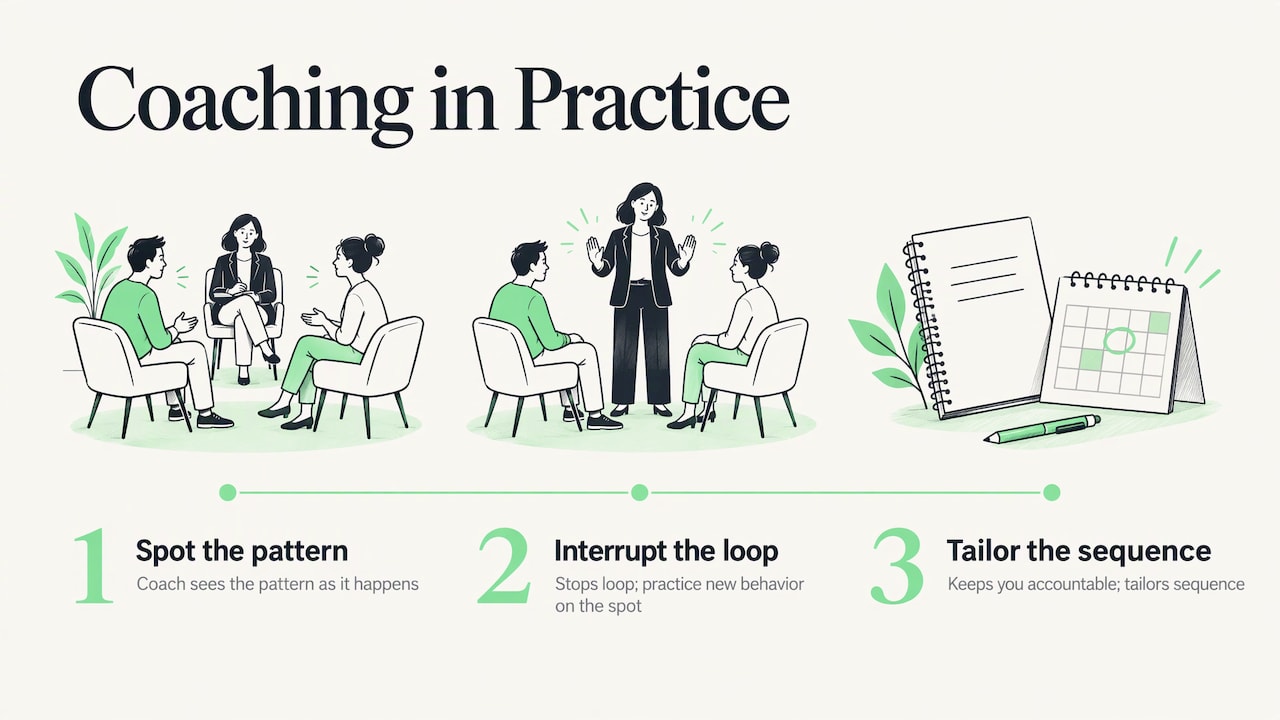
You can read every handout and still fall back into the old loop, because the loop is automatic and a partner in the middle of it is a poor observer. A coach sees the pattern as it happens, stops it, and has you try the new behavior on the spot. The coach also keeps you accountable and tailors the sequence to your relationship.
Structured programs build this in. The OurRelationship program, described in a peer-reviewed overview, has partners work through online activities separately, meet for a key conversation at the end of each of three phases (Observe, Understand, Respond), and talk with a coach in up to four short scripted calls. Guidance, structure and a human voice are the ingredients, and they are the ones we bring to couples working with us.
Who benefits most
Communication coaching fits couples who:
- keep having the same argument with new details;
- feel more like roommates or co-managers than partners;
- are preparing for a big change such as marriage, a move, a baby or a blended family;
- want to rebuild after a rough season and are both willing to try;
- are separated parents who need to talk about their children without conflict. Our co-parenting coaching guide has scripts for that situation.
If one partner wants to join but the other is hesitant, individual sessions can still help, because changing your own side of a loop changes the loop. Our page on relationship hypnosis for couples and individuals explains how.
Coaching, hypnotherapy and when you need more support
Coaching focuses on skills and goals. Therapy is clinical care for diagnosable conditions. Hypnotherapy sits alongside both as a way to build calm and focus. We offer personalized hypnotherapy and life coaching for couples, and our approach includes working with traditional healthcare where a client has a clinician involved. You can read how in our page on combining hypnotherapy with traditional healthcare.
Two situations call for particular care, and we want you to have what you need:
- Safety. If you are afraid of your partner, or there has been physical or emotional abuse, contact the National Domestic Violence Hotline, which is free, confidential and open 24/7 at 1-800-799-7233. Do this before any couples work, because communication exercises assume both people are safe.
- Crisis. If you or your partner are thinking of suicide, call or text 988 in the US right away.
Depression, anxiety and past trauma often show up in relationships too. We have dedicated pages on hypnotherapy for depression, life coaching for anxiety and hypnosis for trauma and PTSD, and they can be combined with couples work when that serves the plan.
Our perspective
Couples rarely come to us because they stopped caring. They come because every conversation seems to start from the worst assumption about the other person, and neither can find the way out.
We believe change sticks when it reaches two levels at once. The first is the practical level: the listening, the clear asks, the agreed time-outs. The second is the felt level: the tight chest, the racing thoughts and the old story that fires in half a second. Coaching handles the first very well. Hypnotherapy is a way of working with the second, helping you stay settled enough to use what you learned.
That is why we combine the two and build a plan around the people in the room, not a template. Your history, your goals and your pace set the sequence. We want you to leave a session with something specific to try on Tuesday, and the calm to try it.
Rachael
Starting with MindShift
We offer life coaching, hypnotherapy and combined hypnosis life coaching for couples, individuals, families and groups, in person and online. Our relationship services are built around customized plans, so the first conversation is about what you want to be different and how we can get you there. See the couples hypnotherapy page for what the work looks like, and the pricing page for current session details.
When you are ready, choose the service that fits on our services page and book your first session.
FAQ
How is couples communication coaching different from couples therapy?
Coaching is practical and goal-based: you learn specific skills, practice them and review progress. Therapy is clinical care that diagnoses and treats mental health conditions. Many couples start with coaching because they want better tools, not treatment.
How many sessions does it take?
It depends on your goals and how consistently you practice. Structured programs in the research are short: one widely studied online program is about eight hours across three phases, with up to four brief coach calls, according to its published description. We build a customized plan with you, so the pace is set around your situation.
Can we do it online?
Yes. A 2020 trial of web-based programs found significant improvements in couples’ relationships that lasted four months. We offer both online and in-person sessions.
What if only one of us wants to do it?
You can begin on your own. Learning to listen differently and state your needs clearly changes how your partner responds, and many partners join once they see the difference at home.
Does it work for separated or divorced parents?
The same skills apply. Clear listening, specific requests and scripted wording help when the topic is a child’s schedule or expenses. Our co-parenting coaching page offers scripts you can use this week.
Sources
- Helping couples achieve relationship success: a decade of couple relationship education research (2021 review)
- Journal of Consulting and Clinical Psychology, 2020: web-based programs for low-income couples
- Integrative Behavioral Couple Therapy, PMC
- APA Integrated Behavioral Health in Primary Care, 3rd edition: relationship handouts
- A feasibility study of a cognitive-behavioral couples intervention, Pacific University
- National Domestic Violence Hotline