Hypnosis can reduce stress, and a 2026 meta-analysis of randomized trials found large effects on stress. Try this now: sit comfortably, breathe slowly, relax your body from head to toe, and repeat one calming phrase. For deeper, longer-term relief, guided audio or sessions with a professional can build on that first reset.
TL;DR:
- A 2026 review found large stress effects (Hedges’ g = 0.75–0.90), while a group program lasting five weeks reduced perceived stress at weeks five and twelve.
- App sessions showed lower stress ratings across the first ten sessions, but the retrospective analysis cannot establish that hypnosis caused the change.
- Longer, interactive sessions tended to outperform short, passive clips, and repeated practice helps build a relaxation response that arrives faster.
- People with psychosis, poorly managed bipolar disorder, suicidal thoughts, or severe dissociation should consult a licensed mental health professional before practicing alone.
Table of Contents
- How does hypnosis reduce stress in your body and mind?
- What does the research say about hypnosis for stress?
- How do you do self-hypnosis for stress, step by step?
- How do you choose a good guided hypnosis audio or app?
- How do you build a stress relief hypnosis practice?
- Is self-hypnosis safe, and when should you see a licensed clinician?
- How can you tailor hypnosis scripts to your type of stress?
- How does hypnosis work together with life coaching for stress?
- How does hypnosis fit with mindfulness, CBT, and other stress tools?
- Why personalization changes what hypnosis can do for stress
- Book a personalized stress relief session with us
- FAQ
- Sources
How does hypnosis reduce stress in your body and mind?
Hypnosis is a relaxed, focused state of awareness. Mayo Clinic describes it as a changed state of awareness with increased relaxation that can help manage behaviors, anxiety, and pain. You are not asleep, and you are not under anyone’s control. You stay aware of where you are and can end a session whenever you choose.
What you feel in this reset has a physical side. Slow breathing and absorbed attention nudge the body away from its “fight or flight” mode and toward its recovery mode. In a controlled study of stressed medical students, a single personalized hypnosis session was linked to greater parasympathetic recovery, measured through heart rate variability, and to changes in electrodermal activity, a measure of the skin’s response to arousal.
Here is what typically happens in a session:
- Induction: you settle your body and narrow your attention, often with breathing or muscle relaxation.
- Deepening: you let the relaxation grow, often by counting down or picturing a calm place.
- Suggestion and imagery: you hear or say short, positive statements while picturing a scene that feels safe.
- Reorientation: you return to normal alertness, usually by counting up.
- Reflection: you notice what shifted, even if it was small.
Repetition matters too. Clinical guidance compares hypnosis to exercise: just as training builds muscle strength, regular practice trains a relaxation response that arrives faster each time.
A sourced figure worth knowing: in that same medical-student study, a single session significantly improved executive function while lowering stress and anxiety compared with the control condition. Calmer physiology and sharper thinking showed up together.
What does the research say about hypnosis for stress?
The evidence comes from several directions, which is what makes it credible. No single study settles the question, but together they point the same way.
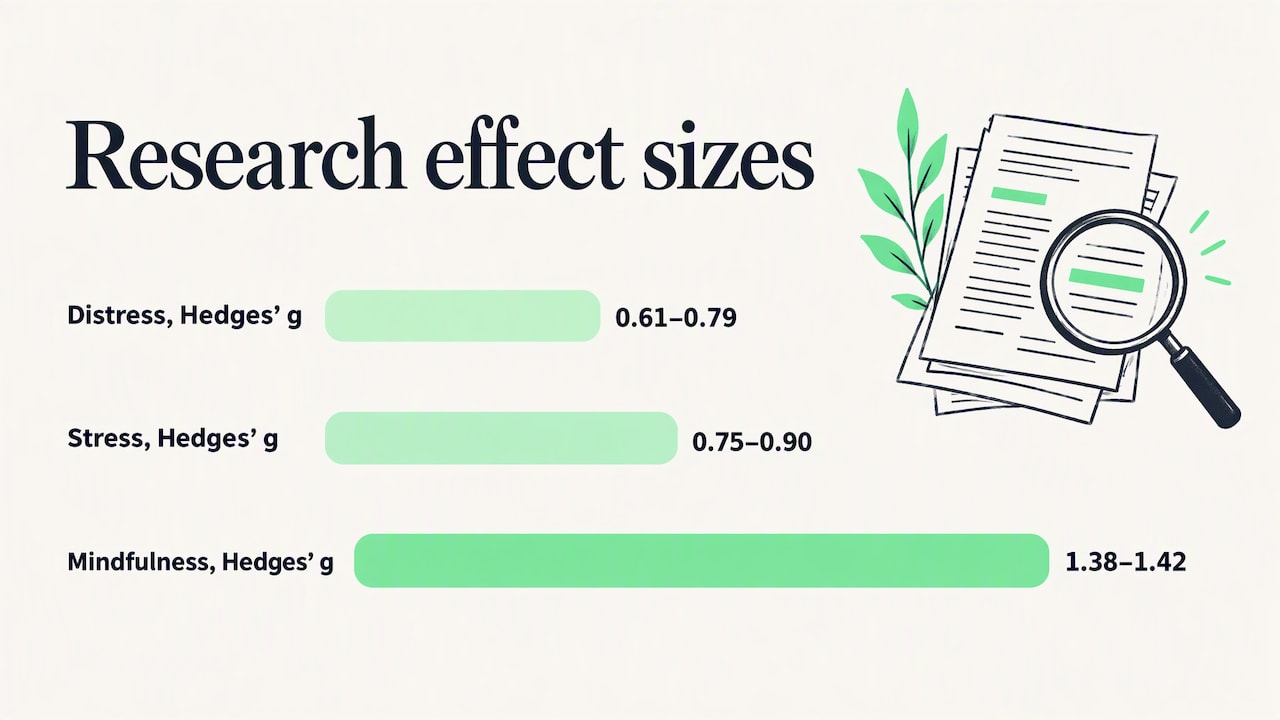
Meta-analysis. A 2026 systematic review and meta-analysis of randomized controlled trials found large effects for mindful hypnotherapy on psychological distress (Hedges’ g = 0.61–0.79) and on stress (Hedges’ g = 0.75–0.90). It also found consistent increases in mindfulness (Hedges’ g = 1.38–1.42). Effect sizes at this level are rarely seen for stress interventions.
Group trial. In a multicenter randomized controlled trial, a five-week hypnotherapeutic group program reduced perceived stress after 5 and 12 weeks compared with an educational booklet. People in the program also improved on depression, self-efficacy, and mental quality of life.
Single-session trial. The medical student study showed that one personalized session improved stress regulation, executive function, and physiological markers including heart rate variability and electrodermal activity.
Large app data. A retrospective analysis of app-delivered self-hypnosis covered 84,395 users and 282,893 sessions. Self-rated stress dropped from before to after sessions across the first ten sessions (Cohen’s d about -0.71 to -0.78). Interactive, regular-length sessions and paying members showed larger effects.
Key takeaways from these studies:
- Group programs, single sessions, and app sessions all showed stress benefits in the studies above.
- Interactive and full-length formats tended to outperform short, passive ones in the app data.
- Teaching hypnosis as a skill matters: systematic reviews of self-hypnosis report medium-to-large effects, and trials suggest it works best when practiced as a skill rather than delivered only as passive recordings.
What the data does not tell us. App evidence is mixed. In a randomized trial of a self-hypnotic relaxation app, both the active app and a placebo app reduced anxiety and pain in some settings, which shows how hard it is to design a fair control. Many commercial apps have never been rigorously tested. The app study above is retrospective, so it cannot prove cause and effect. Treat the research as encouraging, not as a promise.
In plain terms: the strongest, most consistent findings favor structured, practiced hypnosis. The weakest evidence belongs to casual, one-off, passive clips.
How do you do self-hypnosis for stress, step by step?
Start with a quick safety check, then choose the five-minute reset or the full practice.
Before you begin
- Find a quiet place where you will not be interrupted.
- Sit or lie down comfortably. Headphones help if you are using audio.
- Never practice while driving or doing anything that needs alertness.
- Decide on one calming phrase, such as “I can slow down and breathe.”
The quick reset
- Close your eyes and take five slow breaths, making each exhale longer than the inhale.
- Scan your body from forehead to toes, letting each area soften as you pass it.
- Silently repeat your calming phrase three times, picturing a place where you feel safe.
- Count from one to five, telling yourself you will return alert and refreshed.
- Open your eyes, stretch, and notice how your body feels.
The 15–20 minute full practice
- Settle in. Take ten slow breaths and let your eyes close.
- Induction by progressive muscle relaxation. Tense each muscle group for five seconds, then release, moving from your feet up to your face.
- Deepen with grounding imagery. Picture a staircase of ten steps and sink a little deeper with each step down, arriving somewhere that feels warm and secure.
- Stress reappraisal. Tell yourself: “This pressure is a signal, not a threat. I can respond calmly.”
- Resource anchoring. Recall a time you felt capable and calm. Press your thumb and forefinger together as you relive it.
- Cued relaxation. Tell yourself that pressing those fingers together later will bring back this calm.
- Reorient. Count up from one to ten, feeling energy return with each number.
- Reflect. Write down your stress level from 1 to 10 and one thing you noticed.
Pro Tip: Rate your stress before and after every session. A written number turns a vague feeling into progress you can see.
Variations. If you are short on time, do only steps one, three, and seven of the full practice. For nighttime use, skip the counting up at the end and let yourself drift into sleep.
How do you choose a good guided hypnosis audio or app?
Quality varies enormously, and the research shows why that matters. Use this checklist before you commit time to a program:
- Evidence base: look for a program that points to trials or published research on its methods.
- Length: full-length sessions tend to outperform very short clips in the large app analysis.
- Interactivity: formats that ask you to respond or tailor content showed larger effects.
- Clinician involvement: content designed or reviewed by a trained hypnotherapist is a good sign.
- Clear structure: a good session moves from induction to therapeutic suggestions to a proper emergence.
Using audio well
- Use stereo headphones, which clinical practice notes recommend for audio-based hypnosis because they create an immersive sound environment.
- Pick a regular time of day and stick with it.
- Follow a series rather than a one-off track, since skill builds with repetition.
- Prefer interactive or clinician-led formats when you can.
Red flags
- Claims that a recording will “cure” anxiety or any condition.
- Very short, passive clips marketed as “clinical hypnosis.”
- No recognizable structure, such as a missing wake-up or emergence.
Pro Tip: Try a new program for a while before judging it. Your stress ratings before and after each session will tell you whether it earns a place in your routine.
How do you build a stress relief hypnosis practice?
A habit works better than an occasional session. Pick the schedule that fits your life: a daily brief reset plus longer sessions, or a daily practice.
Track four things: a stress rating before and after each session, your sleep quality, your general mood, and any change in focus or work performance. A simple notebook is enough.
Here is a template to follow:
- Start by learning the routine. Do a brief reset regularly. Expect small shifts, since first improvements often appear within days.
- Week 2: add depth. Keep the daily reset and add two full practices of 15–20 minutes.
- Use it in real moments. Practice the finger-anchor cue before a meeting or a hard conversation, then log how it went.
- Review and adjust. Compare your ratings over time. Keep what works and drop what does not.
Durable change usually comes with consistent practice, not a single great session. If your ratings stay flat over time, that is useful information, and it is a good moment to consider tailored support.
Is self-hypnosis safe, and when should you see a licensed clinician?
For most people, hypnosis is generally safe, and you remain in control throughout. Mayo Clinic notes that hypnosis is usually used alongside other treatments, such as cognitive behavioral therapy (CBT), not as a standalone cure.
Talk with a licensed mental health professional first if you have any of the following:
- A history of psychosis
- Bipolar disorder that is not well managed
- Active thoughts of suicide
- Severe dissociation
Clinical guidance also cautions against using self-hypnosis alone to process deep trauma without a licensed clinician. If you are already in treatment, hypnosis can often be combined with CBT, medication, or trauma-focused therapy. We cover how hypnotherapy fits alongside traditional healthcare on our site, and your doctor should know about anything you add to your plan.
How can you tailor hypnosis scripts to your type of stress?
A generic script treats all stress the same. In practice, the source of your stress shapes which suggestions help.
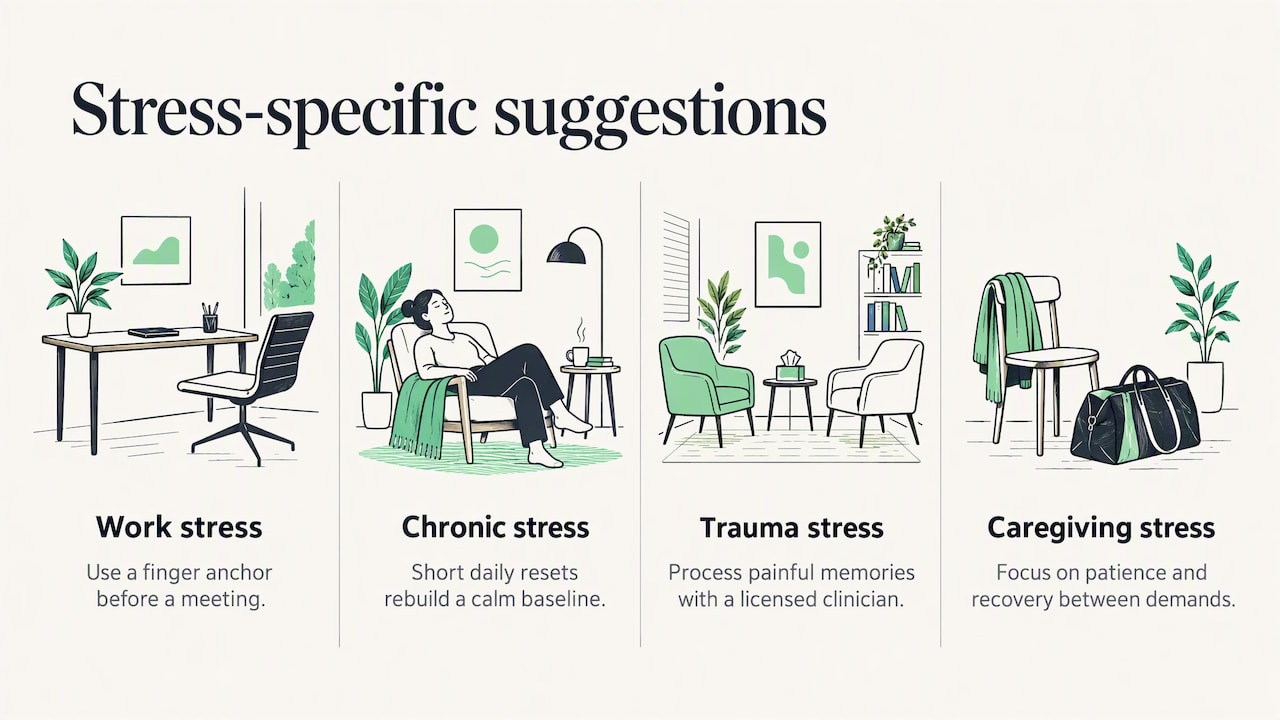
Work stress. Pressure, deadlines, and difficult colleagues respond well to suggestions about pacing and boundaries. Try imagery of a clear desk and a steady breath, and use the finger anchor just before a meeting. Reappraisal fits here: “This demand is a challenge I can handle one step at a time.”
Chronic stress. When stress has become the background of daily life, the aim is to rebuild a baseline of calm. Short daily resets matter more than occasional long sessions, and suggestions focus on rest, sleep, and permission to slow down.
Trauma-related stress. This is the type where self-guided scripts have the clearest limits. Gentle grounding and safe-place imagery can help, but processing painful memories should happen with a licensed clinician, as noted above. A trained professional can pace the work and watch how you respond.
Parenting or caregiving stress. Scripts can focus on patience, recovery between demands, and self-compassion, with imagery of setting down a heavy load for a few minutes.
Whatever the source, the best suggestions use your own words, your own triggers, and images that mean something to you. That is the main reason many people eventually outgrow generic audio.
How does hypnosis work together with life coaching for stress?
Hypnosis helps you feel calmer. Coaching helps you change what keeps triggering the stress. The two fit together naturally.
In a hypnosis session, your mind is relaxed and open to new ways of seeing a situation. Coaching adds structure to that openness: clarifying what you want, spotting the patterns that drain you, and turning insight into specific actions.
Here is how that can look in practice. A client who feels stretched thin might use hypnosis to practice staying calm when a request arrives, then use coaching to decide which requests deserve a yes. The relaxed state makes the new response feel natural, and the coaching plan gives that response somewhere to go.
Coaching also keeps momentum between sessions. Setting small weekly goals, reviewing your stress ratings, and adjusting your plan are coaching habits that make self-hypnosis practice stick. This blend of hypnotherapy and coaching is the core of our approach, and our services overview lays out how the two can be combined for individuals, couples, families, and teams.
How does hypnosis fit with mindfulness, CBT, and other stress tools?
Hypnosis rarely works in isolation, and it does not need to. It tends to strengthen other methods.
Mindfulness. Both build attention and calm, and the meta-analysis above found large increases in mindfulness alongside reduced stress in mindful hypnotherapy. If you already meditate, hypnosis can add focused suggestion to the awareness you have built. A short guided video such as this mindfulness practice pairs well with a self-hypnosis routine.
CBT. Cognitive behavioral therapy changes the thoughts and behaviors that fuel stress. Hypnosis can rehearse those new thoughts in a relaxed state, so they feel familiar when pressure rises. Mayo Clinic notes that hypnosis is often used alongside approaches like CBT.
Daily basics. Sleep, movement, and time away from screens all lower the baseline of stress your hypnosis practice has to work against. If you want to explore related relief for worry, see our page on hypnotherapy for anxiety.
Think of it as a toolkit. Hypnosis is the tool that helps the others become automatic.
Why personalization changes what hypnosis can do for stress
I focus on tailoring sessions to each person’s stressors. Stress has a specific shape for each person, and suggestions work best when they match it. For example, suggestions can be tailored to a stressful moment, such as opening an email. Tracking stress ratings can help you compare your experience over time. If you have practiced steadily and your progress has plateaued, that is a good time to consider a session built around your own triggers.
— Rachael
Book a personalized stress relief session with us
When a self-hypnosis routine is not enough, we offer a personalized next step. Our relevant services include:
- Hypnosis Only: focused hypnotherapy sessions for stress and anxiety
- Hypnosis Life Coaching: hypnosis combined with coaching for practical, lasting change
- Online Services: the same personalized support, delivered remotely
Booking a professional makes the most sense if your stress feels complex, you have a trauma history, or you want scripts written around your own triggers. See our services page for details, and ask us for pricing or check our pricing page. Reach out today to book your first session and start with a plan built around you.
This article is general information, not a substitute for advice from a qualified doctor. Consult a qualified healthcare professional about your own circumstances before acting on anything here.
FAQ
Can being hypnotized help anxiety?
Yes, it can help for many people. Mayo Clinic says hypnosis can help manage anxiety and is usually used alongside other treatments. Results vary by person, so it works best as part of a broader plan.
What hypnotherapy techniques can help with anxiety?
Common techniques include progressive muscle relaxation, slow-breathing inductions, safe-place imagery, and calming suggestions with a cue you can use later. Interactive, structured sessions showed larger effects in the large app-based analysis. A trained hypnotherapist can adapt these to your triggers.
Can hypnosis help with anxiety and depression?
It may help with some symptoms of both. In a multicenter randomized trial, a hypnotherapeutic group program improved perceived stress and also showed secondary improvements in depression. Anyone with depression should work with a licensed professional.
What drink calms anxiety?
We cannot point to research on a specific drink in this guide. Warm, caffeine-free drinks can make a relaxing pause easier, and cutting back on caffeine often helps. If anxiety is persistent, talk with a healthcare provider.
Sources
- Pubmed
- Hypnosis reshapes multilevel stress response and enhances executive performance in stressed medical students – PMC
- Hypnosis – Mayo Clinic