Emotional intelligence coaching trains the awareness and regulation skills that improve relationships, leadership, and job performance. It helps leaders, managers, and anyone caught in recurring conflict build self-awareness, steadier emotion regulation, sharper empathy, and better social skills on the job and at home. The approach is grounded in research showing emotional intelligence is trainable, with meta-analytic evidence linking it to measurable performance gains.
TL;DR:
- A coach should establish a baseline, set one or two behavioral goals, and assign real world practice, such as pausing before responding in tense meetings.
- Choose a coach who uses behavior based 360 feedback and concrete examples from colleagues; observer ratings reveal workplace changes better than self reports alone.
- Research links emotional intelligence with job performance at correlations of 0.24 to 0.30, while training typically produces moderate gains, not personality overhauls.
- Programs commonly meet weekly or biweekly for three to six months, and follow up assessments can check whether behavior changes persist.
- Choose coaching for skill building, but seek a licensed mental health provider when trauma, depression, or anxiety disrupts daily functioning; combined care may be appropriate.
Table of Contents
- Top signs you may need emotional intelligence coaching
- How coaching develops emotional intelligence skills
- Assessments and metrics used in EI coaching
- Coaching methods, session formats, and program scope
- Evidence and expected outcomes from EI training
- How to choose an emotional intelligence coach or program
- MindShift Hypnosis: our integrated approach to developing emotional intelligence
- Customizing coaching plans around individual mental health needs
- Strategies for sustaining emotional intelligence improvements
- Coaching outcomes across relationships and corporate settings
- Trauma recovery and anxiety management within EI coaching
- Practitioner perspective: realistic timelines matter more than quick wins
- Services and next steps at MindShift Hypnosis
- FAQ
- Sources
Top signs you may need emotional intelligence coaching
Certain patterns show up again and again before people seek coaching. Recognizing them early makes the work faster and less frustrating.
- You react strongly before you’ve had time to think, then regret the tone or words you used.
- Conflicts with the same person or team keep recurring despite repeated conversations about it.
- Feedback from a manager or partner lands as an attack rather than useful information.
- You struggle to read what a colleague or family member is actually feeling, even when it seems obvious to others.
- Leading a team through change feels harder than the technical parts of the job ever did.
A workplace example: a manager who dreads performance reviews because employees leave in tears, even when the message was fair, often has a delivery and empathy gap that coaching directly addresses. A personal example: a partner who shuts down during disagreements instead of engaging is often avoiding emotional overwhelm rather than being indifferent.
Coaching is the right fit for skill-building and performance goals. When reactivity, low mood, or conflict stem from trauma, clinical depression, or anxiety that interferes with daily functioning, a referral to therapy or a combined care approach is the more appropriate first step.
How coaching develops emotional intelligence skills
Coaching works through repeated cycles of assessment, goal setting, and deliberate practice rather than one conversation that changes everything. A coach typically starts with a baseline assessment, sets one or two specific behavioral goals, then has the client practice a new response in real situations between sessions.
Common tools include behavioral experiments (“pause for three breaths before responding in your next tense meeting”), reflective journaling to spot triggers, role-play to rehearse difficult conversations, and body-based awareness practices that help clients notice physical signs of rising emotion before they escalate.
This works because emotional and behavioral patterns are not fixed. Skill change relies on neuroplasticity: the brain’s capacity to form new patterns through consistent, focused repetition. A client working on patience during conflict might practice a two-minute pause technique daily, then debrief what happened with their coach the following week, gradually making the response automatic rather than effortful.
Assessments and metrics used in EI coaching
Coaches draw on three main types of measurement. Ability-based tests assess how well someone actually solves emotion-related problems. Self-report inventories capture how people perceive their own emotional skills. Multisource or 360 assessments gather observer ratings from colleagues, direct reports, or family members.
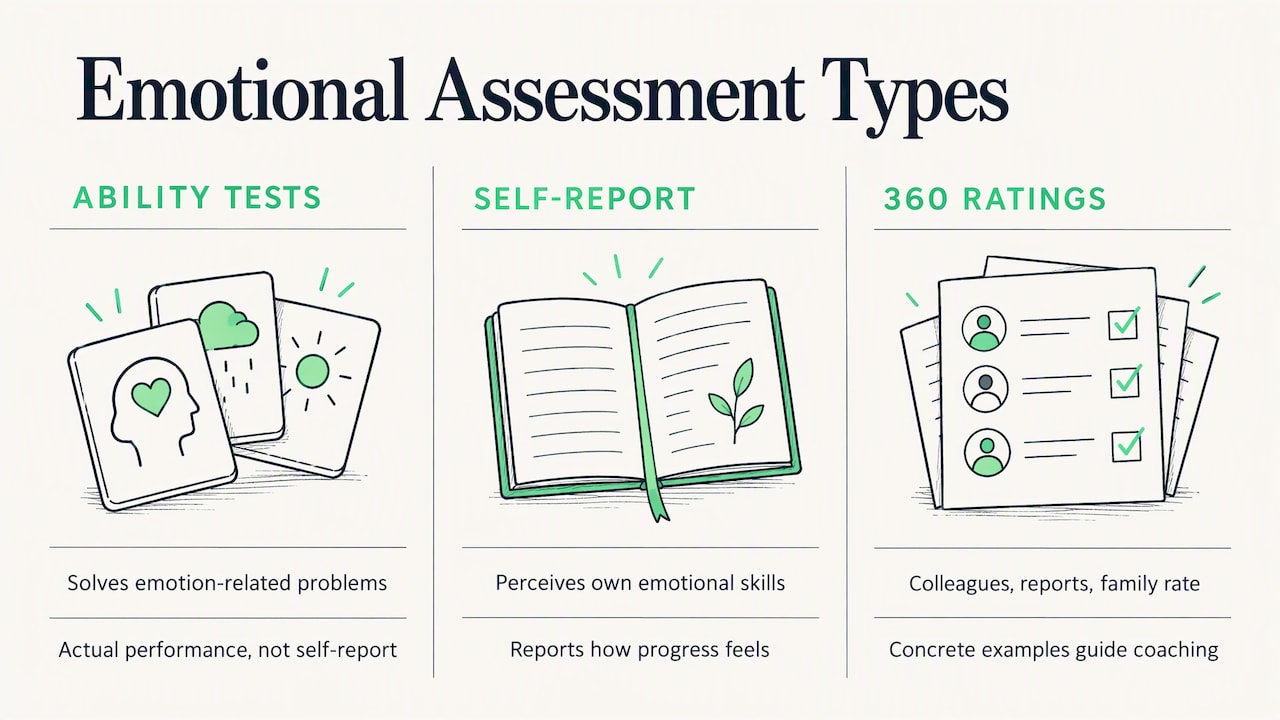
Each has strengths, but observer ratings often give the clearest signal for workplace behavior change because they capture how a shift actually registers with other people, not just how the client feels about their own progress. Behavior-based 360 tools that ask colleagues for concrete examples, rather than only numeric ratings, tend to produce more actionable coaching targets, according to research synthesized in an APA special issue on emotional intelligence in the workplace.
Practical KPIs coaches use include frequency of interruptions in meetings, time-to-recovery after a stressful exchange, and peer ratings of approachability collected before and after a coaching block.
Coaching methods, session formats, and program scope
Programs vary by context and goal. One-to-one coaching suits leaders working on a specific behavior pattern. Cohort workshops build shared vocabulary and peer accountability across a team. Executive programs often blend both, pairing group sessions with individual check-ins.
Blended models that add an adjunct intervention, such as hypnotherapy for performance anxiety or pre-presentation nerves, can support the regulation piece of EI work when the goal is calming an overactive stress response rather than building a new conflict skill from scratch. Sport hypnosis for peak performance is one example of this kind of targeted adjunct work.
Most programs run weekly or biweekly for a period long enough for a behavior to move from effortful to habitual. Coaches maintain clear ethical boundaries: when a client’s material points to clinical depression, unresolved trauma, or a condition requiring diagnosis, the responsible path is referral to a licensed mental health provider rather than continued coaching alone, a boundary echoed in guidance on coaching ethics.
Evidence and expected outcomes from EI training
The research case for EI coaching is solid without being overstated. A meta-analysis categorizing EI research into three measurement streams found corrected correlations between emotional intelligence and job performance in the range of 0.24 to 0.30, a moderate but consistent relationship across ability-based, self-report, and mixed models.
Evidence shows EI training produces moderate improvement, with gains persisting at follow-up in many controlled trials, according to research published in a workplace psychology journal. This matters because it means the gains from coaching tend to hold up months later, not just immediately after a program ends.
Different measurement streams tell slightly different stories. Ability tests measure problem-solving capacity, self-reports measure perceived skill, and mixed models blend trait and competency items. Multisource outcomes, which combine observer feedback with self-report, tend to be the most convincing evidence of real behavior change because they are harder to inflate than self-assessment alone.
Realistic expectations: expect specific, targeted competency gains rather than a full personality overhaul, moderate effect sizes rather than dramatic ones, and a continued need for practice after formal coaching ends.
How to choose an emotional intelligence coach or program
The right coach matters more than the specific curriculum. A few criteria separate credible programs from vague ones.
- Confirm the coach uses evidence-informed assessment, ideally a 360 or behavior-based tool rather than a single self-report quiz.
- Check training and credentials, such as alignment with ICF core competencies covering presence, active listening, and evoking awareness.
- Ask how goals get set and measured, including what a successful outcome looks like at three and six months.
- Ask about supervision and ethics, including how the coach handles material that falls outside coaching scope.
- Ask about confidentiality and referral policy, especially for group or corporate programs where multiple stakeholders are involved.
Pro Tip: Ask a prospective coach to describe one specific behavioral example from a past client’s progress, not just a general outcome. Vague answers are a weak signal.
Red flags include a coach who promises rapid personality change, resists any form of measurement, or has no clear process for referring clients whose needs exceed coaching’s scope.
MindShift Hypnosis: our integrated approach to developing emotional intelligence
We combine personalized hypnotherapy with life coaching to work on the self-awareness and regulation side of emotional intelligence. Our approach centers on customized plans built around each client’s specific patterns, whether that means a leader working on reactivity under pressure or a couple working through recurring conflict.
We work with individuals, couples, families, groups, and corporate teams, tracking progress through the behavioral goals we set together at the start of each engagement. For readers who want to see the services this covers, our services page outlines our offerings.
Customizing coaching plans around individual mental health needs
Emotional intelligence looks different on a leader managing public speaking anxiety than on someone healing from a difficult relationship history, so a coaching plan built on a generic template rarely holds up. The intake conversation matters most here: a coach needs to understand not just the behavioral goal but what has already been tried, what emotional material tends to come up, and whether anxiety, low mood, or trauma history are part of the picture.
Documenting scope of practice at the start, including goals, any contraindications for deeper trauma work, and referral pathways, keeps the plan safe as well as effective, a practice supported by guidance on coaching ethics. From there, a plan for someone with generalized anxiety might lean on regulation techniques and pacing, while a plan for a leader without clinical concerns can move faster into direct behavioral practice.
Our model reflects this directly: a hypnotherapy and life coaching plan for someone managing anxiety alongside leadership goals looks different from one built for a couple working on communication patterns, because the entry point into emotional regulation differs for each. Readers managing anxiety or depression alongside their EI goals can review our depression and anxiety support options to see how that integration works in practice.
Strategies for sustaining emotional intelligence improvements
The gains from a coaching program fade without ongoing reinforcement, which is why the strongest outcomes come from clients who build small daily practices rather than relying on memory of what they learned. A short daily check-in, two or three minutes noting one emotional trigger and how it was handled, keeps the skill active long after formal sessions end.
Scheduled follow-up conversations with a manager, partner, or accountability partner help catch backsliding early. Many programs build in a formal reassessment three to six months after the core coaching block, using the same 360 or behavior-based tool from the start, to measure whether observer-rated change actually held, an approach supported by research synthesized in an APA special issue on workplace emotional intelligence.
Revisiting the original goals periodically also matters. A behavior that felt effortful six months ago, like pausing before responding in conflict, often becomes automatic enough that the original goal needs updating rather than repeating. Clients who treat maintenance as part of the plan, not an afterthought, tend to hold their gains longer than those who stop practicing once formal sessions end.
Coaching outcomes across relationships and corporate settings
The shape of EI coaching outcomes depends heavily on context. In corporate settings, the most common wins are fewer escalated conflicts in meetings, smoother delivery of difficult feedback, and steadier leadership presence during organizational change. A manager who previously avoided tough conversations might, after a coaching block, report giving corrective feedback promptly instead of letting resentment build.
In relationships, outcomes often look like reduced defensiveness during disagreements and better recognition of a partner’s emotional state before it escalates into conflict. Couples working through recurring arguments frequently find that the real shift is in regulation, not in solving every underlying disagreement, since staying calm enough to actually hear each other changes the conversation itself.
In group and team settings, shared vocabulary around emotional patterns tends to reduce misreadings between colleagues who previously assumed the worst about each other’s intentions. Our corporate and group services extend this kind of work to teams looking for a shared framework rather than individual coaching alone.
Trauma recovery and anxiety management within EI coaching
Emotional intelligence coaching touches trauma and anxiety work, but it has a clear boundary with clinical treatment. Coaching can strengthen the regulation skills, like noticing rising anxiety early and using a grounding technique, that make daily functioning easier. It is not a substitute for trauma therapy when the underlying issue requires clinical diagnosis or treatment.
The responsible path is a coordinated one: coaching builds forward-facing skills while a licensed clinician addresses the trauma itself, with clear referral when a client’s material exceeds coaching’s appropriate scope. Our trauma and PTSD support services are designed with that boundary in mind, offering hypnotherapy alongside life coaching for clients whose anxiety or trauma history intersects with their emotional intelligence goals, while remaining clear about when additional clinical care is the right next step.
Practitioner perspective: realistic timelines matter more than quick wins
Clients often expect a breakthrough moment, but real change in emotional regulation looks more like a gradual loosening of an old reflex over a few months of consistent practice. The clients who progress fastest are the ones who treat homework between sessions as seriously as the sessions themselves. When what comes up points to deeper trauma or clinical anxiety, the right move is always a referral alongside the coaching work, not instead of it.
— Rachael
Services and next steps at MindShift Hypnosis
If what you’ve read sounds like your situation, whether that’s a leadership role that keeps testing your patience or a relationship pattern you want to shift, we built our services around exactly this kind of work.
- We offer Hypnosis Life Coaching that blends hypnotherapy with structured coaching goals.
- Our Online Services provide personalized sessions remotely.
- Corporate & Group programs bring this work to teams and organizations seeking shared emotional skills.
The first session typically starts with understanding your specific goals and history before any plan gets built, since a customized approach only works when it is actually built around you rather than a template. Visit our services page to see current offerings and take the next step toward a session that fits what you’re working through.
FAQ
What does emotional intelligence coaching actually involve?
Emotional intelligence coaching involves assessment, goal setting, and deliberate practice aimed at improving self-awareness, emotion regulation, empathy, and social skills. Sessions typically combine reflection, behavioral practice between meetings, and periodic reassessment to track progress.
Can emotional intelligence actually be improved through coaching?
Yes, emotional intelligence is considered a learnable set of skills rather than a fixed trait, according to Harvard Health. Meta-analyses of training programs show moderate effect sizes with gains that often persist at follow-up, as found in research on EI training effectiveness.
How long does emotional intelligence coaching usually take to show results?
Most programs run weekly or biweekly for three to six months, which gives enough time for a new behavioral habit to move from effortful to automatic. Many coaches build in a formal reassessment at the three to six month mark to confirm the change held.
Does hypnotherapy have a role in emotional intelligence coaching?
Hypnotherapy can serve as an adjunct to coaching when the goal involves calming an overactive stress response, such as performance anxiety, that interferes with applying new emotional skills. We combine hypnotherapy with life coaching specifically to support this kind of regulation work alongside behavioral practice.
When should someone see a therapist instead of an emotional intelligence coach?
Coaching is appropriate for skill-building and performance goals, while clinical depression, trauma, or anxiety that interferes with daily functioning calls for a licensed mental health provider. Ethical coaching practice includes clear referral pathways for exactly this situation, as outlined in guidance on coaching ethics.
Sources
- Experts
- Emotional intelligence (Harvard Health)
- Emotional Intelligence in the Workplace (APA special issue introduction)
- Meta-analysis showing EI training effectiveness (SAGE)