
Therapy treats mental health conditions and works through the past. Coaching builds skills and plans to reach goals in the present and future. Many people need one, some need both at different times, and the right pick depends on what you are carrying right now. At MindShift Hypnosis we combine personalized hypnotherapy with life coaching, and we work alongside traditional healthcare, so you can get goal-focused support without having to guess where your own line falls.
TL;DR
- Therapy is a clinical practice: licensed professionals diagnose and treat conditions such as depression, anxiety and PTSD. Coaching is goal-driven and looks forward.
- Therapists are licensed by the state. Coaching is not regulated by state licensing boards, so ask any coach about training and method.
- Insurance typically covers therapy when it is medically necessary. Coaching is generally paid out of pocket.
- Persistent low mood, trauma symptoms or thoughts of suicide call for a licensed clinician first. In a crisis, call or text 988.
- Coaching and therapy are not rivals. Many people use coaching, or hypnotherapy with coaching, to build on what a clinician starts.
Table of Contents
- The core difference: healing vs. moving forward
- Credentials: what a license means and what a coach certification means
- When therapy should come first
- When coaching is the right fit
- Where hypnotherapy with coaching fits
- Cost and insurance: what to expect
- Can one person be both therapist and coach?
- How to decide: five questions
- Our perspective
- Start with the support that fits you
- FAQ
- Sources
The core difference: healing vs. moving forward
The simplest way to separate them is by the question each one answers. Therapy asks, “What is going on inside me, and where does it come from?” Coaching asks, “Where do I want to be, and what is the plan to get there?”
A guide from the New Mexico Regulation & Licensing Department describes therapy as a clinical practice for mental health challenges, emotional struggles and psychological trauma. Licensed therapists diagnose and treat conditions like depression, anxiety, PTSD and relationship issues, often exploring past experiences to heal old wounds. The same guide describes coaching as work toward specific personal or professional goals: developing strategies, building skills and creating actionable plans, such as for career advancement or work-life balance.
A quick comparison:
| Therapy | Coaching | |
|---|---|---|
| Main focus | Mental health conditions, emotional healing, trauma | Goals, performance, habits, direction |
| Time orientation | Past and present | Present and future |
| Who leads | The clinician plans treatment | You set the agenda, the coach keeps you accountable |
| Typical question | “Why do I feel this way?” | “What is my next step?” |
| Regulation | Licensed by the state | Not regulated by state licensing boards |
| Payment | Often billed to insurance | Usually paid out of pocket |
Research comparing the two fields in health and wellness, published in PubMed Central, notes that coaching and psychotherapy draw on overlapping research and approaches. The overlap is real. Both build trust, both use thoughtful questions, and both aim for change. What separates them is the mandate: treating a condition versus helping a person reach a goal.
Credentials: what a license means and what a coach certification means
This is the difference that matters most when you are choosing a person to work with.
Therapists
The National Association of Social Workers explains that a clinical social worker must hold a master’s degree in social work, pass a clinical licensing exam, complete two years of supervised clinical training and keep up continuing education. They may also bill third-party payers. The NASW’s guidance on coaching lays this out. Clinical social work is regulated in every state and jurisdiction, according to the Clinical Social Work Association. Counselors, psychologists and marriage and family therapists follow their own state licensing paths.
The practical upshot: a licensed therapist can diagnose, and a diagnosis is what opens the door to a treatment plan and insurance billing.
Coaches
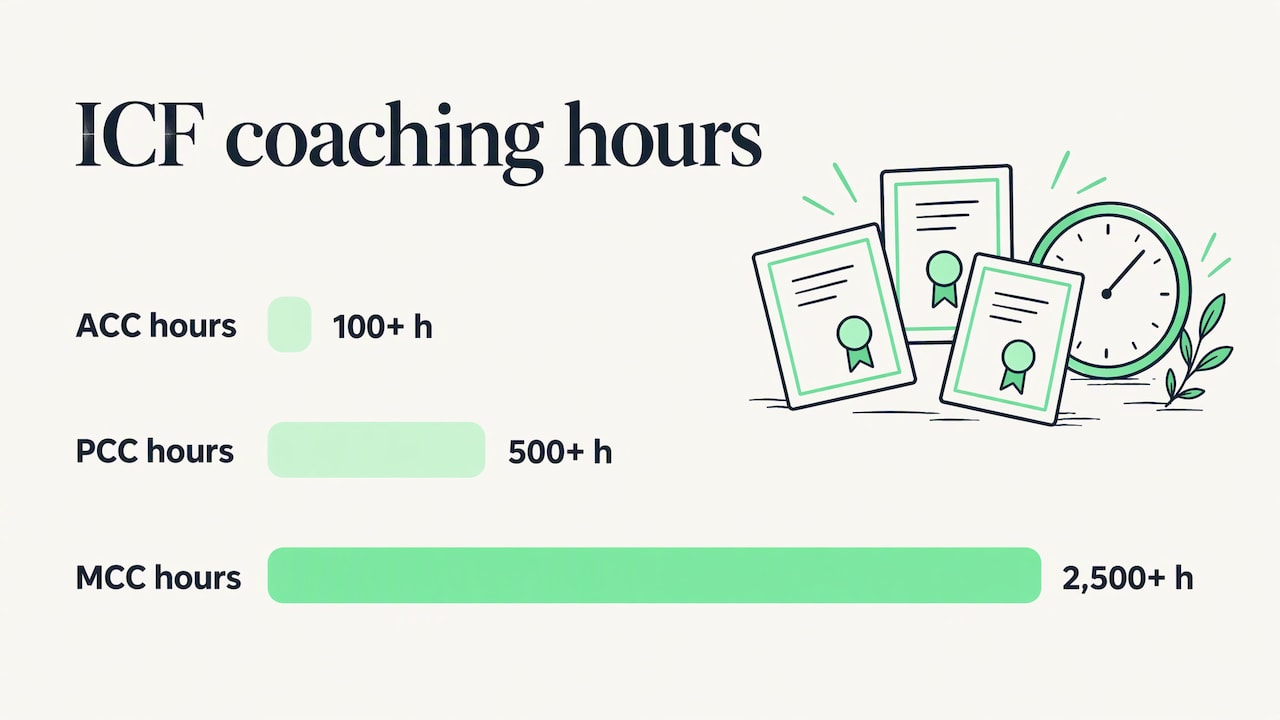
Professional coaching is not regulated by state licensing boards, and certification from the International Coaching Federation (ICF), the largest independent credentialing body, is not required to start a coaching business, per the same NASW page. That freedom is why credentials vary so widely, and why it pays to look at them.
The ICF’s credential application page shows what its three levels ask for:
- ACC: 100 or more coaching hours (75 paid) with at least 8 clients, plus a passing exam.
- PCC: 500 or more hours (450 paid) with at least 25 clients.
- MCC: 2,500 or more hours (2,250 paid) with at least 35 clients and a prior PCC.
Holders must also earn at least 40 continuing coach education credits every three years, according to the ICF’s renewal guide. So when you interview a coach, ask about their training, how many hours they have coached, and whether they hold a credential and keep it current. Those are fair questions, and a good coach answers them readily.
When therapy should come first
Some situations belong with a licensed clinician, and getting there early is a sign of good judgment, not a detour from your goals.
The National Institute of Mental Health says depression is diagnosed when symptoms such as depressed mood or loss of interest last most of the day, nearly every day, for at least two weeks. Treatment is typically psychotherapy, medication or both, and psychotherapy is often tried first for milder forms. If you recognize that pattern, a licensed provider can assess you and, if needed, diagnose.
See a licensed clinician first if you have:
- Symptoms that last two weeks or more and affect sleep, appetite, work or relationships
- A trauma history, flashbacks, nightmares or avoidance that rules your days
- Panic attacks or anxiety that keeps you from basic daily tasks
- A situation where a diagnosis, a medication review or a medical evaluation might be needed
If you are having thoughts of suicide, the NIMH directs people to the 988 Suicide and Crisis Lifeline, and to 911 in a life-threatening situation. Do not wait for a session to be scheduled.
The Clinical Social Work Association also cautions that coaches without clinical training are not qualified to treat trauma histories or complex conditions such as personality disorders. This is why we say plainly that our coaching and hypnotherapy sit beside clinical care for serious symptoms. Our site describes how we combine hypnotherapy with traditional healthcare, so the two can support each other instead of competing.
When coaching is the right fit
Coaching fits when you are functioning but stuck, and you want structure, accountability and a plan. Common examples:
- You have a clear goal (a promotion, a marathon, a difficult conversation, a career change) and keep stalling before you act.
- You feel the pressure of a big transition, such as a new role, a new baby or a move.
- You want to perform better under pressure, as an athlete, a speaker or a musician.
- You want to build habits and follow through on them. Our piece on accountability coaching shows how if-then plans turn intentions into action.
- You want to build steadiness under stress. See our resilience coaching tools for ones to try this week.
A worked example: Dana, a composite example for illustration, is a project manager who dreads presenting to senior leaders. She is not in crisis, and she sleeps and works fine, but she freezes in meetings. Her goal is specific and her timeline is clear. A coach can map the next three presentations, set small rehearsals, and track what happens. Adding hypnosis can help her practice staying calm in the very moment that trips her up. That is a coaching problem, and it is exactly the kind of goal-based work we take on.
Where hypnotherapy with coaching fits
Hypnotherapy is a guided state of focused attention, used to work on habits, fears and responses that talking alone does not shift. Combined with coaching, it pairs the inner work with a concrete plan. At MindShift we offer hypnosis on its own, life coaching on its own, and hypnosis with life coaching together, in person and online. Our work also covers fears and phobias, relationship needs, sport and performance, and corporate and group sessions.
That combination matters because the problem people bring is rarely only a skill gap or only an emotional pattern. A golfer who knows the swing but tightens on the 18th tee has both. Our sport hypnosis page explains how we approach that, and our hypnotherapy for depression page and life coaching for anxiety guide show how we support people who are also working with their healthcare provider.
Cost and insurance: what to expect
Money often decides the question, so here is how it generally works in the United States.
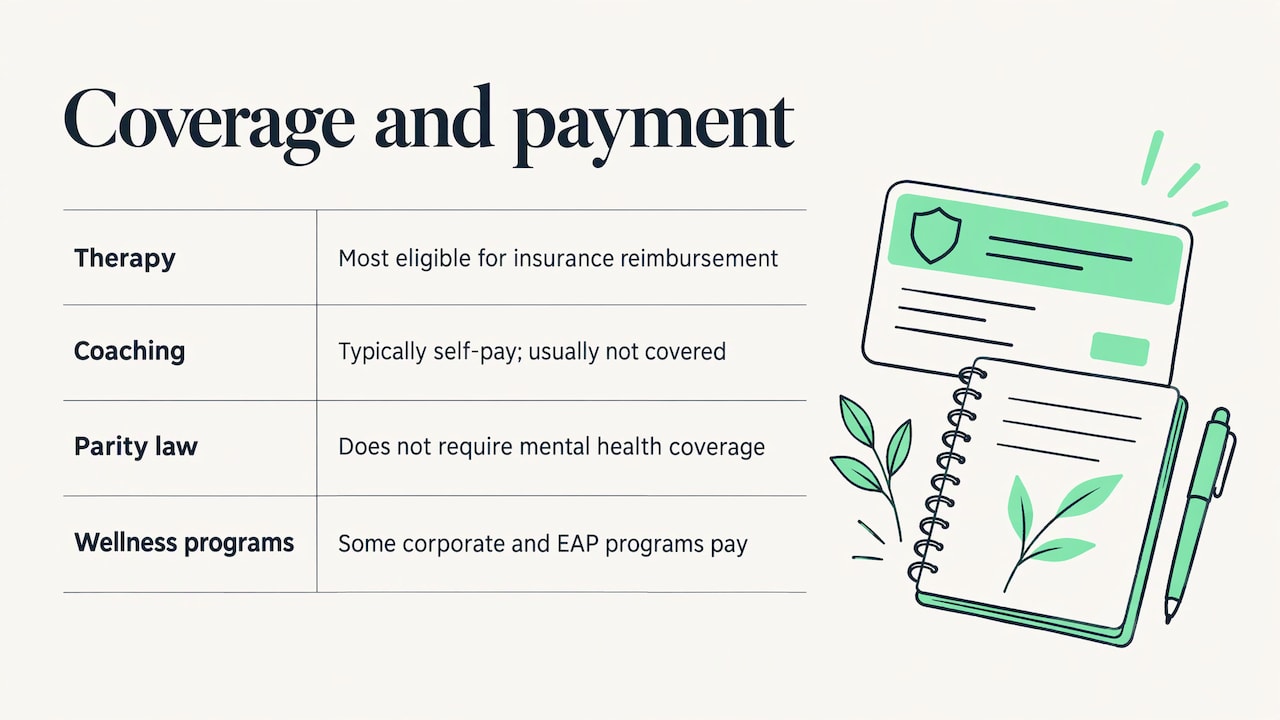
The National Counseling and Psychotherapy Society notes that most therapy is eligible for insurance reimbursement, while coaching is typically not covered, so clients usually pay out of pocket. The federal parity law, the Mental Health Parity and Addiction Equity Act, requires that plans offering mental health benefits not impose greater restrictions on them than on medical and surgical care. The law does not itself require plans to cover mental health treatment.
The rules continue to evolve. A 2024 final rule on parity took effect on November 22, 2024, but in May 2025 the federal departments said they would not enforce its new portions while related litigation is pending. The law’s core obligations still apply. For your own plan, your insurer’s benefits summary is the document that counts.
Coaching sits outside diagnosis codes. The Clinical Social Work Association says coaching has no DSM-5 or CPT codes, and that insurers reimburse it at lower rates. Some corporate wellness programs and employee assistance programs do pay for it, per the NASW. Health and wellness coaching received temporary billing codes in 2020, but reimbursement remains optional. If you are curious how coaching gets packaged and priced inside one kind of health program, this comparison of coaching models and costs is a useful look.
For hypnotherapy specifically, we have written about insurance and CPT 90880 and about what hypnotherapy costs in the U.S.. Session pricing at MindShift is not published on our services page, so reach out to us for details.
Can one person be both therapist and coach?
Yes, but with boundaries. The National Board for Certified Counselors advises that counselors who coach keep the two services separate, explain the difference in informed consent, honor confidentiality limits and reporting duties, and refer clients to counseling when untreated symptoms get in the way. The NASW adds that the boundary is about the activity, not just the title: applying therapeutic techniques with a coaching client may go beyond a social worker’s scope.
For you as a client, that means a clear conversation at the start. Ask any provider which role they are in, what that role covers, and what happens if your needs change.
How to decide: five questions
- Is there a symptom or a goal? If you are mainly trying to stop a symptom that disrupts your life, start with a clinician. If you are mainly trying to reach something, coaching fits.
- How long has it lasted? Two weeks or more of persistent low mood, nearly every day, is a reason to see a licensed provider.
- Does the past drive it? If old events keep resurfacing, a clinician is the first stop. Coaching can then help you build the life you want from there.
- Do you need a diagnosis or insurance billing? Only licensed clinicians can provide either.
- Do you want a plan with accountability? Coaching, or hypnotherapy with coaching, gives you structure and check-ins.
The answers can point to both. Many of our clients are in care with a clinician and come to us to work on performance, confidence, fears or habits at the same time. Couples can look at our relationship hypnosis page, and families can read about family hypnosis.
Our perspective
The question we hear most is, “Am I broken, or am I just stuck?” It’s the wrong frame. Struggling with something is not a verdict on you, and neither coaching nor therapy is a ranking of how serious you are.
We believe the strongest results come from fitting the support to the person. Our approach blends hypnotherapy with life coaching and a strategic plan, built around you, whether you come as an individual, a couple, a family or a team. We work in a safe, supportive space and we are glad to work alongside your doctor or therapist.
Coaching gives you direction and accountability. Hypnosis helps you practice a new response until it feels natural. Together, they help people move from knowing what to do to doing it. If you are not sure where to begin, start with a conversation. We will help you think through what you want to change.
Rachael
Start with the support that fits you
If your goal is clear and you want a plan, or if a fear, a habit or performance pressure keeps getting in your way, we can help. MindShift offers hypnosis only, life coaching, and hypnosis with life coaching, in person or online, for individuals, couples, families and teams.

See every option on our services page, or reach us through mindshifthypnosis.com to talk through what you want to change.
FAQ
How do I know if I need a therapist or a life coach?
Ask whether you are dealing with a symptom or chasing a goal. Ongoing low mood, trauma reactions or anxiety that disrupts daily life call for a licensed clinician. A clear goal, such as a career move or better follow-through, fits coaching. Many people use both.
Is life coaching a form of therapy?
No. Coaching does not diagnose or treat conditions, and unlike therapy it is not regulated by state licensing boards. It focuses on goals, skills and accountability. It can work well alongside therapy, and we often work with clients who are also seeing a clinician.
Can a therapist also be a coach?
Yes, with limits. The National Board for Certified Counselors says counselors who coach should keep the services separate, explain the difference in writing, and refer clients to counseling when symptoms interfere. Ask any provider which role they are in during your sessions.
Does insurance cover coaching?
Generally not. Therapy is usually eligible for insurance reimbursement, while coaching is typically paid out of pocket, though some employer wellness or assistance programs may cover it. Check your plan’s benefits summary or ask your employer’s HR team.
Sources
- Coaching vs. Therapy: Understanding the Difference, New Mexico Regulation & Licensing Department
- Health & Wellness Coaching Services: Making the Case for Reimbursement, PubMed Central
- Coaching: Is it Right for Clinical Social Workers?, NASW
- Insurance Issues, Clinical Social Work Association
- ICF Credential Application
- ICF Credential Renewal Guide
- Depression, National Institute of Mental Health
- Coaching and Psychotherapy: Not Quite the Same, NCPS
- GAO-15-449, Behavioral Health
- Statement on MHPAEA final rule enforcement, CMS
- Coaching: Expanding Counseling Practice, NBCC
- Noom Med vs Found GLP-1: coaching models and cost