
Hypnosis will not replace your surgeon, your physical therapist or your imaging. What it can do is work on the part of recovery that happens in your head: how intensely you feel pain, how well you sleep, how much you trust the injured body part, and how steadily you show up for rehab. Studies in athletes, fracture patients and spinal cord injury patients point in that direction, and that is the work we do at MindShift Hypnosis, in person and online, alongside your medical team.
This guide explains what injury recovery hypnosis is, what the research reports, what a course of sessions looks like, and how to use it safely next to medical care. If you came for “hypnosis for healing” in general, the same logic applies: hypnosis supports the person doing the healing.
TL;DR
- Hypnosis is focused attention with reduced awareness of surroundings and a stronger response to suggestion, and it has its strongest research base in pain and medical procedures.
- A 2025 review of studies in athletes found associations between therapeutic hypnosis and injury recovery and lower psychological distress.
- A spinal cord injury trial reported in 2026 found that hypnosis combined with cognitive therapy reduced pain intensity compared with usual care.
- Hypnosis works best as a partner to your doctor, surgeon or physical therapist, with a properly qualified practitioner and a series of sessions rather than one visit.
- We combine hypnotherapy with life coaching and with traditional healthcare, including sport hypnosis for athletes.
Table of Contents
- What injury recovery hypnosis actually is
- What the research reports
- How hypnosis fits into a rehab plan
- A realistic first month
- When the injury is more than physical
- Safe use and choosing a practitioner
- Why a hypnotherapist who also coaches
- Work with us on your recovery
- FAQ
- Sources
What injury recovery hypnosis actually is
The American Psychological Association’s Division 30 (the society of psychological hypnosis) describes hypnosis as a state of focused attention and reduced peripheral awareness, with an enhanced capacity to respond to suggestion, as the APA reported in April 2024. It is not sleep and not stage entertainment. You stay aware, and you decide whether to act on what the practitioner suggests. Afik Faerman, PhD, of Stanford and Division 30 describes the practitioner as a guide: the person makes the choice.
A typical session, as laid out in a 2024 meta-analytic review in Frontiers in Psychology, has five parts:
- Prehypnotic information: what to expect and what hypnosis is.
- Induction: a guided shift into focused attention.
- Deepening: staying with that focus.
- Therapeutic suggestions: the ideas targeted at your goal, such as comfort, calm or confidence in movement.
- Posthypnotic suggestions: cues you carry out of the session into daily life.
For an injury, those suggestions usually aim at three things: how pain is experienced, the stress and tension around the injury, and your confidence in using the injured area during rehab.
What the research reports
The strongest finding is about pain. The same Frontiers review covered 49 meta-analyses and 261 primary studies. It found the most robust evidence for hypnosis in patients undergoing medical procedures and in patients with pain. Across five reviews, pain effect sizes ranged from d = 0.37 to 0.81. The APA also cites meta-analyses of 85 controlled studies of experimentally induced pain and 42 studies of clinical pain showing meaningful pain relief, with the largest effects in highly suggestible people.
That matters for injuries because pain shapes recovery. When it eases, you sleep better, move more and stick with your exercises.
Athletes and sports injuries
A 2025 systematic review in the International Review of Sport and Exercise Psychology screened 613 papers and included 13 studies. It found statistically significant associations between therapeutic hypnosis and improved athletic performance, injury recovery and reduced psychological distress in athletes.
That last point is practical. Sports injuries bring frustration, worry about losing a place on the team and fear of reinjury. Hypnosis addresses those mental loads directly, so the athlete can put their energy into rehab. If you are an athlete, our sport hypnosis for peak performance work covers the return to play as well as the injury itself.
Fractures
A randomized pilot study by Ginandes and Rosenthal, published on PubMed in 1999, followed 12 healthy adults with an ankle fracture. The hypnosis group showed trends toward faster healing through week 9. That included a notable difference in fracture edge healing on X-ray at 6 weeks, better ankle mobility, a greater ability to descend stairs and lower analgesic use in weeks 1, 3 and 9. It was a small study, and it is best read as a signpost for how mind and recovery experience can go together, not as a promise about your bone.
Trauma patients and spinal cord injury
In a randomized study of 21 hospitalized trauma patients, virtual reality hypnosis added to standard analgesic care reduced pain intensity and unpleasantness at one hour. It also lowered the least pain intensity over the following eight hours, compared with control conditions. The authors presented it as a contribution to multimodal pain control, alongside standard medicine.
More recently, a University of Washington School of Medicine study reported in April 2026 found that six weekly remote sessions combining hypnosis with cognitive therapy significantly reduced pain intensity compared with usual clinical care in people with spinal cord injury. The senior author noted improved sleep and a greater sense of self-control as positive side effects. Two things stand out: it worked over remote sessions, and it was layered on top of regular care.
Pain relief on top of medical care
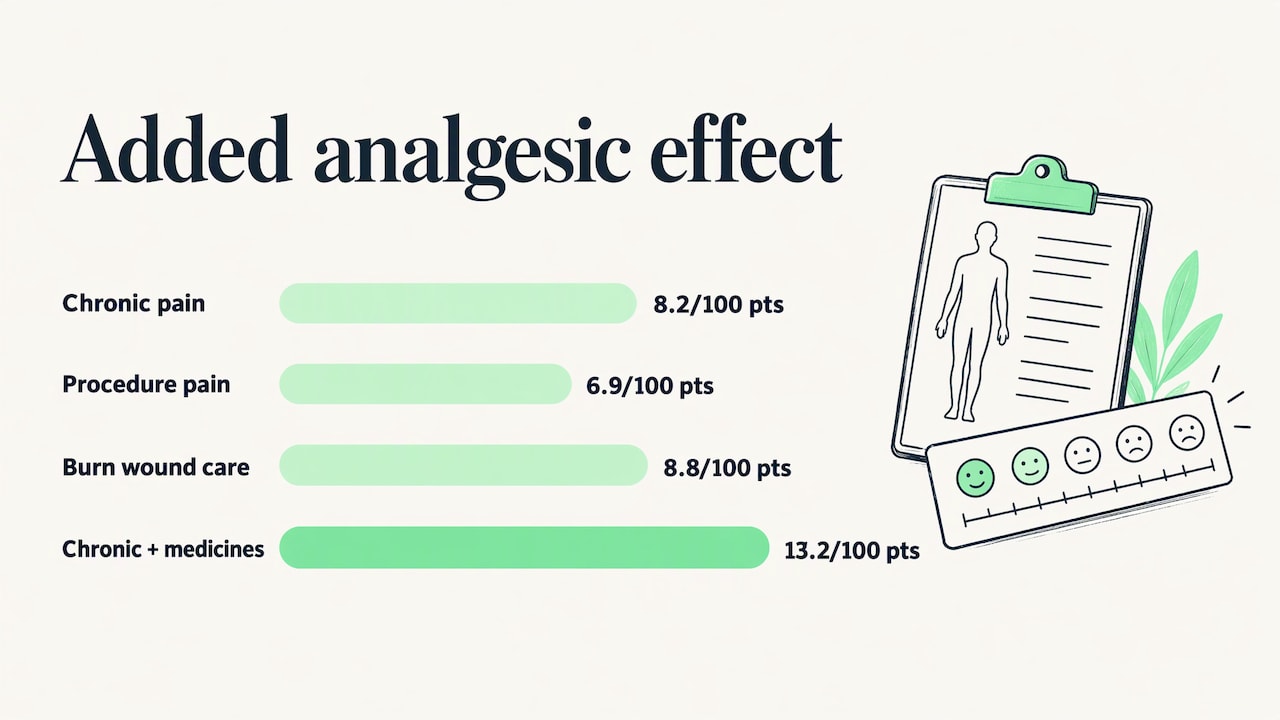
A 2024 meta-analysis of 70 randomized trials with 6,078 participants found that adding hypnosis to usual care gave additional analgesic effects: 8.2 points on a 0 to 100 scale for chronic pain, 6.9 for surgical and medical procedure pain and 8.8 for burn wound care. Paired with medicines for chronic pain, the effect was 13.2 points. A systematic review of meta-analyses also found that hypnosis reduced pain and emotional stress during medical interventions, across 34 trials and 2,597 patients, with no differences in side effects or safety compared with control treatment.
The pattern across all of this is consistent: hypnosis is an add-on. It adds comfort and coping to whatever your medical team has prescribed.
How hypnosis fits into a rehab plan
Jensen and Patterson, in a clinical review of hypnotic approaches to chronic pain, recommend two kinds of suggestion. One targets automatic, long-term pain reduction. The other teaches self-hypnosis for temporary relief lasting hours. They also recommend suggestions that build confidence in physical therapy and exercise.
That gives you a clear way to think about the work:
| Recovery challenge | What hypnosis targets | What it supports |
|---|---|---|
| Pain that limits sleep and movement | How pain is perceived and how much attention it takes | Comfort during daily life and exercises |
| Fear of moving the injured area | Confidence and calm around movement | Showing up fully for physical therapy |
| Frustration, worry, loss of identity as an athlete | Stress response and self-belief | Steadier mood during a long recovery |
| Poor sleep from discomfort | Relaxation and a bedtime routine | Rest, which recovery depends on (see our page on insomnia hypnosis) |
| Anxiety about a procedure or injection | Calm and rehearsal | A more manageable day of surgery or treatment (see our needle phobia hypnosis page) |
How many sessions? NCCIH, the National Institutes of Health center for complementary approaches, notes that according to a few studies hypnosis may reduce chronic pain when patients take part in at least eight sessions. The UW spinal cord injury trial used six weekly sessions. Plan for a short series, and for practicing the skill between sessions, rather than a single appointment.
A realistic first month
Here is how a course of injury recovery hypnosis can be structured, in line with the session pattern above.
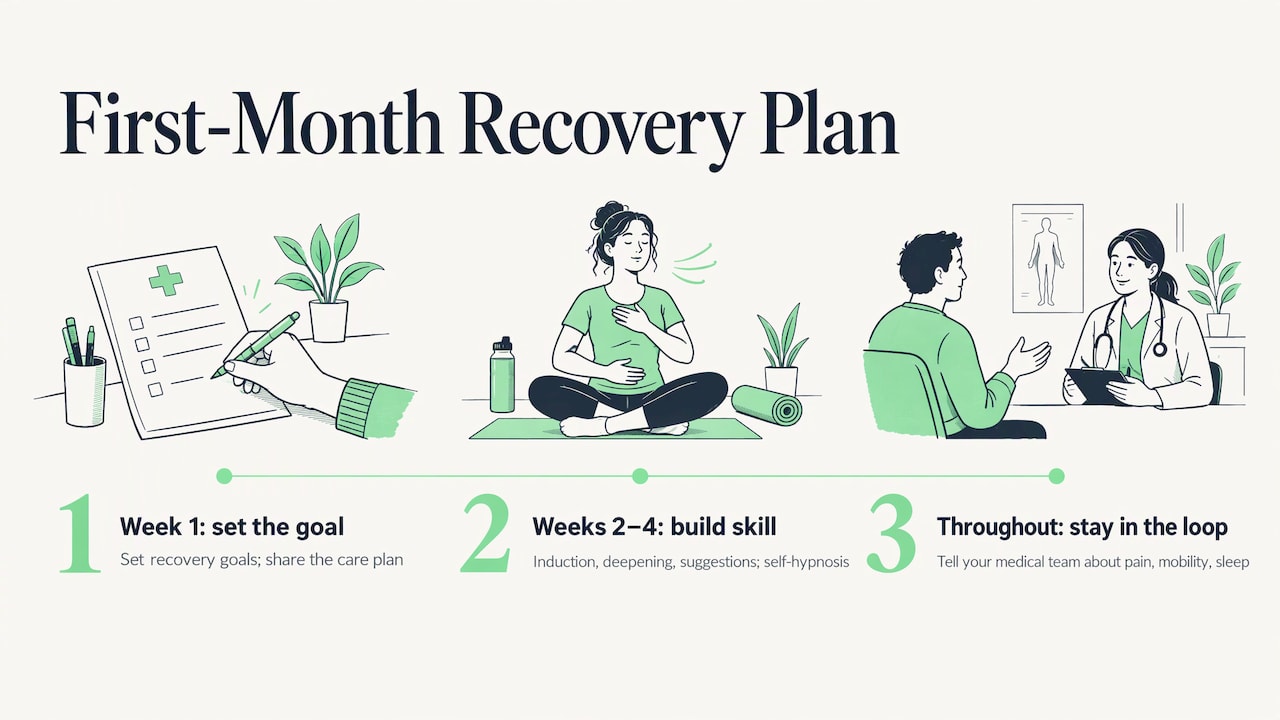
Week 1: set the goal. Name what you want from recovery in concrete terms: sleeping through the night, walking the stairs without bracing, getting through physical therapy with less dread. Tell the practitioner about your diagnosis and your care team’s plan. This is the stage where customized planning matters, because a runner with a stress fracture and a parent recovering from a car accident need different suggestions.
Weeks 2 to 4: build the skill. Each session moves through induction, deepening and suggestions, with posthypnotic cues you can use between sessions. Many people practice a short self-hypnosis routine before exercises or at bedtime, which is the temporary-relief skill Jensen and Patterson describe.
Throughout: keep your medical team in the loop. Mention changes in pain, mobility and sleep to your doctor or therapist. Hypnosis is a complement, and the people managing your injury should know what you are doing. We offer hypnotherapy combined with traditional healthcare for exactly this reason.
When the injury is more than physical
An accident, a hard fall or a season-ending hit can leave more behind than a diagnosis: flashbacks, startle responses, avoidance of the place where it happened, or a sense of being unsafe in your own body. If that sounds familiar, our work on hypnosis for trauma and PTSD addresses it directly, and anxiety or low mood during a long recovery can be addressed through hypnotherapy for depression and anxiety work. Because we also offer life coaching, the plan can include the practical side: how to rebuild routines, return to work or sport, and keep momentum.
Safe use and choosing a practitioner
- Check with your health care provider first. NCCIH says psychological approaches such as hypnosis are generally safe for healthy people when performed appropriately, and advises people considering a complementary approach for pain to check with their health care providers. It adds that some health conditions or pregnancy may require modifying or avoiding certain practices.
- Tell your practitioner about your history. A 2013 review by Kravits states that hypnosis should not be used with people who have a history of psychosis, a cognitive impairment that prevents concentration, or certain personality disorders. If any of these apply, speak with your physician before booking.
- Choose a well-trained practitioner. The same review explains that hypnosis is a nonlicensed practice, so professional organizations set national standards. A well-trained practitioner can anticipate the rare effect of unpleasant memories surfacing, assess risk factors and structure the session to minimize it.
- Keep taking prescribed medication as directed. The trauma-patient study authors did not advocate replacing analgesics. Any change to pain medication is a decision for your prescriber.
- Do not delay care. New severe pain, swelling, numbness or loss of function needs a medical evaluation first. Hypnosis comes after, and alongside, a diagnosis.
Why a hypnotherapist who also coaches
Recovery is rarely only about pain. It is also about a plan: when you return to training, how you handle the setback to your job or your family routine, and what you do when progress stalls. Our approach joins personalized hypnotherapy with life coaching and strategic planning, so the session work and the real-life steps point the same way. We work with individuals, couples, families, groups and corporate teams, in person or online, which suits a recovery when travel is hard.
Our perspective
When someone comes to us after an injury, the first thing we hear is rarely about the injury itself. It is about the worry: will I get back to what I did before, will this pain ever ease, why am I afraid to put weight on it.
That is where we do our best work. The research shows hypnosis has its firmest footing in how pain is experienced and in the stress surrounding medical care, and in athletes it has been associated with better injury recovery and lower distress. We take that seriously, and we build each plan around the person: their injury, their goals, their care team’s instructions.
We combine hypnotherapy with life coaching because a calmer mind needs a direction to go. Our sessions are designed to support the rehab your doctor and therapist set, never to stand in for it. A recovery that feels manageable is one you are more likely to keep showing up for.
Rachael
Work with us on your recovery
MindShift Hypnosis offers hypnosis-only sessions, life coaching and combined hypnosis life coaching, with specialized work for trauma, fears and phobias, depression and anxiety, and sport hypnosis for peak performance. Sessions are available in person and online. If you are recovering from an injury, tell us what your medical team has advised and what you want back, and we will build your plan around it. See our services or start from the MindShift Hypnosis home page.

FAQ
Can hypnosis speed up healing of a broken bone or torn muscle?
Hypnosis does not repair tissue on its own, and we never present it that way. A small randomized pilot on ankle fractures found trends toward faster healing and better mobility in the hypnosis group, and the 2025 athlete review links hypnosis with better injury recovery. Think of hypnosis as support for your rehab, comfort and confidence, working alongside medical treatment.
Does hypnosis work for sports injuries?
The 2025 systematic review of athletes found associations between therapeutic hypnosis and injury recovery and reduced psychological distress. Sport hypnosis typically focuses on pain, fear of reinjury, motivation during rehab and the return to competition. We offer sport hypnosis for peak performance for athletes at any stage of recovery.
How many sessions will I need?
It depends on your injury and goals. NCCIH notes that, according to a few studies, hypnosis may reduce chronic pain with at least eight sessions, and the 2026 spinal cord injury trial used six weekly sessions. Most people think in terms of a short series plus self-hypnosis practice between appointments.
Can I use hypnosis with my pain medication and physical therapy?
Yes, hypnosis is studied as an add-on to usual care, including analgesics and rehabilitation. Keep taking medication as prescribed and tell your doctor and physical therapist that you are using hypnosis. Any change in medication is your prescriber’s decision.
Can I do hypnosis online?
Yes. The University of Washington trial delivered its sessions remotely, and we offer online services as well as in-person sessions, which is helpful when moving around is difficult during recovery.
Sources
- Therapeutic hypnosis and sports performance: a systematic review (2025)
- Using hypnosis to accelerate the healing of bone fractures (PubMed, 1999)
- Virtual reality hypnosis for pain associated with recovery from trauma injuries (2010)
- Uncovering the new science of clinical hypnosis (APA, 2024)
- Meta-analytic evidence on the efficacy of hypnosis (Frontiers in Psychology, 2024)
- Adjunctive use of hypnosis for clinical pain: a systematic review (2024)
- The Efficacy, Safety and Applications of Medical Hypnosis (2016)
- Hypnotic Approaches for Chronic Pain Management (2014)
- UW researchers find hypnosis-based therapy reduces pain after spinal cord injury
- Chronic Pain and Complementary Health Approaches (NCCIH)
- Hypnosis: Adjunct Therapy for Cancer Pain Management (2013)