Hypnosis for anger works by pairing deep relaxation with focused suggestions, so you learn to calm your body and choose your response before a flash of anger takes over. It fits best as one part of a plan that also includes understanding your triggers and practicing new habits between sessions. At MindShift Hypnosis we build that plan around the person, in person or online, and combine hypnotherapy with life coaching so the calm you feel in a session carries into your home, your job and your relationships.
This guide explains what a session looks like, what the research supports, how to stay safe, and how to tell when anger needs a different kind of help first.
TL;DR
- Anger management hypnosis combines a relaxed, focused state with goal-directed suggestions to help you slow down, notice triggers and respond differently.
- A 2024 review of 154 studies found that calming, arousal-lowering activities reduce anger and aggression, while venting does not.
- A 2021 meta-analysis found that adding hypnosis to cognitive behavioral therapy gave small-to-medium extra benefits over CBT alone.
- Hypnosis is generally considered safe. Mild effects such as drowsiness or a headache are uncommon, and it should be used by trained, licensed professionals.
- Seek professional mental health care if anger feels out of control, lasts more than a month, or leads to harm or property damage. In a crisis, call or text 988.
Table of Contents
- What anger management hypnosis actually is
- Why calming the body matters for anger
- What the research says about hypnosis and anger-related problems
- What happens in a session
- Day-to-day habits that support the work
- Anger, depression, trauma and relationships
- Is it safe? What to know before you start
- When anger needs professional mental health care first
- A starting routine you can use this week
- Why a personalized plan beats a generic recording
- Our perspective
- Ready to work on your anger with support
- FAQ
- Sources
What anger management hypnosis actually is
Hypnosis is a state of focused attention and deep relaxation in which you stay aware and in control. A trained practitioner guides you into that state and then offers suggestions tied to a goal you set together. For anger, the goal is rarely “never get angry.” Anger is a normal emotion. The goal is a bigger gap between the trigger and your reaction, so that you can decide what to say or do rather than react.
The VA’s Whole Health Library notes that hypnosis is most often used for sleep, changing habits, and reducing pain, anxiety and irritable bowel symptoms. Anger sits close to several of those. It tends to flare when you are tired, tense or anxious, and it is often tied to habits of thinking and reacting. That is why many people who come to hypnotherapy for anxiety, stress or sleep also raise anger as something they want to change.
Why calming the body matters for anger
Anger is a physical event as well as a thought. Your heart rate rises, your muscles tighten and your thinking narrows. The most useful thing you can do is lower that arousal early.
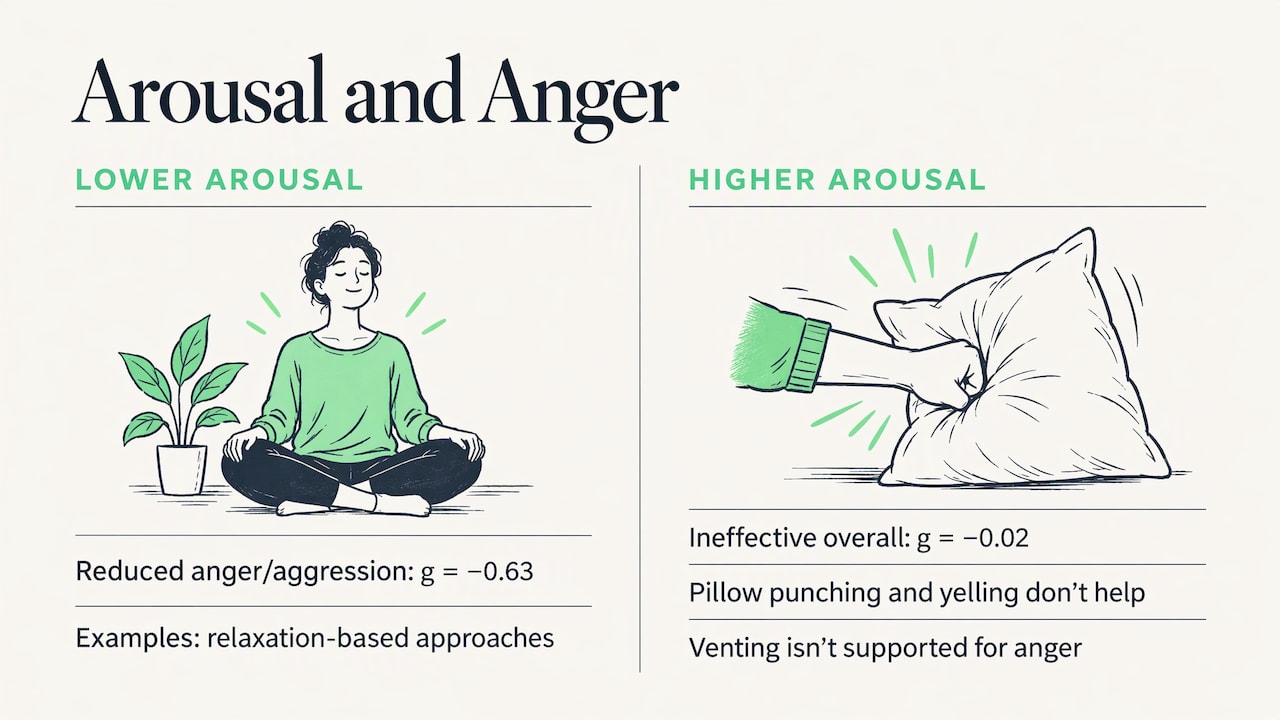
A 2024 meta-analysis by Kjærvik and Bushman pooled 154 studies and 10,189 participants. It found that activities that decrease arousal reduced anger and aggression (g = −0.63), such as relaxation-based approaches. Activities that increase arousal were ineffective overall (g = −0.02), and the review did not support venting as a way to manage anger. In plain terms: punching a pillow or yelling it out does not help, and slowing your body down does.
Hypnosis is built around exactly that skill. The session itself is a practiced experience of slowing down, and the suggestions you receive can be tied to a cue you use in daily life, such as a breath, a phrase or a posture. Our page on stress relief hypnosis shows how a short calming phrase can be practiced and used the same way.
What the research says about hypnosis and anger-related problems
Research on hypnosis specifically for anger is still small, so it helps to look at the closest evidence and read it for what it shows.
Hypnosis alongside cognitive behavioral therapy. CBT teaches you to spot and change the thoughts that feed anger. A 2021 updated meta-analysis found that adding hypnosis to CBT produced small-to-medium advantages over CBT alone after treatment (d = .25 to .41). If you already work with a therapist, hypnosis can be a complement rather than a replacement.
Aggression and distress tolerance. A 2023 study of 30 women aged 25 to 40 with premenstrual dysphoria reported improvement in distress tolerance and aggression after cognitive-behavioral hypnotherapy. It was a small study, but it shows the approach being applied to aggression directly.
Stress and day-to-day distress. A 2020 randomized pilot of mindful hypnotherapy in 42 college-age adults with elevated stress used eight weekly one-hour individual sessions plus daily self-hypnosis audio. Adherence was 84% and the authors reported reduced perceived distress. That study measured stress, not anger, but stress is one of the most common fuels for short tempers.
Breadth of use. A 2024 review of 49 meta-analyses covering 261 primary studies found the strongest evidence in medical procedures and pain, which shows how widely hypnosis has been studied as a clinical tool.
The practical reading: the evidence supports calming skills, hypnosis as an add-on to structured therapy, and a routine of regular practice. That is how we design a plan, not as a single session that is supposed to fix everything.
What happens in a session
Whether the goal is anger, fear or sleep, a session follows a familiar shape. The 2024 review describes common clinical practice as a discussion of expectations and goals first, then induction, deepening, goal-directed suggestions, possible posthypnotic suggestions and re-alerting. The Cleveland Clinic describes the same sequence and says you should not need special preparation, only to be honest about your goals.
For anger, that looks like this:
- The conversation. You describe when anger shows up, what it costs you and what you want instead. Be specific: “I snap at my kids during the morning rush” gives a practitioner far more to work with than “I have a temper.”
- Induction and deepening. You are guided to relax your body and narrow your attention. You stay aware and can open your eyes at any time.
- Suggestions. The practitioner offers suggestions matched to your goal, for example noticing the first physical signal of anger, taking one slow breath, and choosing your response.
- Rehearsal. Many people mentally rehearse a familiar trigger while relaxed, so the new response feels more available when the real moment arrives.
- Return and review. You come back to full alertness, talk through what you noticed and agree on what to practice before the next session.
Finding triggers and building new responses
The conversation and the review are where much of the work happens. Anger often follows a pattern: a particular person, a time of day, a feeling underneath it such as embarrassment, feeling dismissed or exhaustion. Naming that pattern is the first step. The MedlinePlus guide to managing anger suggests paying attention to your triggers, changing “always” and “never” thinking, learning relaxation techniques, taking time-outs and communicating deliberately.
This is where combining hypnotherapy with life coaching earns its place. Hypnosis helps you practice the calm state, and coaching turns it into a plan: what you will do at 6 p.m. when the house is chaotic, how you will raise a problem with a coworker, how you will take a time-out without storming off. Our emotional intelligence coaching page describes how hypnosis and three slow breaths work together in a workplace setting.

Day-to-day habits that support the work
Whatever you do in sessions, daily habits determine how much of it sticks. The CDC’s How Right Now guidance on anger recommends taking calming breaths, even a five-minute break, pausing when you feel irritated and naming the feeling. It also points to a daily routine with at least seven hours of sleep and physical activity, and to limiting social media and news.
Two of those matter more than they look:
- Sleep. Short sleep makes everything feel like a provocation. If poor sleep is part of your picture, our guide to insomnia hypnosis explains what to expect.
- Pausing. A pause of even a few breaths is the skill that hypnosis rehearses. Practice it on small irritations, such as traffic or a slow line, so it is ready for the big ones.
Anger, depression, trauma and relationships
Anger is often the visible part of something else. For some people it sits alongside low mood, and our page on hypnotherapy for depression covers that connection. For others it is tied to past events, and our hypnosis for trauma and PTSD page explains how we approach that work carefully. If anger shows up mainly with a partner, relationship hypnosis and hypnotherapy for couples let both people work on how they respond to each other.
One safety point belongs here. The VA warns that using hypnosis to work through past events can bring up false memories or strong emotional reactions. That is why trauma-related anger should be handled by a trained professional at a pace that suits you, and why you should tell your practitioner about any history you want handled with care.
Is it safe? What to know before you start
The VA’s clinical hypnosis document says hypnosis is generally considered safe in meta-analyses, and that rare effects can include drowsiness, headache, dizziness or anxiety. The 2016 systematic review of medical hypnosis found no higher rate of adverse effects than controls in two meta-analyses. In the 2024 review, a cited 2018 analysis found zero serious adverse events attributed to hypnosis.
The Cleveland Clinic lists uncommon after-effects: dizziness, drowsiness or fatigue, headache, increased anxiety and trouble sleeping. It advises you to tell your hypnotherapist about any negative effects so the approach can be adjusted.
Two more points for safe use:
- Work with trained professionals. The American Psychiatric Association’s position statement says hypnosis should be used by appropriately licensed and trained health professionals within their expertise, after a thorough medical and psychiatric evaluation and consistent with your treatment plan.
- Keep your doctor in the loop. The Cleveland Clinic describes hypnosis as complementary to usual medical care and recommends talking with your primary care provider about new or different symptoms. Our page on combining hypnotherapy with traditional healthcare explains how we work alongside your existing care.
When anger needs professional mental health care first
Some anger needs a clinician’s attention before or alongside anything else. SAMHSA lists signs that it is time to seek professional support:
- Your anger feels out of control.
- You act in ways you regret or harm yourself or others.
- Anger lasts longer than a month.
- You are arguing with coworkers.
- You have damaged property or think about doing so.
MedlinePlus gives similar guidance: contact your health care provider if anger is affecting your relationships or work, or if you worry you might hurt yourself or others. If you are in crisis, the CDC points to the 988 Suicide & Crisis Lifeline: call or text 988, or chat at 988lifeline.org. If someone is in immediate danger, call 911.
If you are supporting someone else with anger issues, SAMHSA suggests talking with a trusted person or finding a support group, and encouraging professional help when the signs above appear.
A starting routine you can use this week
Hypnosis works better when you practice between sessions. Try this simple pattern, which draws on the breathing and pausing advice above:
- Pick one trigger. Choose a recurring, moderate one, such as a particular commute or a daily argument, not your hardest situation.
- Find the first signal. Notice where anger starts in your body: jaw, chest, hands, stomach.
- Breathe slowly for one minute. Let each exhale run longer than the inhale.
- Say a short phrase. Something like “slow down, I choose” gives your mind an anchor.
- Take a time-out if needed. Step away, name the feeling and return when you can speak deliberately.
- Write one line afterward. What happened, what helped, what you would do again.
In a session, we use this same kind of cue and build it into your relaxed state, so it becomes easier to reach. A guided self-practice routine is something we set up with you, so it matches your triggers rather than a generic script.
Why a personalized plan beats a generic recording
Anger looks different in every person. A parent snapping at bedtime, an athlete who loses composure under pressure, a manager who bristles in meetings and a partner who goes cold and then explodes need different cues, different rehearsals and different follow-through. Recordings and scripts can offer relaxation, but they cannot ask what happened yesterday or adjust the plan when something shifts.
Our approach is built on customized treatment plans and strategic planning. Sessions are available for individuals, couples, families, groups and corporate teams, in person and online. For athletes and performers, composure under pressure is a goal of its own, and our sport hypnosis for peak performance page covers it.
Our perspective
We see anger as information, not a character flaw. Underneath it there is usually something that needs attention: exhaustion, fear, feeling unheard, an old pattern that once protected you and now costs you.
That is why we combine hypnotherapy with life coaching. Hypnosis gives you a direct experience of calm and focus, and coaching gives that calm somewhere to go: a plan for the conversations, routines and relationships where anger shows up.
We build each plan around the person in front of us, in a safe and supportive setting, and we value working alongside your doctor or therapist. Anger that feels out of control deserves professional mental health care, and hypnosis can sit comfortably next to it.
The change we care about is practical: the pause before the reaction, the sentence you choose rather than the one that escapes, the evening that ends calmly.
Rachael
Ready to work on your anger with support
If you want a plan built around your own triggers, we offer personalized hypnotherapy and life coaching for individuals, couples, families, groups and corporate teams, in person and online. Our services include help with depression and anxiety, trauma, fears and phobias, and relationship needs.
See our services to choose the format that fits you and book a session.
FAQ
Can hypnosis really help with anger?
Hypnosis helps you practice relaxation and rehearse new responses, which are the skills that reduce anger. A 2024 meta-analysis found that arousal-lowering activities reduce anger and aggression, and a 2021 meta-analysis found added benefits when hypnosis accompanied CBT. It works best as part of a plan with regular practice.
How many sessions will I need?
It depends on your goals and how long the pattern has been in place. The 2020 mindful hypnotherapy pilot used eight weekly one-hour sessions plus daily audio practice, which gives a sense of a structured program. We set the pace with you and review it as you go.
Can I use self-hypnosis for anger?
Many people practice relaxation, slow breathing and a calming phrase on their own, and that supports the work done in sessions. The CDC recommends calming breaths and pausing when irritated. For anger linked to past events or strong emotions, work with a trained professional first.
Will I lose control or say things I do not want to say?
No. You stay aware and can end the session at any time. The Cleveland Clinic notes you should not need special preparation, only honesty about your goals, and that you can tell your hypnotherapist about any effects you notice afterward.
When should I see a doctor or therapist instead?
See a health care provider or mental health professional if anger feels out of control, lasts more than a month, leads to harm or property damage, or damages your work or relationships. If you are in crisis, call or text 988. In immediate danger, call 911.
Sources
- Clinical Hypnosis, VA Whole Health Library
- Meta-analytic evidence on the efficacy of hypnosis (2024)
- A meta-analytic review of anger management activities (2024)
- Clinical Hypnosis as an Adjunct to Cognitive Behavior Therapy (2021)
- Cognitive-behavioral hypnotherapy, distress tolerance and aggression (2023)
- Mindful Hypnotherapy to Reduce Stress (2020)
- The Efficacy, Safety and Applications of Medical Hypnosis (2016)
- Hypnosis: What It Is, How It Works, Benefits & Risks, Cleveland Clinic
- Coping with Anger: After a Disaster, SAMHSA
- Learn to manage your anger, MedlinePlus
- Anger, How Right Now, CDC
- Position Statement on Hypnosis, American Psychiatric Association