Hypnosis can be part of a plan for recurring nightmares, and it is listed in the sleep-medicine literature as an option for nightmare disorder. The same skills, focused attention, vivid imagery and guided suggestion, have also been studied for creative blocks. This guide explains what happens in a session, what the research shows for each goal, how to use hypnosis safely, and how to decide whether to book.
TL;DR
- The American Academy of Sleep Medicine (AASM) says hypnosis may be used for nightmare disorder, alongside its first-line recommendation of imagery rehearsal therapy.
- A hypnosis session has four stages: induction, deepening, suggestions and emergence. Most people remember it and stay in control throughout.
- For creative blocks, a randomized study of 48 people found hypnotic dream work among the most effective techniques tested.
- Nightmares tied to trauma deserve a care team that includes your doctor or a licensed mental health clinician. Hypnosis can sit alongside that care.
- Sessions are available in person and online, so you can start where you are.
Table of Contents
- What hypnosis actually is
- What the research says about hypnosis and nightmares
- How hypnosis can support sleep more broadly
- Safety: who should involve a clinician first
- Hypnosis for creativity and creative blocks
- Nightmares and creativity share a mechanism
- How to choose a hypnotherapist
- Promo: start with a conversation
- Perspective
- Frequently asked questions
- Sources
What hypnosis actually is
Hypnosis is a focused, relaxed state of attention. The AASM task force describes it as a trance-like state in which the mind can concentrate on one thought or memory without distraction and becomes open to suggestions that can change certain thoughts or behaviors.
It is not sleep, and it is not mind control. The American Psychological Association’s Monitor quotes Stanford researcher Afik Faerman, PhD, describing it as a context in which the brain edits conscious experience, and the client decides whether to act on the suggestions. That matters for nightmares, because the goal is to give you a tool you choose to use, not something done to you.
What happens in a session
Cleveland Clinic lists four stages of hypnosis:
- Induction. The practitioner helps you relax and focus, usually with spoken prompts.
- Deepening. The relaxation and focus build.
- Suggestions. Imagery and carefully chosen language guide the change you want.
- Emergence. You are guided back to full awareness.
Most people remember the session and stay in control of their thoughts throughout. A recording can help you relax, but one review notes that the defining ingredient is therapeutic suggestion, and that there is some evidence that prerecorded audio is less effective than a facilitated, face-to-face experience. That is one reason a live session, in person or online, is worth considering over a playlist.
What the research says about hypnosis and nightmares
Nightmares are vivid, distressing dreams that wake you or leave you anxious. When they happen often enough to disrupt sleep or daytime life, sleep medicine calls it nightmare disorder. Some nightmares follow trauma, and others appear with no clear cause.
The established first-line treatment
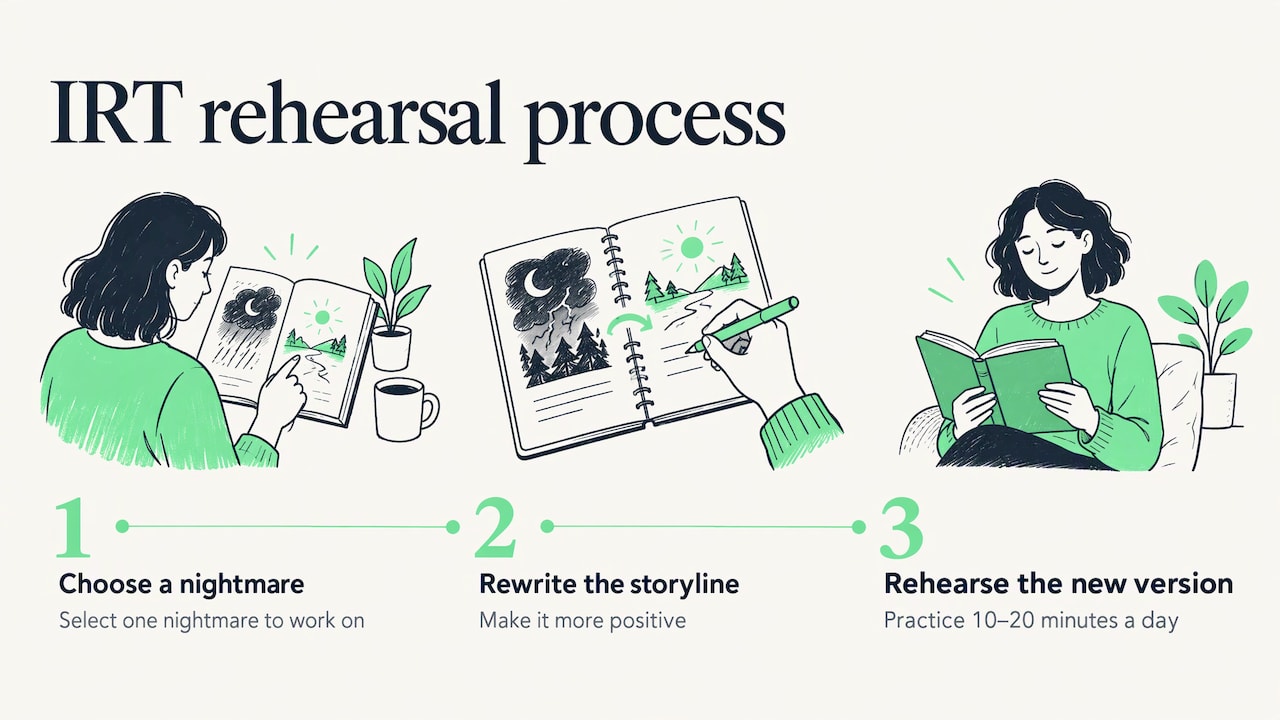
The AASM’s position paper recommends imagery rehearsal therapy (IRT) for nightmare disorder and for PTSD-associated nightmares. In IRT you choose a nightmare, rewrite its storyline into a more positive one, and rehearse the new version in your mind. The American Psychiatric Association’s news service reports that patients are encouraged to rehearse for 10 to 20 minutes a day, and that nine randomized trials with nearly 800 participants found IRT reduced nightmare frequency and distress.
A 2022 network meta-analysis of 29 trials with 2,214 trauma survivors reached a similar view: prazosin and IRT were the two effective interventions for trauma-related nightmares. Prazosin is a prescription medication, so that choice belongs with your physician.
Where hypnosis fits
The same AASM paper says hypnosis may be used for nightmare disorder, and it cites two small case series. In one, 10 patients each received a single 50-minute hypnosis treatment: 71% had improved at 18 months and 67% kept the improvement at five years. In the other, three patients received one to five brief sessions and all benefited, with no adverse effects reported. The AASM’s earlier best practice guide placed hypnosis among the behavioral therapies that may be considered for PTSD-associated nightmares.
A longer-term follow-up of hypnosis for parasomnias, which includes nightmares, was published in the Journal of Clinical Sleep Medicine, and it is one of the most cited studies on the subject.
Researchers reviewing nightmare treatments more broadly note that approaches work best when they give you a sense of control or mastery by working directly with the nightmare content or your emotional response to it, and that brief treatments can be efficient. Hypnosis is built around exactly that: imagery, suggestion and a calmer response to frightening material.
A practical way to think about it
The two approaches are close cousins. IRT asks you to rewrite a dream and rehearse it. In hypnosis, the relaxed, focused state can make that rehearsal vivid, and suggestions can reinforce calm and safety when you return to sleep. If you have already been offered IRT by a sleep specialist or therapist, hypnosis can support the rehearsal rather than replace it.
How hypnosis can support sleep more broadly
A systematic review of hypnosis and sleep outcomes found that 58.3% of 24 studies reported a benefit on sleep, with a low incidence of adverse events. Sessions averaged four (range one to eight), totaling about 3.6 hours. Home practice was encouraged in more than half of the studies, most often with audio recordings.
That pattern is a useful template: a small number of sessions, followed by short daily practice at home. Evening habits also shape how you sleep and dream. If you are building a wind-down routine, this overview of essential oil inhalation and sleep quality covers one scent-based option some people add to it.
A simple home routine to pair with sessions
- Write the nightmare down in a few sentences while it is fresh.
- Choose one change that makes the ending safer or more manageable. You decide what it is.
- Each evening, for 10 to 20 minutes, picture the new version, the pace IRT studies use.
- Finish with a few slow breaths before bed.
Start with a milder nightmare, not the most frightening one. If the images feel overwhelming, stop and bring it to your clinician or hypnotherapist.
Safety: who should involve a clinician first
Hypnosis is typically described as a low-risk treatment, but the sleep review cautions that it may cause dizziness, confusion, unpleasant physical symptoms, false memories or panic attacks. Earlier research estimated moderate to severe after-effects at 7%, and because they are short-lived they may be underreported.
Another review notes that hypnosis is safe when practiced by a well-trained, experienced, licensed provider, and that one undesirable effect is inadvertently retrieving unpleasant memories, which a trained practitioner can anticipate and minimize. Responses depend on expectations, suggestibility, phrasing and delivery.
In practice:
- If your nightmares began after a traumatic event, or come with flashbacks, panic, or thoughts of harming yourself, tell your physician or a licensed mental health professional. In the United States, anyone in crisis can call or text 988, the Suicide & Crisis Lifeline.
- If nightmares began after a new medication, or you also have loud snoring or gasping at night, ask your doctor to look at those causes.
- Tell your hypnotherapist about any diagnosis and any medication so sessions can be planned around your care. We cover this on our page about combining hypnotherapy with traditional healthcare.
If trauma is part of the picture, our page on hypnosis for trauma and PTSD explains how we approach it.
Hypnosis for creativity and creative blocks
The other half of this topic is a different goal with the same tools. A creative block is a stretch where the work stalls: the writer who cannot start the chapter, the musician who has lost the thread, the designer staring at an empty file.
What the study found
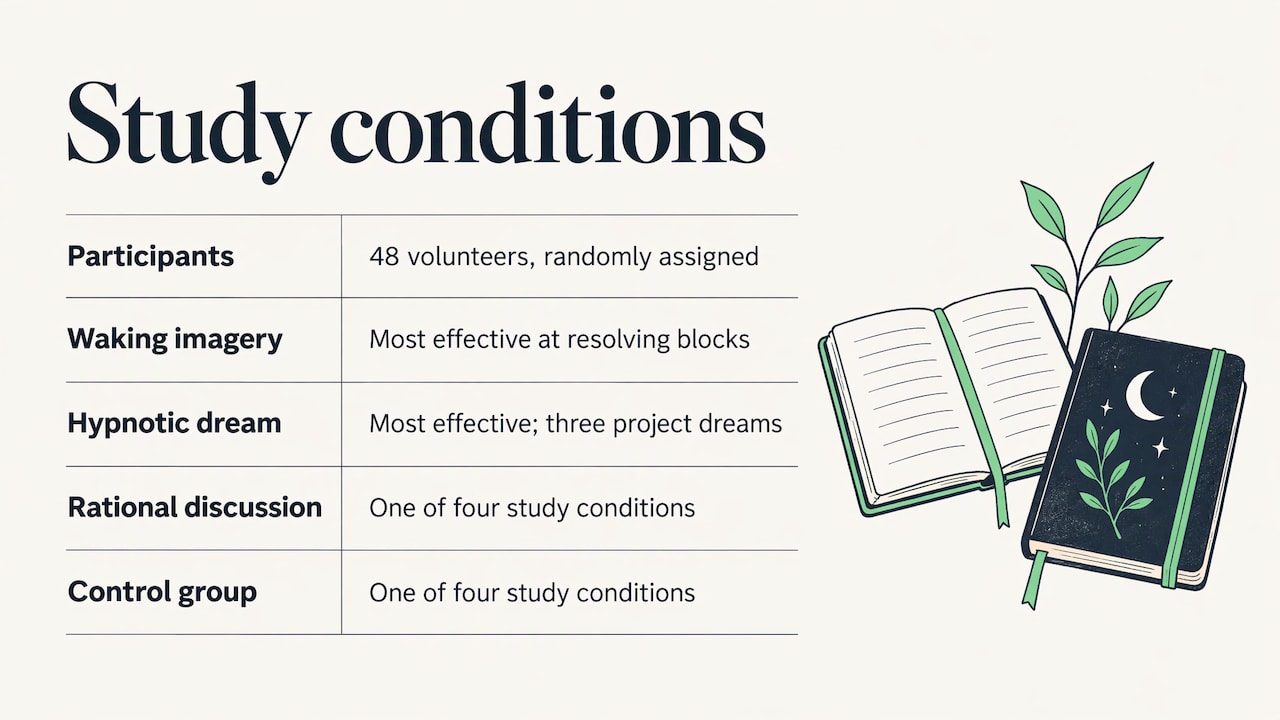
In a controlled study, 48 volunteers who reported blocks in artistic, literary, scientific or professional projects were randomly assigned to one of four conditions: waking imagery, hypnotic dream, rational discussion, or a control group. Waking imagery and hypnotic dream were the most effective at resolving blocks. In the hypnotic dream condition, participants had a hypnotic induction followed by three dreams related to their projects.
People with good attentional control and low daydreaming that is tinged with distress before treatment were the most likely to change. A week after treatment, participants rated their satisfaction and described how their block had shifted. The study dates from 1981, but it remains a frequently cited experiment on this question.
More recently, a 2025 overview in the International Journal of Clinical and Experimental Hypnosis examined how hypnosis alters consciousness to enhance creativity, looking at artistic, musical and work-related problem solving. It explores possible mechanisms including positive mood, flow, heightened senses and thought processes.
What this means if you write, paint or perform
- Imagery is the working method. Hypnosis for a block is usually about picturing the project, or a dream about it, in a relaxed state and noticing what surfaces.
- Practice between sessions. Short, regular imagery rehearsal builds the habit, just as it does for nightmares.
- Pair it with a plan. A block often hides a practical question: a deadline, a fear of judgment, an unclear next step. That is where coaching helps, and it is why we combine the two. See our page on hypnosis for peak performance in sport for how the same skills apply to performers under pressure.
If the block comes with low mood or anxiety, it is worth addressing those directly, with a physician or a licensed clinician where appropriate.
Nightmares and creativity share a mechanism
It can look odd that one article covers both. The link is imagination. A nightmare is your mind generating an image you did not choose. A creative block is often the reverse: you cannot get the image you want. In both cases hypnosis works with imagery and suggestion, so you can steer what your mind does with it. That is also why many people notice calmer, more vivid and more useful dream and idea life once they learn to relax into focused imagery.
How to choose a hypnotherapist
- Ask about training and licensure. Safe use depends on a well-trained practitioner.
- Look for coordination with your healthcare. Anything involving trauma, depression or anxiety should be coordinated with your doctor or therapist.
- Expect a plan. Research on sleep hypnosis shows a few sessions, home practice and, in some studies, tailored suggestions. A good plan fits your nightmare or project.
- Choose the format that suits you. Sessions can be in person or online.
Promo: start with a conversation
We combine personalized hypnotherapy with life coaching for individuals, couples, families, groups and corporate teams. Our plans are customized to you, whether the aim is quieter nights, relief from fears and phobias, or getting unstuck on a creative project. Sessions are offered in person and online, and we work to integrate with traditional healthcare.
See our services to find the right fit, or read about how pricing works before you reach out.
Perspective
When people come to us about nightmares, they rarely want a lecture on sleep science. They want to stop dreading bedtime. What I tell them is that the research gives us a clear map: rewrite the dream, rehearse it, and build a sense of control. Hypnosis is one of the most natural ways to do that, because it is a state built for vivid imagery and focused suggestion.
Our approach is customized and holistic. We combine hypnotherapy with life coaching and strategic planning, so the session is not an isolated event. You leave with a plan for the week, a short practice for the evening, and a clearer sense of what you want to change.
The same goes for creativity. A block is rarely just a block. It is a mix of attention, fear and unclear next steps, and hypnosis plus coaching lets us address all three. If you are working with a physician or therapist, we want to work alongside them, not around them.
Rachael
Frequently asked questions
Does hypnosis work for nightmares?
The AASM says hypnosis may be used for nightmare disorder, and two small case series reported lasting improvement. Imagery rehearsal therapy is the first-line recommendation, and hypnosis can support the same rehearsal skills. Ask a licensed professional to plan it around any trauma history.
Are you tired after hypnosis?
Many people feel relaxed afterward, and some feel a little drowsy. Cleveland Clinic notes that you are guided back to full awareness at the end of a session. Dizziness or confusion can occur, so avoid driving until you feel fully alert.
How many sessions will I need?
In the sleep-hypnosis review, studies used an average of four sessions, with a range of one to eight, and often encouraged home practice. Your own number depends on your goal and history, which is why we build a plan with you.
Can hypnosis help with writer’s block?
In a randomized study of 48 people with creative blocks, hypnotic dream work was among the most effective methods tested. Hypnosis combined with coaching can address both the imagery and the practical plan behind a block.
Sources
- Position Paper for the Treatment of Nightmare Disorder in Adults (AASM, 2018)
- Best practice guide for the treatment of nightmare disorder (AASM, 2010)
- Efficacy and acceptability of interventions for trauma-related nightmares (2022)
- Sleep Specialists Assess Treatments for Nightmares (Psychiatric News, 2018)
- The Treatment of Parasomnias with Hypnosis: a 5-Year Follow-up
- Psychosocial treatments for nightmares in adults (2023)
- Hypnosis Intervention Effects on Sleep Outcomes: A Systematic Review
- Hypnosis: Adjunct Therapy for Cancer Pain Management
- Hypnosis: What It Is, How It Works (Cleveland Clinic)
- Uncovering the new science of clinical hypnosis (APA Monitor, 2024)
- The Treatment of Creative Blocks: A Comparison of Waking Imagery, Hypnotic Dream and Rational Discussion Techniques
- Hypnosis, Psychedelics, and Creativity: An Overview (2025)
- Essential oil inhalation and sleep quality overview