Insomnia hypnosis uses guided relaxation and focused attention to change the thoughts and habits that keep you awake, so you sleep better once the sessions are done. It is not a trick to knock you out in the chair. It works best when it is built around your own sleep pattern, your stress and your history, and when it sits alongside care from your doctor. That is how we approach it at MindShift Hypnosis, in person and online.
TL;DR
- Sleep hypnotherapy aims to change the thoughts and habits around sleep, not to put you to sleep during the session.
- The VA’s evidence map lists insomnia among the conditions with evidence of a positive effect from clinical hypnosis.
- In studies that reported benefits, 3 to 4 sessions on average were enough, and home practice with session audio may add to the effect.
- Ongoing insomnia deserves a medical check for sleep apnea, pain, medications and mood. Hypnosis can work alongside that care.
- If you have PTSD, psychosis, suicidal depression or take psychiatric medication, work only with a highly experienced practitioner who coordinates with your doctor.
Table of Contents
- What hypnosis for insomnia actually is
- What the research says
- Where hypnosis fits next to CBT-I
- What a session feels like
- How many sessions it usually takes
- Working with a practitioner versus going it alone
- Is hypnosis safe for sleep problems?
- When insomnia needs a medical check first
- Pain and sleep: where pain management hypnosis comes in
- Making hypnosis work for your sleep
- Our perspective on sleep hypnosis
- Start with a plan built for your nights
- FAQ
- Sources
What hypnosis for insomnia actually is
Hypnosis is a state of focused attention. You are awake, aware and in control. In sleep work, the practitioner uses that state to deliver suggestions that match your particular sleeping problem.
The Sleep Foundation describes the goal of sleep hypnosis as changing negative thoughts or habits related to sleep, so that you sleep better after the therapy ends, rather than making you drift off during the session itself. That distinction matters. Many people searching for this topic expect a recording that works like a sedative. Hypnotherapy is closer to training: you rehearse a calmer response to bedtime until it becomes your default.
A typical process includes:
- Informed consent and a conversation about your sleep and goals.
- Calming imagery and breathing to move into a focused state.
- Deepening, often with a visualization.
- Suggestions tailored to your symptoms.
- A guided return to full alertness.
The suggestions are specific. WebMD gives examples such as getting deeper, more restorative sleep or committing to an earlier bedtime each night. A good practitioner writes them around your pattern: trouble falling asleep, waking at 3 a.m., or a mind that starts racing the moment the lights go off.
What the research says
The evidence base for hypnosis and sleep is growing, and several reviews point in an encouraging direction.
- The VA’s Whole Health program says clinical hypnosis can help with anxiety, pain management and trouble sleeping. Its evidence map, developed by VA Health Services Research & Development, lists insomnia among the conditions with evidence of a positive effect.
- A 2018 systematic review in the Journal of Clinical Sleep Medicine looked at 24 papers. 58.3% reported a hypnosis benefit on sleep outcomes. The authors called hypnosis for sleep problems a promising treatment and noted a low incidence of adverse events.
- A 2015 meta-analysis found that hypnotherapy significantly shortened the time it took to fall asleep compared with a waitlist (SMD of -0.88).
- WebMD reports on a small study of about 70 young women in which hypnosis that included a suggestion to sleep deeper led to deeper sleep and faster sleep onset.
The takeaway: hypnosis has real research behind it as a sleep tool, particularly for falling asleep and for the anxious, wound-up thinking that feeds insomnia. It also fits well inside a broader plan, which is how the American Academy of Sleep Medicine frames sleep treatment overall.
Where hypnosis fits next to CBT-I
The American Academy of Sleep Medicine’s 2021 guideline recommends multicomponent cognitive behavioral therapy for insomnia (CBT-I) for chronic insomnia disorder in adults, and it suggests relaxation therapy as a single-component option. Hypnosis is built on relaxation and suggestion, and the Sleep Foundation notes it may be combined with CBT-I and may promote better sleep hygiene.
That combination is the way we like to work. Sleep habits (a steady wake time, a wind-down routine, limiting caffeine and screens) give your body the right conditions. Hypnosis works on the part habits can’t reach: the automatic tension, worry and bedtime dread that turn a bedroom into a place you associate with struggle. Our approach blends hypnotherapy with life coaching, so the sleep suggestions come with a practical plan for your evenings and your days. We also combine hypnotherapy with traditional healthcare, so your sleep work can run beside whatever your doctor is doing.
What a session feels like
The VA describes the first clinical hypnosis session as starting with a conversation about your concerns and goals. Then comes a guided state of focused attention, where you may feel deeply relaxed or very focused. You stay in control throughout and can stop at any time. Medical News Today adds that you have no obligation to follow any suggestion and can bring yourself out of hypnosis whenever you choose.
Here is what that looks like for sleep.
The conversation. Expect questions about when you fall asleep, how often you wake, what runs through your head, what you have tried, and what else is going on: stress, pain, medications, caffeine, shift work. This is where a tailored plan starts. Two people with the same complaint of poor sleep can need very different suggestions.
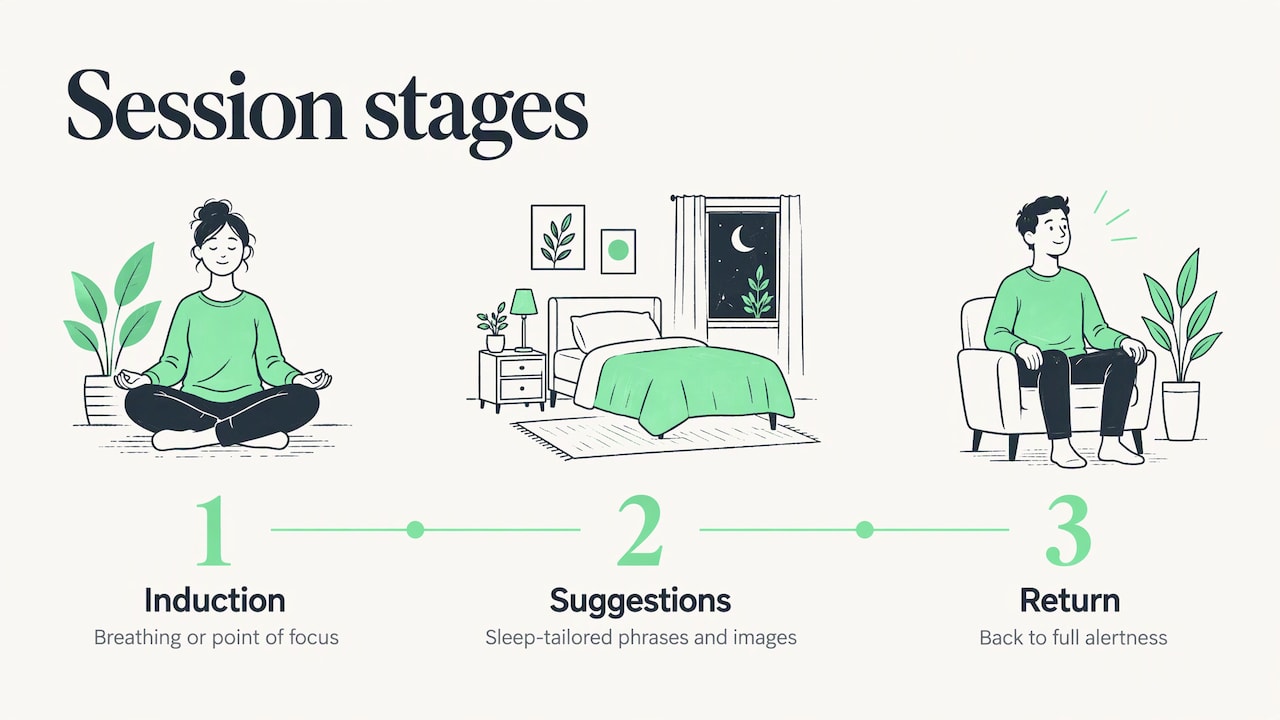
The induction. You settle into a comfortable position, focus on your breathing or a point of attention, and are guided into a calm, narrowed focus. Some people feel heavy and warm. Others feel light or simply quiet. Many say it feels like the moment just before sleep, while still hearing everything.
The suggestions. Phrases and images aimed at your pattern: letting the day’s thoughts stay outside the bedroom, associating the bed with ease, or sleeping through the night.
The return. You are brought back to full alertness. Because the aim is a change in habit and response, you are not expected to fall asleep in the room, and you are not expected to feel drowsy afterward.
We offer sessions in person and online, so the work can happen from a comfortable place at home if that suits your schedule. Details of our formats are on our services page.
How many sessions it usually takes
The 2018 systematic review found that, in studies reporting positive effects, on average 3 to 4 sessions were enough to obtain benefits for sleep outcomes. The same review notes that home practice supported by audio recordings of sessions may boost the efficacy of treatment and reduce the number of sessions.
So the realistic picture is a short course rather than an open-ended one, with practice between visits. Longstanding insomnia, or sleep trouble tangled up with anxiety, can take a different shape, and your plan should be adjusted as you go. Each person responds differently, and no one can promise you a number in advance.
Working with a practitioner versus going it alone
A recording or an app can be more practical than traveling to an office, and many people start there. The Sleep Foundation notes that research on self-guided hypnosis is still limited, so it advises talking with your doctor or therapist before using a recording, video or app. It also notes that experts recommend sleep hypnotherapy be guided by a trained professional.
There are good reasons for that. A practitioner can:
- Write suggestions around your exact pattern rather than a generic script.
- Notice when something other than habit is driving your sleeplessness and suggest you raise it with your doctor.
- Adjust the pace if the process brings up something unexpected.
- Pair the sleep suggestions with a plan for your daytime stress, which is often the real engine of a restless night.
A generic recording can’t do any of that. It speaks to everyone, so it speaks specifically to no one. Our approach is highly customized and holistic: modern hypnotherapy techniques combined with life coaching and strategic planning, delivered in a safe, supportive environment. If you want a sleep plan built around you, our services are the place to begin.
Is hypnosis safe for sleep problems?
Hypnosis is generally considered safe when a trained professional conducts it, according to the Sleep Foundation, though rare adverse reactions have been described. The 2018 review notes that some people may experience dizziness, confusion, unpleasant physical sensations, false memories or panic attacks. It cites an earlier estimate of 7% for moderate to severe after-effects in research and clinical samples. The same review found a low incidence of adverse events in sleep studies.
A few groups should take specific care:
- PTSD and other mental health conditions. The Sleep Foundation says people with conditions such as PTSD may be advised to use caution and receive hypnotherapy only from a highly experienced counselor. If trauma is behind your sleep trouble, see our page on hypnosis for trauma and PTSD.
- Psychosis, suicidal depression or psychiatric medication. Medical News Today says people in these situations should receive hypnotherapy only from their doctor or psychiatrist, or with their doctor or psychiatrist present. If you are in crisis or thinking about harming yourself, call or text 988, the Suicide & Crisis Lifeline, or call 911.
- Anyone starting out. The Sleep Foundation advises talking with a health professional before beginning hypnosis. Tell your doctor you plan to try it, and bring your sleep notes to the first appointment.
Hypnosis also doesn’t suit everyone’s temperament or circumstances. We cover that openly in our piece on why hypnosis isn’t for everyone, so you can judge your own fit.
When insomnia needs a medical check first
Persistent insomnia is sometimes a symptom of something else. The American Academy of Sleep Medicine’s provider fact sheet on insomnia tells clinicians to look for conditions that contribute to or mask insomnia: mental health conditions, medical conditions such as pain or another sleep disorder, medications or substances, and sleep hygiene problems. It also points to referral to a sleep medicine physician for disorders such as obstructive sleep apnea or restless legs syndrome.
See your doctor if you snore loudly, wake gasping, have uncomfortable leg sensations at night, are in pain, or if sleeplessness has gone on for weeks and is affecting your days. Hypnosis then becomes one piece of a plan rather than the whole plan, and we are comfortable working that way.
Pain and sleep: where pain management hypnosis comes in
Pain is one of the most common reasons a night falls apart, and people who search for sleep hypnosis often search for pain relief too. A 2013 article on hypnosis as adjunct therapy for cancer pain states that research over the previous 20 years had firmly established that hypnosis can be effective for acute and chronic pain associated with cancer and its treatment. It describes hypnosis as a brief, time-limited adjunct to the primary pain management strategy.
The key word is adjunct. Hypnosis for pain sits beside your medical care, not in place of it. If pain keeps you awake, your doctor needs to know about it. Within that care, hypnosis can help you ease the tension around pain and quiet the nighttime attention it grabs. The same article says hypnosis is safe when practiced by a well-trained, experienced, licensed provider, and that one undesirable effect can be the inadvertent retrieval of unpleasant memories, which a well-trained hypnotist can anticipate and minimize.
Making hypnosis work for your sleep
A few habits tend to separate people who get more from the process.
- Keep a simple sleep log for a week or two. Note bedtime, time to fall asleep, wake-ups, caffeine and alcohol. It gives your session something concrete to target.
- Practice between sessions. Home practice supported by audio of your session may boost effects, according to the 2018 review.
- Protect the basics. A regular wake time, a dim wind-down hour and a cool, dark room all give suggestion something to build on.
- Name your trigger. Is it racing thoughts, worry about not sleeping, or tension from work? The more specific the target, the better the suggestions fit.
- Be patient with the first week. Some people notice changes within a few sessions, and your plan should adapt to your response.
- Keep your doctor in the loop. Especially if you take medication, have a mental health diagnosis or have pain.
Roughly 15% of people are highly receptive to hypnosis, according to the Sleep Foundation, and responsiveness varies widely. That is a reason to work with someone who adapts the approach to you instead of running a script.
Our perspective on sleep hypnosis
Most people who come to us about sleep are not really asking for sleep. They are asking for relief from a loop: the clock-watching, the dread at 10 p.m., the replaying of the day at 2 a.m. That loop is learned, and what is learned can be reshaped.
That is why we don’t hand everyone the same script. We start with the person: their schedule, their stress, their history, and what else is going on in their health. Then we build a plan that blends hypnotherapy with life coaching and strategic planning, so the calm you practice in session has a daily routine to live in.
We also like to work with your wider care. Hypnotherapy can sit comfortably alongside what your doctor recommends, and we see that combination as the more complete way to help. You can read more on how we combine hypnotherapy with traditional healthcare.
Our sessions are in person or online, in a safe and supportive space where you are always in control. If you have been lying awake wondering whether anything will help, a conversation is a good first step.
Rachael
Start with a plan built for your nights
MindShift Hypnosis offers hypnosis only, life coaching, and combined hypnosis life coaching, in person and online. Services include support for depression and anxiety, trauma and PTSD, and fears and phobias, all of which can keep a mind awake at night. Your sessions are shaped around your goals and your life, not a template.
See the full list on our services page and reach out from there to talk through your sleep.
FAQ
Can hypnosis cure insomnia?
Hypnosis is best understood as a tool for improving sleep, not a guaranteed cure. Reviews report benefits for sleep outcomes, and the VA lists insomnia among the conditions with evidence of a positive effect from clinical hypnosis. Results vary from person to person, and it works best alongside good sleep habits and medical care when needed.
Will I fall asleep during a hypnosis session?
You might feel very relaxed, but falling asleep during the session is not the goal. The aim is to change the thoughts and habits around sleep so that you sleep better afterward. You stay in control throughout and can end the session whenever you wish.
How many sessions does sleep hypnotherapy take?
In studies that reported positive effects, an average of 3 to 4 sessions was enough to gain sleep benefits. Practicing at home with audio from your sessions may boost the effect and reduce the number of sessions. Your own course depends on your pattern and what else is affecting your sleep.
Is it safe to try hypnosis for sleep while taking medication?
Talk with your doctor first, and tell your hypnotherapist what you take. People with psychosis, suicidal depression or psychiatric medication should receive hypnotherapy only from, or with, their doctor or psychiatrist. People with PTSD should work with a highly experienced practitioner.
Can hypnosis help if pain keeps me awake?
Hypnosis is used as an adjunct to medical pain management, and research describes it as effective for acute and chronic pain in cancer care. Tell your doctor about pain that disrupts your sleep, and use hypnosis as part of that plan with a trained, licensed provider.
Sources
- How Effective Is Hypnosis to Help You Fall Asleep? (Sleep Foundation)
- Clinical Hypnosis, Whole Health (U.S. Department of Veterans Affairs)
- Hypnosis Intervention Effects on Sleep Outcomes: A Systematic Review (Journal of Clinical Sleep Medicine, 2018)
- Hypnosis Intervention Effects on Sleep Outcomes (PMC full text)
- Hypnotherapy for insomnia: a systematic review and meta-analysis (PubMed, 2015)
- Sleep Hypnosis for Insomnia (WebMD)
- Hypnosis for insomnia (Medical News Today)
- Provider Fact Sheet: Insomnia (American Academy of Sleep Medicine)
- Behavioral and psychological treatments for chronic insomnia disorder (AASM guideline, 2021)
- Hypnosis: Adjunct Therapy for Cancer Pain Management (PMC, 2013)