
Hypnotherapy for grief is a guided, one-on-one process. A trained practitioner helps you reach a calm, focused state, then uses imagery and suggestion to work with the sadness, anger, guilt or anxiety that follows a loss. It doesn’t erase the loss or set a schedule for mourning. It gives you a steadier way to carry the loss at your own pace. This guide covers what a session looks like, what the evidence supports, the safety points worth knowing, and when grief calls for a licensed mental health professional.
TL;DR
- Hypnotherapy for grief uses focused attention, guided imagery and suggestion to help you process emotions and cope, not to make you “get over” a loss.
- You stay aware and in control the whole time. A session typically moves through induction, deepening, suggestions and a return to full awareness.
- Research on grief specifically is limited, mostly case reports, so treat hypnosis as one support alongside friends, counseling and medical care.
- Hypnosis is considered low-risk, but working through painful memories can bring up strong emotions, so choose a trained practitioner.
- If grief stops you from functioning for months, or you have thoughts of ending your life, call or text 988 or see a licensed professional now.
Table of Contents
- What hypnosis for grief actually is
- How hypnosis may help with grief
- What happens in a grief hypnotherapy session
- Safety: using hypnosis for grief well
- Checking a hypnotherapist’s qualifications
- When grief needs a licensed professional too
- Working with MindShift
- A few ways to support yourself between sessions
- FAQ
- Sources
What hypnosis for grief actually is
The American Psychological Association’s Division 30 describes hypnosis as a state of focused attention with reduced awareness of your surroundings and a heightened responsiveness to suggestion. It uses the word hypnotherapy for using hypnosis to treat a medical or psychological concern. Grief hypnotherapy is that tool pointed at the experience of loss.
Most people picture a stage show, so a few corrections matter. Cleveland Clinic explains that hypnosis is not sleep, mind control or brainwashing. Most people remember what happens during a session and stay in control. You can’t be made to say or do something you don’t want to.
Hypnotherapy versus a recording or sleep meditation
Search results for this topic are full of grief meditations and sleep hypnosis audio. They can be soothing, and many people use them at night. But a recording is written for everyone, so it can’t respond to you.
In a live session, the practitioner starts by listening. They ask about who you lost, how it happened, what you’re stuck on and what you hope will change. Then the work is built around those answers. If anger comes up instead of sadness, or guilt about the last conversation, the session moves with you. That responsiveness is the main difference.
How hypnosis may help with grief
Grief isn’t a single feeling. It can arrive as sadness, anger, numbness, dread, guilt, trouble sleeping or a constant sense of tension. Practitioners use hypnosis to address several of these at once.
Regulating overwhelming emotion. A deeply relaxed, focused state lets you approach painful feelings without being flooded by them. Practitioners describe helping people regulate emotions such as sadness, anger and anxiety as a central aim.
Gradual acceptance. Suggestions and imagery can help you take in the reality of the loss a little at a time, rather than all at once or not at all.
Rest. Grief often disrupts sleep. The relaxation skills learned in session carry over to bedtime.
Reconnecting with your own strengths. Many people feel they’ve lost their footing. Sessions can bring back a sense of capability, so daily tasks feel less impossible.
What the research says
Here is an honest picture. Cleveland Clinic notes that hypnosis may help with symptom management and changes in habits or behaviors, while many reported benefits are anecdotal and researchers are still learning how it works.
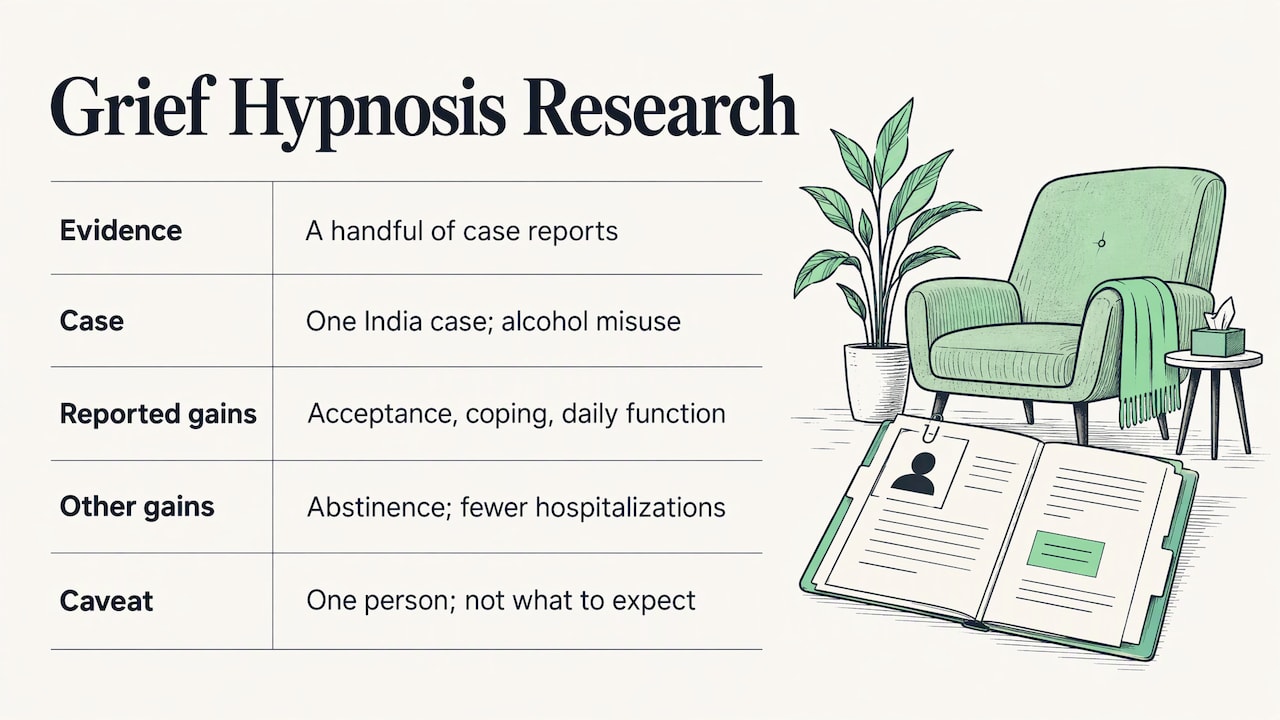
For grief in particular, the published evidence is a handful of case reports. One peer-reviewed case report from India describes a patient whose grief was linked to alcohol misuse. After hypnotherapy added to his care, he showed better acceptance of the loss, more adaptive coping, better day-to-day functioning, abstinence and fewer hospitalizations. It is one person, so it shows what is possible, not what to expect. That is why hypnosis works best as part of a wider support plan.
What happens in a grief hypnotherapy session
A session follows a predictable shape. Cleveland Clinic lists four stages: induction, deepening, suggestions and emergence. In grief work they look like this:
- Conversation first. You talk about your loss, your history and your goals. A grief-focused session often begins with this discussion before any hypnosis starts.
- Induction. Guided breathing and relaxation help your attention narrow and settle.
- Deepening. The practitioner guides you further into a calm, absorbed state, often with imagery.
- Therapeutic work. This is where emotional processing happens, using positive suggestions and imagery suited to you.
- Emergence. You are brought back to full, alert awareness, and you talk about what came up.
Techniques a practitioner might use
The published case report gives a concrete picture. Its 90-minute session combined guided imagery, a body scan, sensory visualization, ideomotor signaling (small finger movements that let you answer without speaking), direct and indirect suggestions, future progression, metaphors and deep breathing to close. The session was audio-recorded so the patient could practice self-hypnosis daily.
That last point is practical. Between sessions, a short recording or a simple breathing routine keeps the benefit going on days when no appointment is near.
How many sessions, and what to expect
No reliable figure exists for grief, because it depends on the loss, how recent it is, your other supports and what you want to change. Some people come for a few sessions to settle sleep and acute distress. Others use longer support during anniversaries or major transitions. A good practitioner will tell you their plan for the first few sessions and revisit it as you go. You can read more about what to expect from hypnotherapy on our site.
Expect to feel relaxed, and possibly tearful. Tears in a session are not a setback. Many people feel lighter afterward, and some feel tired for the rest of the day. Plan a quiet evening after your first visit.
Safety: using hypnosis for grief well
Hypnosis is regarded as low-risk. Cleveland Clinic lists rare effects such as dizziness, drowsiness, fatigue, headache, increased anxiety and trouble sleeping. The VA Whole Health Library reports that meta-analyses find hypnosis to be very safe.
The same VA page adds one point that matters for grief: using hypnosis to work through past events can bring up strong emotional reactions and may create false memories. The American Medical Association’s Council on Scientific Affairs likewise found that recollections under hypnosis can include confabulation and be less reliable than ordinary recall.
What that means in practice:
- Use hypnosis for coping, calm and acceptance, not to “dig up” facts about what happened.
- Tell your practitioner about any trauma history, so they pace the work carefully.
- Say so if something feels like too much. A good practitioner slows down or stops.
- Keep your doctor or therapist informed. We believe hypnotherapy works best alongside traditional healthcare.
Checking a hypnotherapist’s qualifications
In the United States, hypnotherapy is practiced by people with very different training, and titles vary by state. The VA notes that the American Society of Clinical Hypnosis and other groups offer certification programs. Before you book, ask:
- Where did you train, and in what kind of grief or loss work?
- Do you work alongside doctors and therapists?
- What does a first session include, and how will we decide on next steps?
- Do you offer online sessions if travel is hard right now?
A clear, unhurried answer to each is a good sign.
When grief needs a licensed professional too
Grief is not an illness. Still, sometimes it becomes heavy enough that you need more than one kind of help. The Mayo Clinic says to contact your doctor or a mental health professional if intense grief keeps you from functioning. It describes complicated grief as being unable to move through the usual stages more than a year after a death, with signs such as intense longing, trouble accepting the loss, withdrawal from others, deep guilt or feeling that life has no meaning.
Seek licensed care promptly if you notice:
- You can’t work, care for yourself or others, or keep up basic routines for weeks.
- You are using alcohol or other substances to get through the day.
- You feel life isn’t worth living, or wish you had died with the person.
If you are thinking about ending your life, or worry about someone who is, call, text or chat 988. The 988 Suicide & Crisis Lifeline is free, runs 24/7 anywhere in the United States and is open to anyone in emotional distress, not only in a suicide crisis. In an immediate danger, call 911.
Grief often brings depression, anxiety or trauma responses with it. If that’s your situation, see our pages on hypnotherapy for depression and hypnosis for trauma and PTSD. When a loss strains a relationship, relationship hypnosis can help partners grieve without drifting apart.
Our perspective on grief work
We don’t see grief as a problem to fix. It is love with nowhere to go, and our job is to help you carry it with more ease, not to hurry you past it.
At MindShift we pair personalized hypnotherapy with life coaching. The hypnosis side helps the body and mind settle, so the sleeplessness, tension and spiraling thoughts loosen their grip. The coaching side helps you plan: how to get through the first holiday, the anniversary, the return to work, the conversation with family that you keep putting off.
Every treatment plan we build is customized to the person. Someone grieving a parent after a long illness needs something different from someone who lost a friend suddenly. We also work with couples and families, because grief is often shared and each person mourns differently.
We welcome working alongside your doctor or therapist. Hypnotherapy is one part of your support, and the best results come when the parts talk to each other.
Rachael
Working with MindShift
We offer hypnotherapy, life coaching and a combined hypnosis and coaching approach, in person and online, for individuals, couples, families and groups. Our services include support for depression and anxiety, trauma and relationship needs, all of which often travel with grief. See the full list on our services page, or review our hypnotherapy pricing.

If you’re ready to talk about what support could look like for you, start from the MindShift Hypnosis home page and tell us a little about your loss. We will suggest a first step at a pace that suits you.
A few ways to support yourself between sessions
Hypnotherapy works better when the rest of your week supports it. These small habits help many people:
- Practice a short daily routine. Ten minutes of slow breathing or a session recording gives your nervous system a regular rest.
- Keep a few anchors. Meals, a walk and a bedtime, even when nothing else feels normal.
- Name one person to check in with. Grief isolates, and a standing call or coffee protects against it.
- Mark the hard dates in advance. Birthdays, anniversaries and holidays are easier with a plan you made on a calmer day.
- Let feelings move. Crying, anger and numbness are all part of grieving, and none of them means you’re doing it wrong.
If you are also facing a large life change after a loss, such as new family roles or a return to work, resilience coaching tools can give you practical footing.
FAQ
Can hypnosis take away grief?
No, and a good practitioner won’t promise that. Hypnosis can help you manage sadness, anger and anxiety, rest better and move toward acceptance. The loss stays part of your story, but it can weigh less heavily over time.
Is hypnosis safe if I’m grieving?
Hypnosis is generally considered low-risk, with rare effects such as drowsiness, headache or dizziness. Because grief work can stir up strong emotions, choose a trained practitioner, share your history and ask to slow down whenever you need to. If you also have depression or trauma symptoms, keep your doctor or therapist informed.
Will I lose control or be unable to wake up?
No. You remain aware and in control, and most people remember the session. At the end, the practitioner guides you back to full awareness, and you can open your eyes whenever you choose.
Is a hypnosis recording enough, or do I need a live session?
Recordings can help with relaxation and sleep. A live session adds a person who listens to your story and shapes the work around it. Many people combine both, using a recording from their session for daily practice.
Can online hypnotherapy work for grief?
Many people find it comfortable to do sessions from home, where they can rest afterward. We offer online services, so distance or low energy need not stop you from getting support.
Sources
- Hypnosis: What It Is, How It Works, Benefits & Risks, Cleveland Clinic
- American Psychological Association Division 30, definitions of hypnosis
- Clinical Hypnotherapy in Grief Resolution: A Case Report
- Understanding Grief and how Hypnotherapy can help
- Clinical Hypnosis, VA Whole Health Library
- Scientific status of refreshing recollection by the use of hypnosis, AMA Council on Scientific Affairs
- Complicated grief, Mayo Clinic
- 988 Frequently Asked Questions, SAMHSA