
Family hypnosis is the use of hypnosis, alone or alongside family therapy and coaching, to help the people in one household change the patterns that keep them stuck. Instead of treating one person in isolation, the work looks at how everyone communicates, reacts and supports one another, then uses focused attention and guided imagery to open new options. Below you will find how a session runs, who can take part, what research says, and how to choose support in the United States.
TL;DR
- Family hypnosis applies guided focus to the whole family system, so the work targets patterns between people, not only one person’s symptoms.
- Professionals have written about combining hypnosis with family therapy since the 1980s, and a published family hypnotherapy model dates to 1985.
- Sessions are conversational. Hypnosis is not mind control and does not make anyone reveal secrets they would not otherwise share.
- Children can take part, and the research on pediatric hypnosis is encouraging, but it works best alongside the child’s doctor or mental-health provider where a medical or trauma issue is involved.
- At MindShift we pair personalized hypnotherapy with life coaching for individuals, couples, families and groups, in person or online.
Table of Contents
- What family hypnosis actually is
- What happens in a session
- Who can take part
- Concerns families bring
- What the research says
- Using hypnosis safely alongside healthcare
- Understanding hypnosis practitioners in the US
- Getting the most from sessions
- Perspective from our practice
- Start with MindShift
- FAQ
- Sources
What family hypnosis actually is
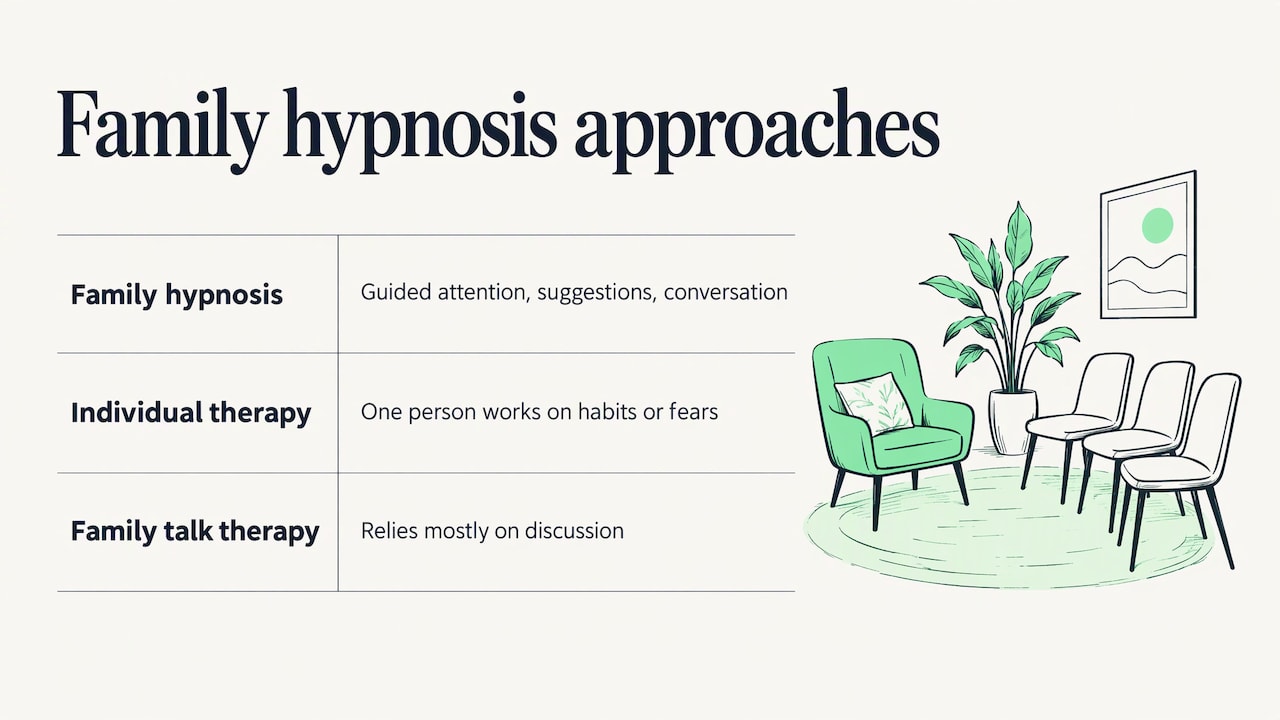
There is no single product called family hypnosis. It is a way of working. A practitioner guides one or more family members into a state of focused, relaxed attention, then uses suggestions, metaphors and conversation to help them respond differently to each other and to the problem that brought them in.
That is different from individual hypnotherapy, where one person works on their own habits, fears or stress. It is also different from talk-based family therapy, which relies mostly on discussion. Family hypnosis borrows from both. The therapist pays attention to the connection between practitioner and clients, between each person and their own experience, and looks for ways to create shared experiences among family members that can let patterns change on their own.
The idea has a long track record in professional writing. A book by Ritterman, described by the Milton H. Erickson Foundation as the first devoted to family hypnotherapy, says its hypnotic techniques can be added to virtually any family therapy model. Daniel Araoz, quoted on the same page, describes how what a family has been doing ineffectively can be turned around once members become aware of their communication patterns.
Why families are a natural fit
Hypnosis can feel unfamiliar, but families already live inside something like it. Researcher Camillo Loriedo notes that using hypnosis with families appears easy and natural because the family is where most of us have our earliest hypnotic experiences: a parent’s soothing voice, a bedtime story, a mood that spreads through a room. In his work on systemic trances, he adds that studying how a family naturally induces trance is one of the best ways to learn to use hypnosis with couples and families.
Think of the evening argument that repeats every night. Everyone knows their lines. That repetition is a kind of trance. Family hypnosis aims to interrupt it gently and replace it with something calmer.
What happens in a session
Every practitioner works a little differently, and good work is individualized. Still, the shape is familiar.
- Listening first. Each person describes the concern in their own words. A good session gives every member a turn, including the quiet teenager and the skeptical parent.
- Setting goals together. The family agrees on what “better” looks like: fewer blowups before school, easier conversations about money, less tension after a loss.
- Guided focus. Participants are invited to relax, breathe and concentrate on a calm image or a simple instruction. They stay aware the whole time. Nobody loses control.
- Suggestions and metaphors. The practitioner uses stories and imagery that fit this family, aimed at confidence, patience or a new response to a familiar trigger.
- Small experiments at home. Families leave with a short practice to try, such as a shared breathing pause before dinner or a new way to start a hard conversation.
Professional literature describes the same spirit. In a case Douglas Flemons uses to illustrate hypnosis-informed work, a family is struggling with a boy’s truancy. The therapist connects with each member, explores how each makes sense of the problem, and watches for small spontaneous shifts in how they interact. Small shifts matter because they often grow.
If school stress is part of your story, calm routines for young children can support what you practice in sessions. Simple mindfulness practices for preschoolers are one way to build the same habits of pausing and breathing at home.
What hypnosis is not
People often hesitate because of stage shows. The American Society of Clinical Hypnosis explains in its Q&A that hypnosis is not a truth serum and that people in trance reveal nothing they would not reveal when awake. Family members keep their privacy, their judgment and their right to stop at any moment.
Who can take part
Family hypnosis can include parents, partners, siblings, grandparents and older children. Some sessions involve everyone together. Others work with one member while the rest are kept in the loop, or alternate between joint and individual meetings. The right mix depends on the concern and on who is willing.
A few practical principles apply:
- Participation is voluntary. Nobody should be pushed into trance. Someone can listen, observe or sit out and still contribute through conversation.
- Consent is ongoing. The International Society for Hypnosis ethics code says that when a clinical patient faces unusual stress or risk, they should be informed and give consent, and that the patient’s welfare comes first.
- Children get age-appropriate work. Younger children respond to stories, play and imagery. Parents are usually present, and the language stays simple and positive.
- Privacy is agreed up front. Families decide what is shared with whom, especially when teens are involved.
We offer sessions for individuals, couples, families and groups, so your household can start with the format that fits. For couples, our guide to relationship hypnosis shows how the same ideas work with two people.
Concerns families bring
Families usually arrive with a mix of everyday friction and heavier stress. Common examples include:
- Constant arguments, power struggles or a tense atmosphere at home
- Anxiety in a child or parent, and worry that spreads through the household
- Adjusting to separation, a move, a new baby or a blended family
- Grief and the aftermath of a family shock
- Fears and phobias that shape the family’s routines
- School avoidance and behavior at school
- Performance pressure in a young athlete or performer
Parents who are separated may also find our co-parenting coaching scripts useful for hard conversations. For fears that dominate family life, our fears and phobias work is part of what we offer, and young athletes can explore sport hypnosis for peak performance.
What the research says
The family-specific literature is mostly clinical writing and case studies, not large trials. John Churchill’s 1986 article in the American Journal of Family Therapy sets out a rationale for combining hypnotherapy and conjoint family therapy, illustrated with a case spanning three generations of one family. The earlier 1985 model by Araoz and Negley-Parker aimed to help families draw on experiential, right-hemisphere functioning through hypnosis.
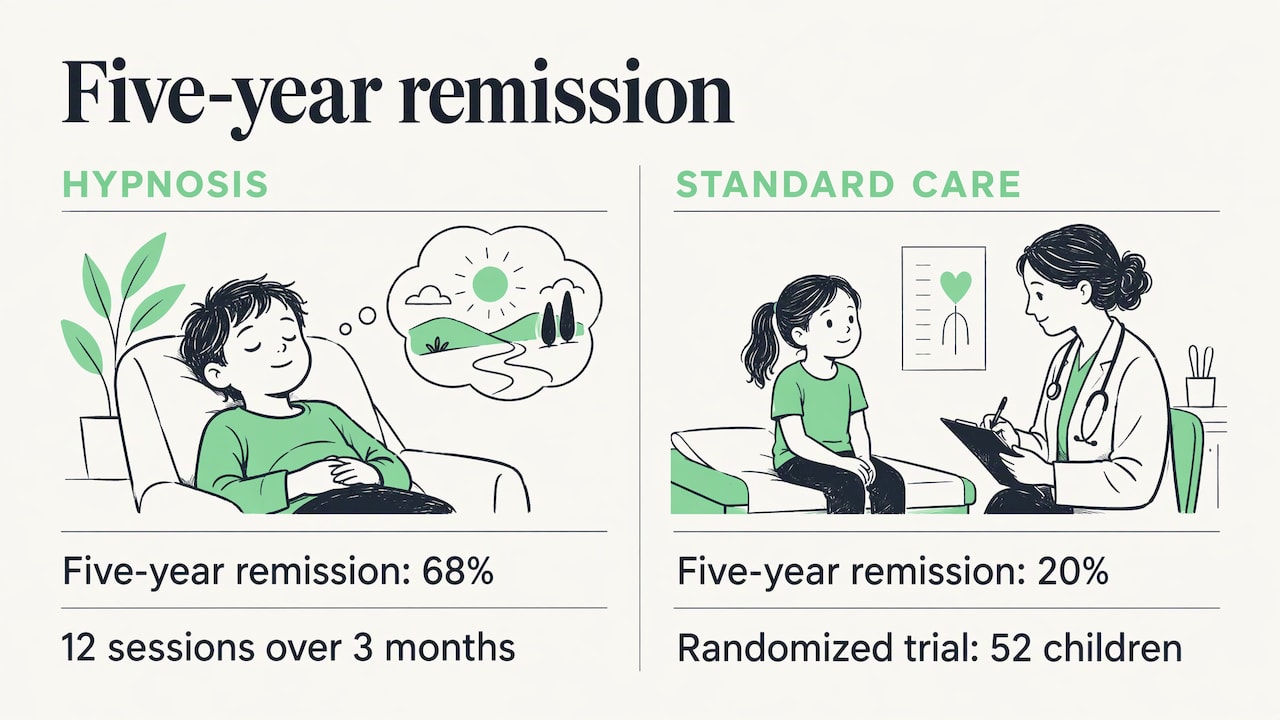
The strongest numbers come from pediatric hypnosis. A 2016 review in Pediatrics describes a randomized trial of 52 children with functional abdominal pain. Twelve hypnosis sessions over three months improved pain frequency and severity, and at five years remission was higher with hypnosis than standard care, 68% versus 20%. That is a stomach-pain study, not a family-conflict study, but it shows children can respond well to the method.
The ASCH lists many areas where clinicians use hypnosis, including pain, unwanted habits, depression, sleep, phobias and athletic performance. The same Pediatrics review explains why large studies are hard: good hypnosis is built on rapport and tailored to the individual, which does not fit a standardized protocol. That individualization is exactly what we put first at MindShift.
Using hypnosis safely alongside healthcare
Hypnosis works best when it is part of a coordinated plan. The Pediatrics review says clinical hypnosis should be used by appropriately trained providers who can manage the clinical situation. It gives two examples: a mental-health practitioner should involve a physician for a child with irritable bowel syndrome, and a pediatrician should collaborate with a mental-health practitioner when using hypnosis for PTSD.
Put simply for your family:
- If a child has a physical symptom such as recurring stomach pain, headaches or bedwetting, keep the pediatrician involved and let hypnosis support that care.
- If anyone in the family has experienced trauma, has symptoms of PTSD, or is in a mental-health crisis, bring in their doctor or licensed therapist. In an emergency or if someone may harm themselves, call 988, the Suicide & Crisis Lifeline, or 911.
- If a family member already sees a therapist or takes medication, tell every provider what you are doing so the plan stays consistent.
This is how we approach it too. Our work is designed to integrate with traditional healthcare, and you can read how in our page on combining hypnotherapy with traditional healthcare. For deeper concerns, see our pages on hypnosis for trauma and PTSD and hypnotherapy for depression.
Understanding hypnosis practitioners in the US
Hypnosis is regulated unevenly across the country. The ASCH says there are few, if any, state laws regulating the practice of hypnosis, so the training and background of practitioners vary widely. Its consumer guide separates licensed health care providers trained in hypnosis from non-licensed or lay hypnotherapists, and notes that state registration is not the same as licensure and may not include educational requirements.
What that means for you is to understand the type of service you are booking. Hypnotherapy and life coaching are personal-development and wellness services. When a concern is a diagnosed medical or mental-health condition, the best results come from combining that care with a licensed provider, which is the model we follow.
Insurance is another practical question. Coverage for hypnosis depends on the provider and the plan, and we explain the billing code questions in our guide to hypnotherapy insurance in the US.
Getting the most from sessions
A few habits make family sessions more productive:
- Agree on one clear goal. “Fewer mornings that end in shouting” beats “be happier.”
- Practice between sessions. Five minutes of shared breathing or a short audio practice keeps momentum.
- Stay curious, not accusing. The point is to change the pattern, not to find who is to blame.
- Let each person move at their own pace. Some members will take to it quickly, others will need time.
- Notice small wins. One calmer dinner is real progress, and it tends to build.
Resilience tools help here too. Our resilience coaching tools are simple practices that individuals can try today.
Perspective from our practice
Families rarely come to us because they want hypnosis. They come because something at home feels stuck, and they are tired of having the same argument or watching someone they love struggle.
Our view is that change sticks when it is personal. That is why we combine hypnotherapy with life coaching and strategic planning. Hypnosis helps people settle, listen and see new options. Coaching turns those options into plans and habits a family can actually use on a Tuesday night.
We build each plan around the people in the room. A family with a worried child, a couple rebuilding trust and a team under pressure all need different things, so we do not hand out a script. We also work with traditional healthcare, not around it, because the best outcomes come when everyone supporting you is pulling in the same direction.
Safe, supportive and individualized: that is the standard we hold ourselves to, whether we meet you in person or online.
Rachael
Start with MindShift
If your family is ready to try a different approach, MindShift Hypnosis offers personalized hypnotherapy and life coaching for individuals, couples, families and groups, in person and online. We build a customized plan around your goals, whether that is calmer communication at home, support through a hard season, or overcoming a fear that affects everyone.

See our services to find the format that fits, or visit MindShift Hypnosis to get in touch and book a session.
FAQ
Is family hypnosis the same as family therapy?
No. Family therapy is mostly conversation about relationships and patterns. Family hypnosis adds guided focus and imagery to that work, so members can have shared experiences that shift how they respond to each other. Professionals have described hypnosis as something that can be woven into virtually any family therapy model.
Can children take part in family hypnosis?
Yes, in age-appropriate ways. Children usually respond to stories, play and imagery, with a parent present. Published pediatric research includes a trial in which children with functional abdominal pain improved with hypnosis, and the review notes that trained providers should manage the clinical situation. For medical or trauma-related concerns, keep the child’s doctor or therapist involved.
Will hypnosis make my family reveal private things?
No. Hypnosis is not a truth serum, and people in trance reveal nothing they would not share when awake, according to the ASCH. Everyone stays aware and in control, and families agree in advance on what is shared.
Can we do family hypnosis online?
Yes. We offer online sessions as well as in-person ones, so relatives in different places can join the same session. See our services page for the formats available.
Sources
- Hypnosis and Family Therapy, Douglas Flemons
- Family Hypnotherapy, American Journal of Family Therapy (ERIC)
- Using Hypnosis in Family Therapy, Milton H. Erickson Foundation
- Hypnosis in Couple and Family Therapy, Springer
- Hypnotherapy and Conjoint Family Therapy, Taylor & Francis
- Mind-body therapies in children and youth, Pediatrics review
- ASCH Questions and Answers
- ASCH Choosing a Clinician
- Code of Ethics, International Society for Hypnosis
- Mindfulness for Preschoolers, Bloomwise Learning