
Relationship hypnosis is guided hypnotherapy that works with the beliefs, emotional habits and old patterns that shape how you connect with a partner. You can do it as a couple or on your own. It is best used alongside good communication work and, when needed, licensed mental health care, not as a stand-in for either. Below you will find how it works, what a session looks like, what the research does and does not show, and how to choose a practitioner.
TL;DR
- Relationship hypnosis uses focused relaxation and guided imagery to work with unconscious patterns, such as guardedness, fear of conflict or repeating the same dynamic, that affect closeness and trust.
- It can be done in couples sessions or individually. Often one partner’s change shifts the whole dynamic.
- Research on hypnosis in couples work is still limited. Clinicians describe it as a way to support therapy, not a guaranteed fix.
- Choose a practitioner who is clear about training, works with your goals, and coordinates with a therapist or doctor when depression, trauma or abuse is involved.
- At MindShift we pair hypnotherapy with life coaching, so insight turns into daily habits you and your partner can keep.
Table of Contents
- What relationship hypnosis actually is
- How hypnosis can help couples communicate and reconnect
- What a couples hypnosis session looks like
- What the research says
- > Perspective
- Who relationship hypnosis can suit
- How to choose a relationship hypnosis practitioner
- What to expect over a few weeks
- Work with MindShift Hypnosis
- FAQ
- Sources
What relationship hypnosis actually is
Hypnosis is a state of focused attention and deep relaxation in which you stay aware and in control, and are more open to new ideas and imagery. In relationship work, the practitioner uses that state to explore how you respond to closeness, conflict, rejection and trust.
The idea behind it is that many of our relationship reactions were learned early and reinforced by experience. A professional overview of hypnosis for relationships explains that hypnotherapy may help by engaging the brain states where those patterns were first encoded. Focused relaxation can ease the hypervigilant conscious mind and let the work reach patterns held in implicit memory.
In plain terms: you may know you should not shut down during an argument, yet you do it every time. Knowing is not the same as changing the automatic response. Hypnosis aims at the automatic response.
Why “relational” matters
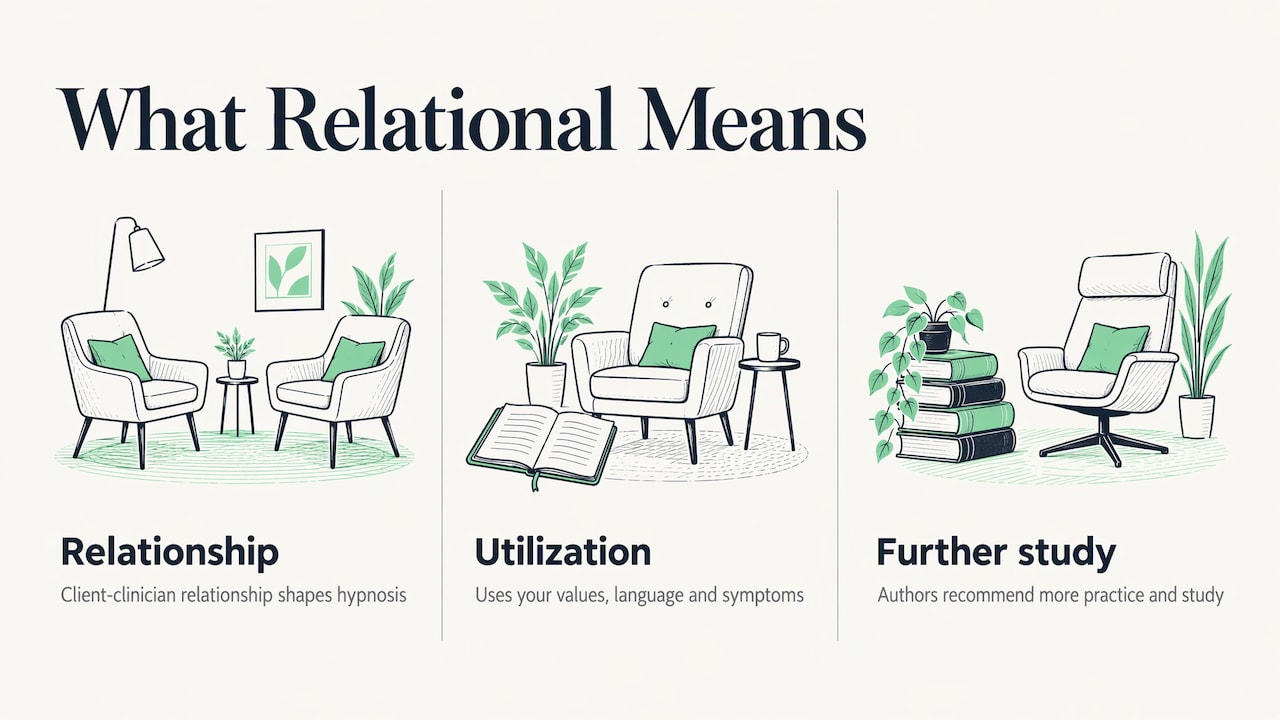
Modern clinical hypnosis does not treat the practitioner as someone who does something to you. A 2020 panel summary by Spiegel and colleagues from the American Society of Clinical Hypnosis looked at how the relationship between client and clinician, and attachment processes, shape what hypnosis can do. The authors recommend more clinical practice and study in this area, which is a fair reflection of where the field stands.
A 2024 Couples Conference presentation on hypnosis for couples points to a central Ericksonian strategy called utilization. The practitioner uses your own values, language and even the symptom itself to attune to your world instead of imposing a script.
How hypnosis can help couples communicate and reconnect
Couples work is harder than individual work. A 2005 article by Amanda Ferguson notes that the therapist has to manage power struggles and two people’s emotions and versions of reality at once. She describes hypnosis as a way to move more nimbly between partners while validating each person’s feelings, thoughts and beliefs.
Hypnosis is not new to marriage and family work either. Dr. D. Corydon Hammond, a former president of the American Society of Clinical Hypnosis, is listed by the University of Utah School of Medicine as combining clinical hypnosis with couples work, including marital communication and conflict resolution training.
Here is what that can look like in practice.
| Common concern | What hypnosis work often focuses on |
|---|---|
| Arguments that escalate fast | Calming the body’s alarm response so you can pause before reacting |
| Shutting down or avoiding conflict | Imagery and suggestions that make it feel safer to speak |
| Distrust after betrayal | Easing the habit of scanning for threat, whether too guarded or too clingy |
| Repeating the same type of partner | Noticing the belief underneath, such as “I have to earn love” |
| Feeling like roommates | Rebuilding attention, curiosity and appreciation toward each other |
Trust, hurt and repeated patterns
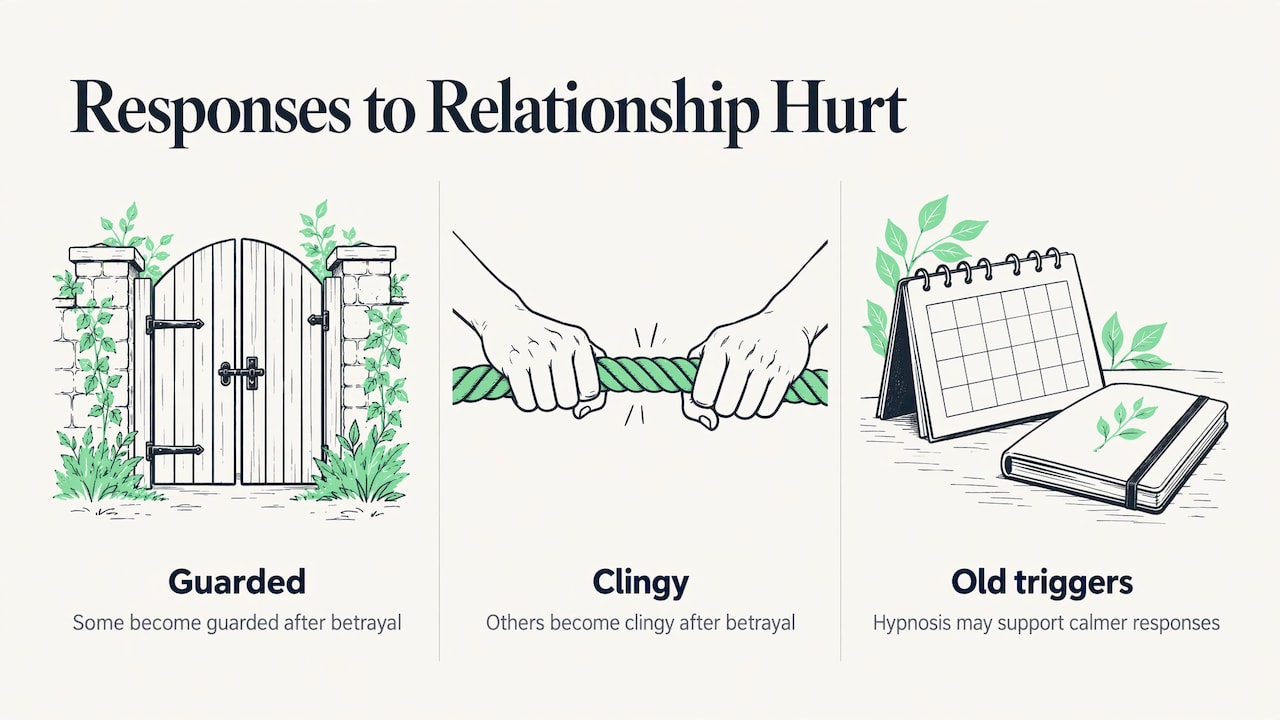
After a history of betrayal, some people become guarded, others clingy. The professional overview cited above describes hypnotherapy as a way to work with unconscious patterns formed in early life and reinforced since. Ferguson’s article adds that couples who come to therapy are often ready to work unconsciously, but conscious issues can get in the way. Trance sets conscious chatter aside and lets each person look at defenses more readily.
If the hurt is tied to a breakup, divorce or co-parenting, the emotional pull of an ex can linger long after the legal work is done. A guide on managing emotions after divorce covers the practical side, and hypnosis can sit beside it by helping you respond more calmly to old triggers.
What a couples hypnosis session looks like
Practices differ, but a session usually follows a rhythm like this. This describes our general approach, and the details are tailored to each client.
- Conversation first. You talk about what is happening, what you want and what you have already tried. The assessment is brief and aims to find a clear target, an approach in the spirit of the one Zeig and Tanev describe in their 2020 analysis of Milton Erickson’s marital hypnotherapy.
- Goal setting. Each partner names one or two specific changes, such as “we pause before raising our voices” or “I feel heard when I bring up money.”
- Induction. A guided relaxation, often with breathing and imagery, helps you settle into a focused state. You are awake and can open your eyes at any time.
- Suggestion and imagery. The practitioner uses evocative, personalized language, plants ideas that can pay off later and moves in small steps. The same 2020 analysis stresses that the main aim is to draw out resources you already have.
- Return and discussion. You come back to full alertness and talk about what you noticed.
- Practice. You leave with simple things to do between sessions.
Sessions can be done together, one partner at a time, or with one partner only. If your partner is not interested, individual work on your own responses is still a legitimate starting point.
Can partners practice self-hypnosis at home?
Yes, and it is often part of the plan. Self-hypnosis is a short, guided relaxation you run yourself. In the one controlled study of hypnosis and couples we reviewed, participants received a CD for home self-hypnosis practice alongside group sessions (Grégoire et al., 2021). A few simple habits that fit relationship goals:
- Practice a three-minute calming routine at a regular time, not in the middle of an argument.
- Pair it with one phrase you both agree on, such as “slow down, we’re on the same side.”
- Use a short visualization before a hard conversation, picturing how you want to sound and how you want your partner to feel.
- Check in weekly: what worked, what did not, what to adjust.
For a calming phrase you can try right away, see our guide to stress relief hypnosis.
What the research says
Here is the honest picture, so you can set realistic expectations.
- Hypnosis has mostly been studied for individual problems. A 2020 article presenting a Milton Erickson marital session notes that hypnosis has primarily treated individual problems and only occasionally couples’ problems.
- Early clinical work looks promising in sexual health. A paper on hypnosis in psychiatry reports on a study by Araoz of 200 couples in which 150 received hypnosis in addition to traditional sex therapy. It describes a large difference in favor of the hypnosis group at one-year follow-up.
- Results depend on who receives the intervention. In the 2021 exploratory study of women with cancer and their partners, the hypnosis program was delivered to patients only. It found no significant effect on partners’ distress, couple communication or dyadic coping, though 32% of partners said they noticed a change in the couple relationship (Grégoire et al.). The takeaway for couples: when both people take part, the work can address both sides.
- The field wants more study. The ASCH panel summary recommends further clinical practice and research on relational hypnosis.
Hypnosis is best seen as one tool inside a broader plan. That is how we use it.
> Perspective
We see relationship problems as patterns, not verdicts. Two people who care about each other can still get stuck in a loop: one pursues, one withdraws, and both feel unseen. Willpower rarely breaks a loop like that, because the reaction happens faster than the decision.
That is why we combine hypnotherapy with life coaching. Hypnosis works with the automatic layer: the guardedness, the fear of conflict, the old story about what love costs. Coaching works with the practical layer: how you talk on a Tuesday night, how you plan time together, how you repair after a fight. Either one helps. Together they give change somewhere to land.
We build each plan around the people in the room, whether you come as a couple, as a family or on your own. We also stay in step with your doctor or therapist when you have one, because the best results come from a team that shares the same goals.
Rachael
Who relationship hypnosis can suit
People usually come to this kind of work for one of a few reasons:
- Couples who feel stuck. The same argument returns in new clothes, and talking about it makes it worse.
- Individuals with a repeating pattern. You keep choosing the same kind of partner or pulling away when things get close.
- People healing from a breakup or betrayal. You want to feel safe trusting again without swinging to either extreme.
- Families under strain. Blended households, separation and co-parenting stress all tax communication. Our co-parenting coaching scripts give practical wording for hard conversations.
- People whose stress is spilling into the relationship. Work pressure, anxiety or low mood can shape how you show up at home.
When to bring in a licensed professional
Hypnosis is typically used as an adjunct alongside other psychological or medical treatment, as Psychology Today describes it. Certain situations need a licensed clinician involved, with hypnosis in a supporting role if at all:
- Ongoing depression, panic or thoughts of self-harm. Talk to your doctor or a licensed therapist. In the US, you can call or text 988, the Suicide & Crisis Lifeline, at any time.
- Trauma or PTSD tied to the relationship. Our page on hypnosis for trauma and PTSD explains how we work, and our approach to combining hypnotherapy with traditional healthcare covers how we coordinate with your care team.
- Any form of abuse or coercive control. Couples work is not the right setting; contact a domestic violence advocate or licensed therapist first.
How to choose a relationship hypnosis practitioner
Use these criteria:
- Training and scope. Ask what training they have in hypnotherapy and in working with couples. For reference, Psychology Today notes that membership in the American Society of Clinical Hypnosis requires a doctoral degree in medicine, dentistry or psychology, or a master’s in nursing, social work, psychology or marital and family therapy, plus approved hypnosis training hours.
- Clear goals. A good practitioner helps each of you define a specific, observable change.
- Fairness. In couples work, both partners must feel heard. Ferguson’s article highlights validating each person’s reality.
- Coordination. They should be comfortable working with your therapist or physician.
- Format. Check whether in-person or online sessions suit your schedule. We offer both.
- Homework you can keep. Short practices you can actually do beat long ones you will skip.
What to expect over a few weeks
Change usually shows up first in small moments. You notice the pause before the sharp reply. You bring up a topic you used to avoid. You recover faster after a disagreement. Many people find it useful to track two or three of these each week.
An example plan, not a promise of results, might look like this:
- Weeks 1 to 2: Clarify goals, learn a short calming practice, map the main loop.
- Weeks 3 to 4: Work on the core pattern in hypnosis, such as the reaction to feeling criticized, and practice new wording in daily life.
- Weeks 5 and beyond: Reinforce what is working, plan for stressful periods and decide together how often to check in.
If stress at work is feeding tension at home, our piece on emotional intelligence coaching shows how a few breaths and a clear intention can change how you walk through the door.
Work with MindShift Hypnosis
We offer personalized hypnotherapy and life coaching for individuals, couples, families and groups, in person and online. Relationship work is built around your goals, with a customized plan and practical steps for between sessions. You can read more about hypnotherapy for couples or see everything we offer on our services page.
The current fee information is on our pricing page, and you can reach us through the main site at mindshifthypnosis.com to ask which format fits you best.
FAQ
Does hypnosis for couples really work?
Research on hypnosis specifically for couples is still limited, and clinicians generally present it as a support to therapy rather than a stand-alone cure. Some clinical reports, such as Araoz’s work combining hypnosis with sex therapy, describe benefits, and practitioners describe it as a way to work with unconscious patterns. Results depend on the goals, the practitioner and how much practice happens between sessions.
Do both partners need to attend?
No. Sessions can be joint or individual, and individual work is a valid starting point. Changing your own reactions often changes the dynamic. That said, when both partners take part, each person’s experience can be addressed directly.
Will I lose control or say things I do not want to say?
No. In hypnosis you stay aware and can end the session whenever you wish. You are not made to reveal anything, and good practitioners work at a pace you are comfortable with.
Can hypnosis help after a breakup or betrayal?
It can support you in easing guardedness, rumination and strong emotional triggers, and in building trust in yourself. If the experience involved abuse or you feel persistently low or anxious, see a licensed therapist or your doctor as well.
Is online hypnosis as useful as in-person sessions?
Many people do well online because they can relax in their own space, and partners can join from the same couch. We offer both, and we can help you pick the format that suits your situation.
Sources
- Hypnosis for Relationships, International Hypnosis credentials overview
- Hypnosis for Couples, 2024 Couples Conference presentation
- D. Corydon Hammond, University of Utah School of Medicine
- Marital Hypnotherapy: A Session with Milton Erickson, PubMed
- Hypnosis and The Therapeutic Relationship, PubMed
- Exploratory Controlled Study of the Impact of Hypnosis on Couples, Grégoire et al.
- Application of hypnosis in psychiatry, treatment of sexual disorders
- Hypnotherapy, Psychology Today
- Managing emotions after divorce, CoParent Navigator