
Hypnosis can help you feel calmer about flying by pairing deep relaxation with focused suggestions that change how your mind reacts to boarding, takeoff and turbulence. It is not a magic switch, and it works best when you take part in it. This guide covers how it works, what the research says, what a session is like, how to prepare for your next flight, and when to bring in a doctor or psychologist as well.
TL;DR
- Hypnosis for flight fear uses relaxation and guided imagery to help your mind treat flying as manageable instead of threatening.
- In one study of 178 flying-phobia patients, hypnotizable patients were over 2.5 times more likely to report some positive impact after a single 45-minute session.
- You stay aware and in control the whole time. Hypnosis is not sleep and not mind control.
- Mayo Clinic says hypnosis is effective for coping with anxiety but is usually recommended alongside other treatments such as CBT.
- Full panic attacks, or fear that keeps you from traveling at all, deserve professional support from a licensed clinician.
Table of Contents
- Why flying scares people who know the odds
- How hypnosis works for a fear of flying
- What the research says
- What a hypnosis session for flight fear looks like
- Preparing for your session
- Self-hypnosis and calming habits for the day of the flight
- Flight anxiety, panic attacks and when to get more help
- Our perspective
- Choosing a qualified hypnotherapist
- Online or in person
- How to help someone who is afraid of flying
- Work with us on your fear of flying
- FAQ
- Sources
Why flying scares people who know the odds
Most people who fear flying can recite the safety statistics and still feel their stomach drop when the cabin door closes. That gap is the whole point. The fear does not come from a lack of information. It comes from the part of your brain that reacts before you think: the alarm system that reads confinement, noise, motion and lack of control as danger.
The fear usually shows up in a few forms:
- Anticipatory dread. Weeks or days before the trip, you rehearse worst-case scenarios.
- Fear in the cabin. Takeoff, turbulence and unfamiliar sounds set off a surge of adrenaline.
- Fear of your own reaction. Some people are less afraid of the plane than of having a panic attack with nowhere to go.
- Avoidance. You turn down trips, jobs or family events to avoid a flight.
The Anxiety and Depression Association of America points out, as summarized by Medical News Today, that anticipatory anxiety is often more intense than anxiety on the plane itself, and that feeling anxious does not mean a situation is dangerous. That matters for hypnosis, because much of the work happens well before you get to the airport.
How hypnosis works for a fear of flying
The APA Dictionary of Psychology defines hypnotherapy as the use of hypnosis in psychological treatment to modify behavior patterns or ease symptoms, and notes evidence for its use in anxiety disorders. In practice, a session for flight fear tends to do four things.
Deep relaxation first
You are guided into a focused, relaxed state, usually with your eyes closed, through slow breathing and calm imagery. A body that has practiced relaxing on cue is harder for anxiety to hijack.
Rehearsal in the mind
While you are relaxed, you are guided through the flight in detail: packing, the airport, boarding, the engines spooling up, the climb, a bump of turbulence, landing. Because your mind responds to vivid imagery much like it responds to real events, you get repeated practice at feeling steady in moments that normally trigger alarm.
New suggestions about what the experience means
The therapist offers suggestions tailored to you. These might be that the sounds of the aircraft are routine, that your breath can settle your body, or that you can feel curious or even excited about the trip. The goal is to update the automatic response, not to talk you out of a feeling.
A cue you can use anywhere
Many people leave with a short technique, such as a breathing pattern or a mental image, that they can use in their seat. This is a form of self-hypnosis, and we cover it below.
What the research says
Hypnosis for flying has been studied directly, and anxiety in general has a larger body of research. Here is what the evidence supports, and what it does not claim.
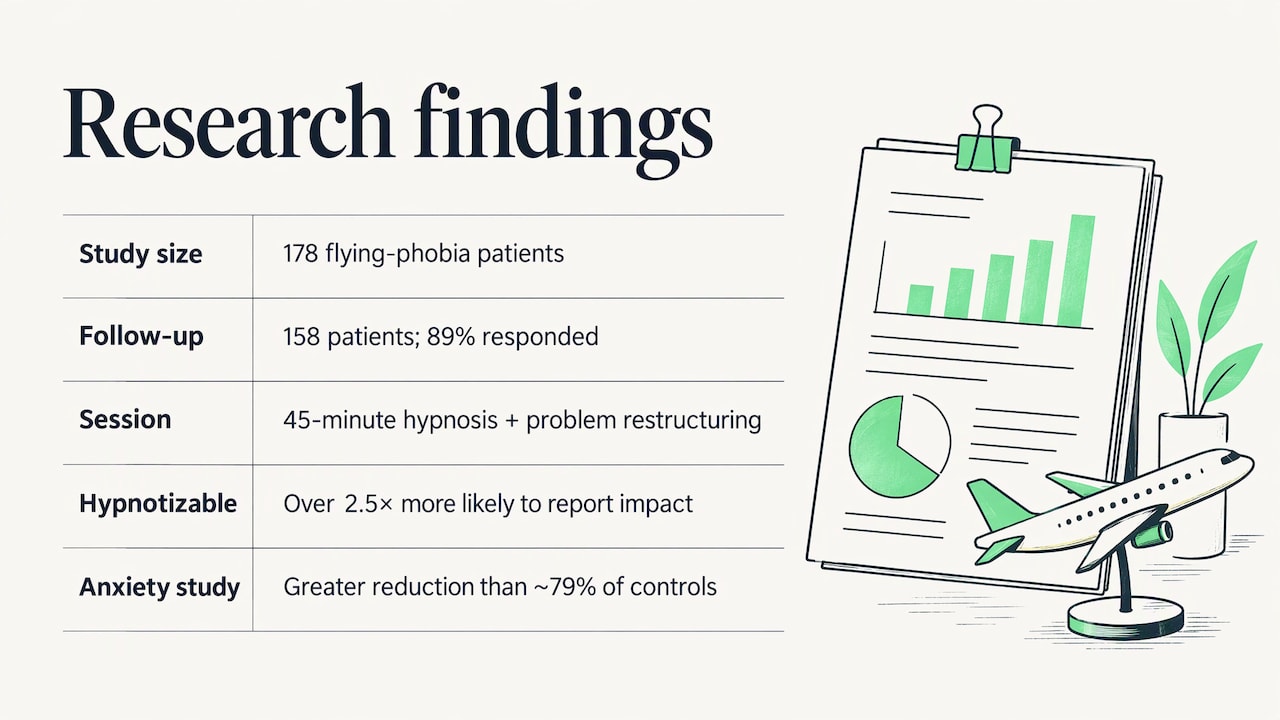
Flying phobia specifically. A study of 178 patients treated for flying phobia used a single 45-minute session combining hypnosis with problem restructuring. Of those patients, 158 (89%) completed follow-up questionnaires. Hypnotizable patients, meaning people who respond readily to hypnotic suggestion, were over 2.5 times more likely to report some positive treatment impact.
Anxiety more broadly. A meta-analysis of hypnosis as a treatment for anxiety found that, at the end of active treatment, the average person receiving hypnosis reduced anxiety more than about 79% of control participants.
What this means for you. Results are not identical for everyone. People differ in how readily they respond to hypnosis, and the flying study reflects that. What the research supports is that hypnosis is a reasonable, evidence-informed option for anxiety, including flight anxiety, and that it is often best used as one part of a plan.
That plan can include other proven approaches. Medical News Today reports that behavioral therapy is one of the most effective treatments for specific phobias. Cognitive behavioral therapy for aerophobia reinforces that flying is safe and teaches coping skills such as breathing control and relaxation. Many people find hypnosis and these skills reinforce each other. If you want to see how that fits together, read our page on combining hypnotherapy with traditional healthcare.
What a hypnosis session for flight fear looks like
If you have never tried hypnosis, the first session is usually less dramatic than people expect. Both Mayo Clinic and Cleveland Clinic describe it as a state in which you stay aware and keep control of your behavior. It is not unconsciousness and not mind control.
A typical session moves through these stages:
- Conversation. You talk through your history with flying: when the fear began, what triggers it, what you do to cope, and when your next flight is. Be specific. Is it turbulence, enclosed spaces, heights, or the thought of a panic attack?
- Goal setting. You decide what success looks like. For some people it is simply boarding the plane. For others it is sleeping on a red-eye or enjoying the window seat.
- Induction. The therapist guides you into deep relaxation with a calm voice, breathing and imagery.
- Therapeutic work. You rehearse the flight, practice calm responses and receive tailored suggestions.
- Return and review. You come back to full alertness, talk about what you noticed, and plan how to practice before the trip.
You may feel heavy, light, drifting or simply relaxed. Some people feel they were barely “under” at all, and that is normal. You can hear the therapist throughout, and you can open your eyes and end the session if you want to.
How many sessions will you need?
There is no single number that fits everyone. The flying study above measured a single 45-minute session, but how much support you need depends on how long you have had the fear, how intense it is, whether panic is involved, and how soon you fly. At MindShift we build a customized plan after hearing your situation, and we adjust it as you progress. Our page on what to expect from hypnotherapy walks through the process in more detail.
Preparing for your session
You do not need special preparation. Cleveland Clinic says you should simply be yourself and be honest about what you hope to accomplish. Mayo Clinic adds two practical tips: wear comfortable clothing, and make sure you are well rested so you are less likely to fall asleep during a session meant to be relaxing.
A few things help the work go further:
- Write down your three worst flight moments before you come.
- Note your flight dates, so the plan can be timed to them.
- Bring questions about how you will use the technique in your seat.
- Mention any medications or health conditions, as discussed below.
Self-hypnosis and calming habits for the day of the flight
A session builds the skill. Practice keeps it sharp. These steps work together with whatever your therapist teaches you.
Practice before you travel
Set aside ten minutes a day in the week or two before your flight. Sit comfortably, slow your breathing, and run through the flight in your mind, ending with a calm landing. The more familiar that calm feels, the easier it is to reach in the cabin.
Look after your body
BU Today reports that adequate sleep, hydration and a healthy meal before flying can help reduce your starting level of anxiety. A tired, dehydrated body reacts more strongly to stress, so give yourself every advantage.
Calm your nervous system with simple grounding
Physical grounding gives your attention somewhere steady to land. Pressing your feet into the floor, feeling the armrest under your hands, and naming things you can see are quick options. If you want to read more about the idea, there is a helpful overview of grounding techniques for anxiety relief that you can try at home in the days before you travel.
Reframe the sensations
The ADAA suggestions summarized by Medical News Today include learning how airplanes handle turbulence, treating each flight as a form of exposure therapy, and telling the people you travel with how they can help. The first of these replaces a vague threat with a clear explanation. The second turns every trip into practice.
Mind what you say
How you talk about your fear matters. Telling everyone around you how terrified you are keeps your attention on the fear. Try stating your plan instead: “I’m using my breathing technique and I’ll be fine.”
Flight anxiety, panic attacks and when to get more help
Some nervousness before a flight is normal. Panic is different. BU Today notes that fear of flying can involve panic attacks with a racing heart and shortness of breath. A psychologist quoted there advises that full panic attacks call for professional support such as psychotherapy, and that a provider may also recommend medication.
See a licensed mental health professional or your primary care provider if:
- you have had panic attacks on planes or while thinking about flying,
- the fear is causing you to avoid work or family travel,
- you have other anxiety symptoms that appear outside of flying,
- you notice new or different symptoms.
Cleveland Clinic says hypnosis as complementary medicine works alongside traditional medical approaches, and that you may need other treatments alongside it. This is how we see it too. If anxiety reaches beyond flying, our pages on hypnotherapy for anxiety and hypnotherapy for depression explain how we approach those concerns.
Our perspective
Fear of flying is rarely just about planes. It is about control, trust in your body, and what your mind predicts will happen next. That is why we do not hand every client the same script.
At MindShift we combine hypnotherapy with life coaching and strategic planning. Hypnosis changes how your mind and body respond in the moment. Coaching gives you a plan: how to get to the airport, what to do when the seatbelt sign comes on, how to talk to your travel companions, and how to build on each trip so the next one is easier.
We design each plan around the person. A business traveler who flies every month needs something different from a parent trying to reach a family wedding, and our approach is built around those differences. We also work with your doctor or therapist when that serves you, because hypnotherapy fits alongside traditional care, and clients tend to do best when each part supports the others.
If you are thinking about trying it, bring your honest story. The more we understand about what you feel at 30,000 feet, the better we can help you change it.
Rachael
Choosing a qualified hypnotherapist
Safety comes from who is guiding you. Cleveland Clinic says hypnotherapy is safe when you work with a trained, certified therapist, and recommends a professional properly trained, licensed and credentialed in a healthcare field, with additional hypnosis training. It also notes that the American Society of Clinical Hypnosis, the Society for Clinical and Experimental Hypnosis and the American Association of Professional Hypnotherapists have information on finding a hypnotherapist near you. Your regular healthcare provider may also be able to suggest one.
A few points to know about side effects and suitability:
- Cleveland Clinic lists rare after-effects such as dizziness, drowsiness or fatigue, headaches, increased anxiety and trouble sleeping.
- The UK’s Royal College of Psychiatrists says that, in the hands of a qualified health professional, hypnotherapy has few if any side effects, and that your therapist should keep checking how well it is working.
- The same source says hypnotherapy might not be suitable for people experiencing psychosis, so share any existing health conditions with your therapist before you begin.
It also suggests working toward a point where you can cope on your own. That is a sensible goal for flying: the aim is a skill that belongs to you, so you can board your next flight without needing a session first. Hypnosis is not right for every person or every situation, and our article on why hypnosis isn’t for everyone explains how we decide with you whether it fits.
Online or in person
Flight fear is one of the concerns that adapts well to online sessions, because the calm you build at home is the calm you take with you. Our services page lists in-person and online options. Online work can be convenient when your travel schedule is tight, and in-person sessions suit people who prefer to be in the room with their therapist. Choose whichever helps you relax more.
How to help someone who is afraid of flying
If the person afraid of flying is your partner, parent or friend, your calm matters more than your arguments. Therapists commonly suggest that a supportive companion:
- asks before the trip about specific fears and triggers,
- stays calm and offers practical help, such as carrying bags or handling check-in,
- validates the feeling instead of dismissing it,
- offers to breathe slowly or ground together,
- respects how the person wants to be supported, which may mean conversation or quiet.
Avoid saying that there is nothing to worry about. It feels dismissive and rarely works. If panic attacks are involved, encourage them to speak to a licensed professional.
Work with us on your fear of flying
We offer personalized hypnotherapy and life coaching for fears and phobias, in person and online. Your plan is built around your history, your triggers and your travel dates, and we can combine hypnosis with coaching so you leave with both the relaxation skills and a practical plan for the trip. Learn more on our fears and phobias page or see everything we offer on our services page.

If the fear shows up in other places, our guide to fear of heights hypnosis shows how a similar approach works, and our needle phobia script shows how practice before the event can help.
FAQ
Can hypnosis really cure a fear of flying?
Hypnosis can reduce fear and help many people fly more comfortably, but no honest practitioner can promise a cure. In a study of 178 flying-phobia patients, hypnotizable patients were more than 2.5 times more likely to report a positive impact after one session. Your own result depends on how you respond and how you practice.
How can I overcome my fear of flying quickly?
Combine a relaxation skill with preparation. Practice self-hypnosis or slow breathing daily before the trip, sleep and eat well beforehand, and learn how planes handle turbulence. If your flight is close, tell your therapist the date so the work can focus on it.
Is hypnosis safe for flight anxiety?
It is considered safe with a trained, licensed professional. Cleveland Clinic notes that rare side effects can include dizziness, drowsiness, headaches or trouble sleeping. Tell your therapist about any health conditions first, particularly psychosis, for which hypnotherapy may not be suitable.
Can flight anxiety trigger panic attacks?
Yes, for some people. Panic can bring a racing heart and shortness of breath, as BU Today describes. If this has happened to you, speak with your doctor or a licensed therapist about additional support, such as psychotherapy or medication, alongside any hypnosis.
Do I need to be hypnotizable for it to work?
People differ in how readily they respond, and the flying research found better outcomes in more hypnotizable patients. That is one reason we start with a conversation and tailor the approach, and why we may combine hypnosis with coaching and other supports.
Sources
- Hypnotic Responsivity and the Treatment of Flying Phobia (PubMed)
- The Efficacy of Hypnosis as a Treatment for Anxiety (Taylor & Francis)
- Hypnosis, Mayo Clinic
- Hypnosis: What It Is, How It Works, Benefits & Risks, Cleveland Clinic
- Hypnosis and hypnotherapy, Royal College of Psychiatrists
- APA Dictionary of Psychology: hypnotherapy
- Treatment options for overcoming aerophobia, Medical News Today
- Feeling Anxious about Flying? Some Tips to Help, BU Today
- Grounding for Anxiety Relief: Techniques and Earthing