Hypnosis can help many people feel calmer in enclosed spaces, and it has real research behind it in one setting in particular: getting through an MRI scan. It is not a proven stand-alone cure for claustrophobia. The strongest evidence for lasting change belongs to exposure therapy, and hypnosis works best as a companion to it: it builds relaxation, a sense of control and a calm response that you then practice in real situations. Below is what the studies show, what a session looks like, and how to decide whether it fits your situation.
TL;DR
- Hypnosis is not a proven cure for phobias on its own. A 2016 review found the evidence for chronic anxiety disorders, including phobia, negative or insufficient.
- The best-supported use is medical: studies of hypnosis and self-hypnosis before and during MRI scans show fewer claustrophobic events and less need for sedation.
- Exposure therapy and cognitive behavioral therapy are the two main treatments for claustrophobia, and hypnosis can sit alongside them.
- Claustrophobia is a specific phobia, not a form of PTSD, though a frightening past experience can be part of its story.
- A good session teaches you a skill you can repeat: slow breathing, mental imagery and calm suggestions you rehearse before the situations you avoid.
Table of Contents
- Can hypnosis cure claustrophobia?
- What claustrophobia is, and what it is not
- What research shows about hypnosis and MRI scans
- How hypnosis can help with claustrophobia
- What is the most effective treatment for claustrophobia?
- Getting ready for an MRI if you are claustrophobic
- Our perspective
- Work with us on claustrophobia
- FAQ
- Sources
Can hypnosis cure claustrophobia?
Honestly, “cure” is the wrong word. A review of hypnosis for anxiety and phobic disorders concluded that the evidence to date is negative or insufficient for chronic anxiety disorders, phobia included. The authors, including the clinician Antoine Pelissolo, say more research is needed to identify which patient profiles are most likely to respond well.
That is a statement about the research, not about your odds. Many people report feeling better after hypnosis. The Cleveland Clinic notes that scientists do not fully understand exactly how or why hypnosis works, even though many patients report real benefits. Responses differ from person to person, which is why a plan built around you matters more than any single technique.
The practical reading: treat hypnosis as a way to change your relationship with the fear response, then pair it with gradual real-world practice. If you only listen to a recording and keep avoiding elevators, small rooms and scanners, the fear has nothing new to learn from.
What claustrophobia is, and what it is not
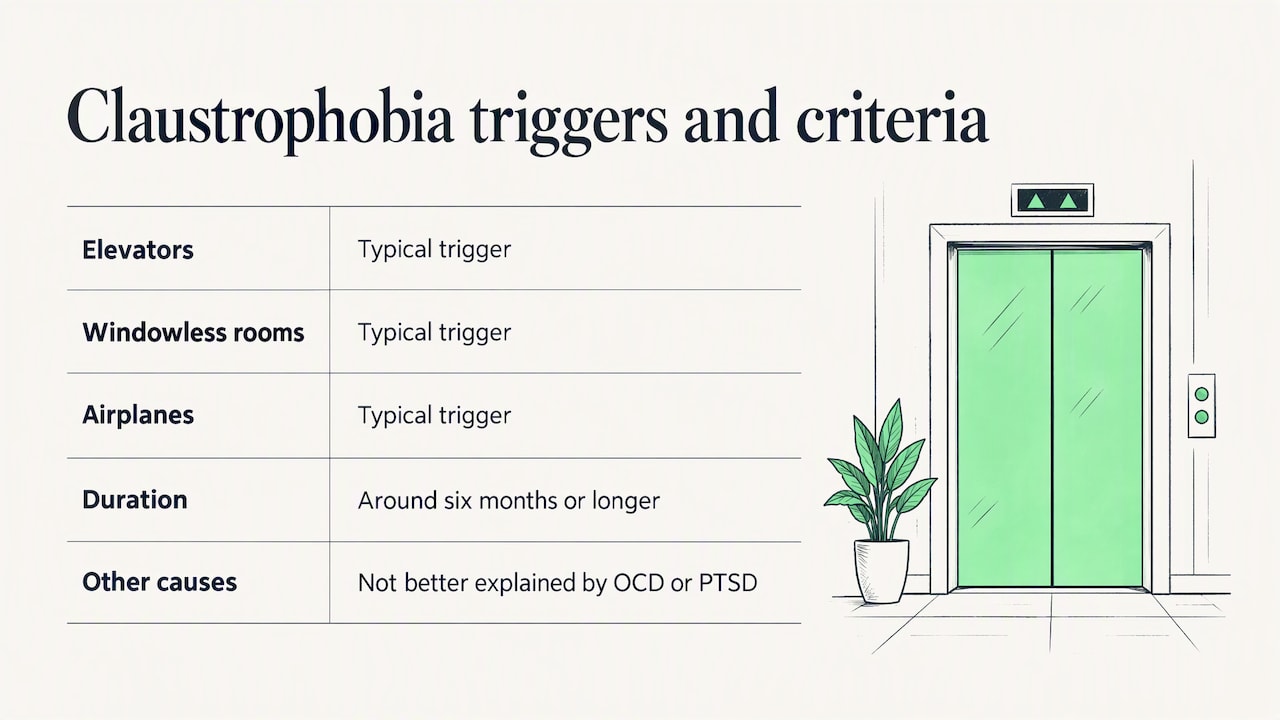
Claustrophobia is an intense fear of confined or enclosed spaces, with a strong urge to escape. Medical News Today describes it as a specific phobia under the DSM-5. Typical triggers include elevators, windowless rooms and airplanes. A diagnosis generally requires that the fear has lasted around six months or longer and is not better explained by another condition such as OCD or PTSD.
Is claustrophobia a type of PTSD?
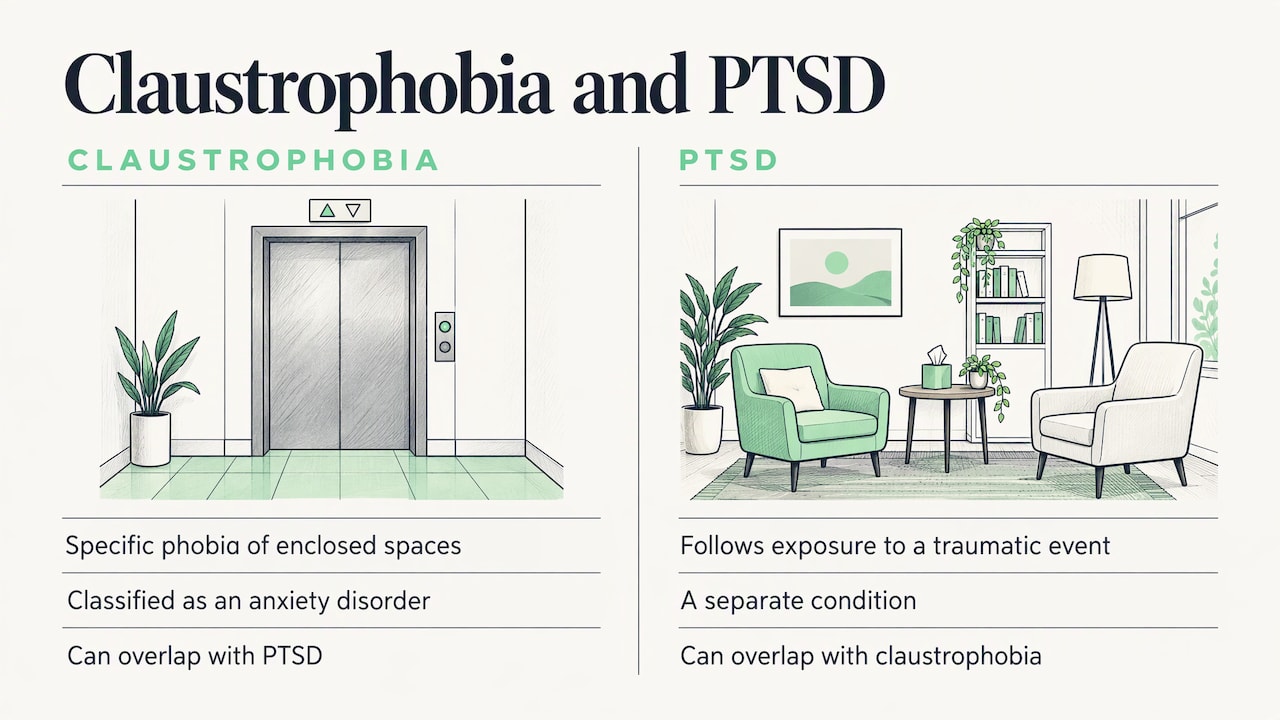
No. Claustrophobia is classified as a specific phobia, an anxiety disorder, while PTSD is a separate condition that follows exposure to a traumatic event. The two can overlap. Someone who was trapped in an elevator, a collapsed structure or a locked room may develop both a fear of enclosed spaces and trauma symptoms such as flashbacks and nightmares. If your fear began with a frightening event and you also have intrusive memories, avoidance across many areas of life or a constant sense of threat, tell a licensed mental health professional. Treatment may need to address the trauma first or alongside the phobia. Our page on hypnosis for trauma and PTSD explains how we approach that kind of history.
What research shows about hypnosis and MRI scans
The most useful evidence comes from a very practical problem: lying inside a narrow scanner tube.
- Self-hypnosis with audio. A 2021 observational study in European Radiology found that patients who used an audio-guided self-hypnosis script directly before an MR scan had significantly less claustrophobia (16%) than a control group (43%). The authors also noted that very anxious patients may be harder to hypnotize.
- Clinician-guided hypnosis. A retrospective study from Switzerland found that medical hypnosis was a valid alternative to general anesthesia for claustrophobic patients having MR exams, without significant loss of image quality. Patients induced a trance under the guidance of a board-certified medical hypnotherapist who stayed in contact by microphone, and completed their exams without anxiety medication.
- A small cardiac MRI comparison. In a 2021 study of cardiovascular magnetic resonance, all 10 patients treated with medical hypnosis finished the exam without stress, while none of the 3 patients given 2.5 mg of lorazepam did. The group was small, so read it as encouraging rather than conclusive.
The Hypnosis Efficacy Task Force says efficacy should be judged against recent, high-quality, peer-reviewed systematic reviews, ideally with a meta-analysis. That is a fair standard, and it is why the claims in this article stay modest: the MRI results are promising, and larger trials would strengthen them.
How hypnosis can help with claustrophobia
Hypnosis uses focused relaxation, imagery and suggestion to change how a person thinks, acts or responds. A typical session, as the Cleveland Clinic outlines, includes induction, deepening, suggestions and emergence. For claustrophobia that structure usually plays out like this:
- Goals and history. We talk about when the fear started, what triggers it, what you avoid and what you want to do again: ride the elevator, take a flight, sit through a scan.
- Safe place. You learn to guide yourself into a calm, comfortable mental setting and to return to it on cue.
- Induction and deepening. Slow breathing and guided relaxation bring your attention inward and your body down.
- Suggestions and imagery. In that calm state you rehearse entering a small space while staying relaxed, with suggestions for steadier breathing, an open feeling in your chest and a clear sense that you can leave if you need to.
- Emergence and practice. You return to full awareness and leave with a short routine to use between sessions.
You stay aware and in control throughout. If you want a plain-language walkthrough of the first visit, see what to expect from hypnotherapy.
Self-hypnosis and recordings
Recorded sessions are cheap and handy for rehearsal, which is also why they dominate the search results. The scanner study above shows that an audio script used right before a procedure can help. Recordings are less able to adapt to you, though: they cannot notice that a particular image makes you tense, or adjust the pace. Many people use a recording to keep practicing between live sessions.
Safety and side effects
Hypnosis is generally well tolerated. Rare side effects reported by the Cleveland Clinic include dizziness, drowsiness, headaches, increased anxiety or sleep disturbances. If a panic attack is a regular feature of your life, or you have a history of trauma or psychosis, tell your practitioner at the start so the pace can be adjusted, and speak to your physician or psychiatrist about it. Our article on why hypnosis isn’t for everyone covers who may need a different approach.
What is the most effective treatment for claustrophobia?
The best-supported treatment is exposure therapy. The Cleveland Clinic names exposure therapy and cognitive behavioral therapy as the two main treatments. Exposure may use real-time practice, describing the feared experience, pictures or virtual reality, combined with relaxation and breathing exercises, and a psychologist should set the pace to match symptom severity.
The numbers are strong:
- An NIH fact sheet says exposure therapy successfully treats up to 80 to 90% of patients who complete it, by gradually introducing feared situations in a safe, individualized progression.
- A meta-analysis of 33 randomized studies found large benefits over no treatment and better results than placebo and other active psychotherapies. Direct real-life exposure outperformed imaginal or virtual-reality exposure right after treatment, although that edge was not maintained at follow-up.
- In a Swedish claustrophobia trial of 50 participants, one three-hour exposure session was as effective as five one-hour sessions, both right after treatment and at one year.
For medical situations, some U.S. centers offer short programs. The University of Nebraska Medical Center describes individualized exposure therapy for patients who need medical care, including virtual-reality or immersive methods, commonly in two 60-minute sessions, with insurance coverage depending on your plan.
Where hypnosis fits next to exposure
The two are not rivals. Exposure supplies the real-world learning; hypnosis can supply the calm state, the imagery and the confidence to take each step. A simple combination looks like this:
| Step | What you do | How hypnosis helps |
|---|---|---|
| Build a calm response | Practice slow breathing and a safe-place image daily | Hypnosis trains the response so it is available on cue |
| Rank your fears | List situations from mildly to very uncomfortable | Imagery rehearsal of the easiest items first |
| Step into real situations | Stand in a closet, take one elevator floor, then more | A short self-hypnosis routine beforehand |
| Maintain gains | Repeat exposures regularly | Refresher sessions and recordings |
We also treat other specific fears this way. Our guides to fear of heights hypnosis and needle phobia practice scripts show the same principle: calm first, then gradual contact with the thing you fear.
Getting ready for an MRI if you are claustrophobic
If a scan is what brought you here, a few steps help whichever route you choose:
- Tell the imaging team ahead of time. Ask about an open scanner, a shorter protocol, a mirror or headphones, and whether a person can stay in the room.
- Talk to your prescribing doctor before deciding about medication. Do not stop or change anything yourself.
- Start practicing 1 to 2 weeks before. Rehearse your breathing and safe-place routine daily, ideally lying down with your eyes closed for the length of a typical scan.
- Use your routine in the waiting room, not only inside the tube. Starting calm matters. Some people add simple grounding techniques for anxiety to their pre-scan ritual.
- Agree on your signal. Scanners have a squeeze-ball or intercom. Knowing you can stop is itself calming.
If you want hypnosis to be part of the plan, ask whether your care team can coordinate with us. We work to complement medical care, and you can read more about combining hypnotherapy with traditional healthcare.
Our perspective
Claustrophobia is rarely about the space itself. It is about what your mind predicts will happen in it: that you will run out of air, that you will not be able to leave, that you will lose control. That prediction fires so fast it feels like fact.
What we do at MindShift is slow that moment down. Hypnotherapy gives you a way to settle your body and rehearse a different outcome, and the life coaching side gives you a plan for the practice that follows. We build each plan around the person in front of us, because a fear of elevators, a fear of MRI scanners and a fear that started after a frightening event are different problems with different starting points.
We are clear with clients that the research on hypnosis for phobias is still growing, and that gradual real-world practice is what turns calm into lasting change. That is why we pair sessions with a step-by-step plan, and why we are glad to work alongside your doctor or therapist. Done this way, hypnosis is not a shortcut. It is a way to make the next step feel possible.
Rachael
Work with us on claustrophobia
If enclosed spaces are limiting your life, MindShift Hypnosis offers personalized hypnotherapy and life coaching for fears and phobias, in person and online. We combine calming hypnosis sessions with a clear, gradual plan for the situations you want back. You can also read about our approach to overcoming fears and phobias.
See every option on our services page, or check hypnotherapy pricing before you book. If anxiety is wider than one fear, our page on hypnotherapy for anxiety in Riverside and Corona may be a better fit.
FAQ
Can claustrophobia be cured with hypnosis?
There is no solid evidence that hypnosis alone cures a phobia; a 2016 review called the evidence for phobias negative or insufficient. Many people still find it reduces their fear response and makes real-world practice easier. For lasting change, combine it with gradual exposure, ideally with a licensed professional guiding the pace.
What are three things hypnosis cannot do?
It cannot make you do something against your will, since you stay aware and in control. It cannot erase memories or give you abilities you do not have. And it cannot replace medical diagnosis or treatment, so conditions like panic disorder or PTSD still need a qualified clinician.
Does hypnosis really help before an MRI?
Studies suggest it can. An observational study found that audio-guided self-hypnosis before a scan was linked to less claustrophobia than in a control group, and a Swiss study found clinician-guided hypnosis a workable alternative to anesthesia for claustrophobic patients. Larger controlled trials would give firmer answers.
Can I use a hypnosis recording on my own?
Yes, many people use recordings to rehearse relaxation between sessions or just before a procedure. Stop and talk to your doctor if a recording increases your anxiety, or if you feel dizzy or unwell. A live practitioner can adapt the session to you, which a recording cannot.
Sources
- Hypnosis for anxiety and phobic disorders: a review
- Hypnosis: What It Is, How It Works, Benefits & Risks (Cleveland Clinic)
- Claustrophobia: What Is It, Symptoms, Causes & Treatment (Cleveland Clinic)
- Claustrophobia: Causes, symptoms, and treatments (Medical News Today)
- Audio-guided self-hypnosis for reduction of claustrophobia during MR imaging
- Is hypnosis a valid alternative to spontaneous breathing general anesthesia in MR exams?
- Overcoming claustrophobia in cardiovascular magnetic resonance (ESC 365)
- Guidelines for the Assessment of Efficacy of Hypnosis (Hypnosis Efficacy Task Force)
- Treating Phobias (NIH fact sheet)
- Psychological approaches in the treatment of specific phobias: a meta-analysis
- One 3 hour exposure session was as effective as 5 one hour sessions (Evidence-Based Mental Health)
- Be Calmed for Medical Care (University of Nebraska Medical Center)
- Grounding for Anxiety Relief: Techniques and Earthing