Hypnosis for childbirth is a way of preparing your mind and body for labor. You learn to reach a deeply relaxed, focused state, then use it to stay calm and change how you experience contractions. Most people learn it during pregnancy, practice it for several weeks, and bring it into labor alongside their medical team, not instead of it. Here is what it involves, what the evidence says, and how to start.
TL;DR
- Childbirth hypnosis (often called hypnobirthing) combines relaxation, breathing, visualization and self-hypnosis to help you cope with labor sensations.
- A Cochrane review found hypnosis may reduce overall use of pharmacological pain relief, but not epidural use, and the evidence on other outcomes is mixed.
- Start practicing some weeks before your due date. Daily short sessions work better than a last-minute cram.
- Tell your doctor or midwife you are using it, and keep your plan flexible so pain medication stays an option if you want it.
- If fear of birth is the main obstacle, working on that fear directly can be a good first step.
Table of Contents
- What hypnosis for childbirth actually is
- What the research says
- Hypnobirthing techniques you can practice before labor
- When to start and how often
- Using hypnosis during labor
- Hypnosis, Lamaze and Bradley: how the approaches differ
- Can hypnosis replace medical pain relief?
- Choosing a class or practitioner
- Perspective
- Working with MindShift before your birth
- A short practice script to try tonight
- FAQ
- Sources
What hypnosis for childbirth actually is
Hypnosis is a state of inward-focused attention and heightened responsiveness to suggestion. Cochrane researchers describe how, in childbirth, it is used to promote relaxation and change how contractions are perceived, helping women cope with labor pain.
It is not sleep, and you do not lose control. You stay aware of where you are and who is with you. Think of the absorbed feeling when you are lost in a book and the hour passes unnoticed. Hypnosis training teaches you to reach that state on purpose and to pair it with calming suggestions.
The usual explanation is fear and tension. When labor feels frightening, muscles tighten and pain feels sharper. A 2021 meta-integration of studies suggests hypnosis may change beliefs about childbirth, which can build confidence, reduce anxiety and muscle tension, and in turn reduce pain. Breaking that loop is the goal.
Hypnobirthing, childbirth hypnosis and hypnotherapy: the same family
These terms overlap. Hypnobirthing is a childbirth preparation method that uses relaxation, visualization and self-hypnosis to help you feel calm and cope with labor sensations, as Tommy’s explains. Childbirth hypnosis is the broader idea. Hypnotherapy for labor usually means one-to-one work with a trained practitioner, who may also teach you self-hypnosis and record audio for you to use.
What the research says
The honest summary: promising, with real gaps, and valued by many families.
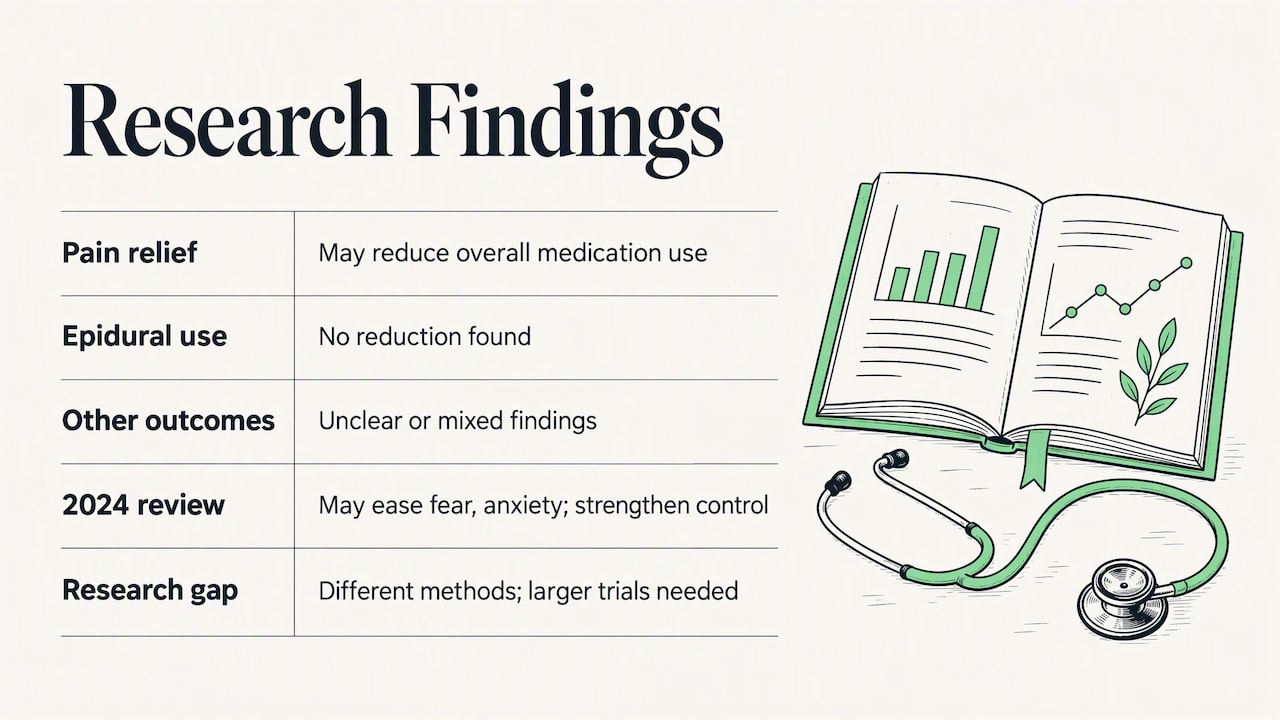
Pain relief medication. The Cochrane review found hypnosis may reduce the overall use of pharmacological pain relief during labor. It did not reduce epidural use. Evidence was unclear for satisfaction with pain relief, coping with labor and spontaneous vaginal birth, and findings on the birth experience were mixed. The authors call for more large, well-designed trials (Cochrane Library).
Fear, anxiety and the birth experience. A 2024 review on fear, pain and birth experience reports that hypnosis-based approaches may improve the overall experience by reducing fear and anxiety and strengthening your sense of control during labor. The same paper notes that studies use very different interventions, which makes results hard to compare.
Official guidance. The American College of Obstetricians and Gynecologists (ACOG) notes that many people use nonpharmacologic techniques such as relaxation methods, though high-quality data on their exact relative effectiveness is limited. The VA’s Whole Health library describes hypnosis as a safe, low-risk strategy to try.
What this means in practice: treat hypnosis as a skill that can make labor feel more manageable and less frightening, not as a guarantee of a painless birth. Nobody can promise that, and a good practitioner will not.
Hypnobirthing techniques you can practice before labor
The Cleveland Clinic lists the core techniques: deep, controlled breathing, guided imagery, visualization, and positive affirmations or mantras. Here is how each looks in daily practice.
Slow, controlled breathing
Breathe in through your nose, then out slowly through your mouth, making the out-breath longer than the in-breath. Practice for five minutes while sitting, then while lying on your side. The goal is for this pattern to become automatic when a contraction builds.
Guided imagery and visualization
Pick a place that feels safe, such as a beach, a forest path or a warm room, and rehearse it in detail: sounds, temperature, smells. Many people also picture the body softening and opening during a surge. Recorded scripts help, and you can record your own.
Affirmations and mantras
Short phrases you believe, such as “I can take one breath at a time”, are easier to hold onto than long ones. Choose two or three. Your birth partner can say them aloud during labor.
Self-hypnosis and anchors
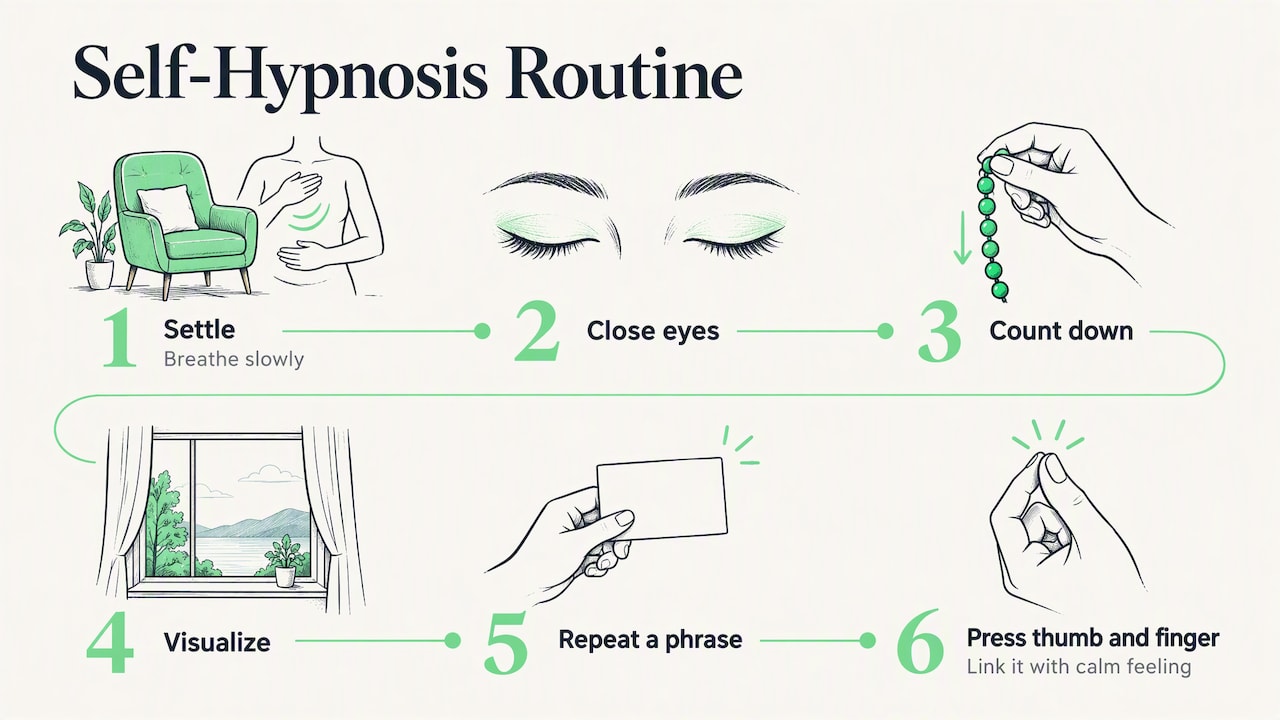
Combine the above into a short routine: settle, breathe, let your eyes close, count down, visualize, repeat a phrase. Add a physical cue, such as pressing thumb and finger together, that you link with the calm feeling. The cue is then available in the delivery room.
Involve your birth partner
Teach your partner the script, the touch cues and the words that help you. They become the guardian of the calm environment: dimming lights, keeping conversation quiet, and speaking up for your preferences.
When to start and how often
The UK’s NCT advises starting some weeks before the end of pregnancy, so you have time to find what works for you. A simple plan:
- Weeks 28 to 32: choose a class, book or practitioner. Try a 10 minute relaxation recording most days.
- Weeks 32 to 36: add visualization and affirmations. Practice with your partner at least a few times a week.
- Weeks 36 to birth: rehearse in different positions and settings, including when you are mildly uncomfortable or tired. Review your birth plan.
If you cannot attend classes, the NCT notes that hypnobirthing can be learned through books or audio recordings and used anywhere, including at home or while waiting for a cesarean birth.
Using hypnosis during labor
During labor, hypnosis acts as a coping strategy. Some people use it alone with audio tracks. Some have a practitioner or trained partner guiding them. Early labor is often a good time to settle into your routine at home, before moving to the hospital or birth center.
One practical point from the NCT: relaxation can make labor look calmer than it is, so clinicians may underestimate your progress. Tell your care team at the start that you are using hypnosis and what you would like them to do, for example, to speak softly and ask for your consent before examinations.
Hypnosis, Lamaze and Bradley: how the approaches differ
All three are childbirth preparation. Hypnobirthing centers on deep relaxation, self-hypnosis and fear reduction. Lamaze today puts more weight on informed decision-making and individual preferences, while the Bradley Method emphasizes nutrition, partner coaching and avoiding unnecessary interventions, according to this comparison of the three methods. Teaching varies by instructor in every method, so ask any teacher how they handle medical interventions and pain relief before you commit.
You do not have to pick only one. Many people take a general childbirth class at their hospital for the medical picture and add hypnosis practice for the mental side.
Can hypnosis replace medical pain relief?
No, and it does not need to. The NCT points out that hypnobirthing can be used alongside pharmacological pain relief, and that using it does not mean you will never want other options or that nothing unexpected will happen. ACOG says nonpharmacologic and pharmacologic techniques can be used sequentially or in combination, and that pain medication should be available to women who want it.
ACOG also advises you to discuss pain-management preferences with your care team and keep plans flexible so that you and your baby stay safe. A February 2026 ACOG article makes the same point for people planning to avoid medication: preparation should not stand in the way of accepting medical help if the situation changes.
A useful way to frame it: hypnosis is a skill you bring, and an epidural, if you choose one, is another tool. Using both is not failure. Discuss both with your obstetrician or midwife before labor begins, especially if you have a high-risk pregnancy, a history of trauma, or a condition that affects your birth plan.
Choosing a class or practitioner
- Training and format. Ask what training they have, whether they teach self-hypnosis you can use alone, and whether they provide audio.
- Fit with your medical team. A good instructor encourages you to talk to your clinicians and keeps room for medical decisions.
- No promises. Be wary of anyone guaranteeing a pain-free or intervention-free birth.
- Partner inclusion. Choose a program that trains your partner too.
- Location. Online sessions work well for hypnosis, since you will practice at home anyway.
Perspective
Our view at MindShift is that the biggest thing hypnosis offers a person approaching birth is not a technique, it is a changed relationship with fear. We see this every day in our work with anxiety, phobias and past trauma: when someone learns to calm their body on purpose, the thing they dreaded starts to feel more manageable.
That is why we believe in individualized work. Two people can be equally nervous about labor for completely different reasons: a frightening medical experience, a story from a relative, a general fear of losing control. A script that works for one may miss the other. Customized sessions let us find what is driving the tension and build suggestions around it.
We also believe hypnosis belongs next to good medical care, not in competition with it. Tell your doctor or midwife, keep your options open, and use your practice as a source of steadiness whatever your birth looks like.
Rachael
Working with MindShift before your birth
If worry about labor, needles, hospitals or a past difficult experience is what keeps you tense, that is the kind of fear and anxiety we work on. We offer personalized hypnotherapy sessions, in person and online, for fears and phobias, anxiety and trauma, and we build each plan around you. Because we also value working alongside traditional healthcare, your sessions are designed to complement your prenatal care.
See our services and pricing, or get in touch to talk through what you would like help with. If you have a specific fear of needles, our guide to practicing a hypnosis script before a shot is a good place to begin.
A short practice script to try tonight
Find a quiet spot and sit or lie on your side. Read this slowly or record it in your own voice.
- Take a slow breath in for four counts and out for six. Repeat five times.
- Let your eyes close. Relax your forehead, jaw, shoulders and hands in turn.
- Picture your safe place. Notice the light, sounds and temperature.
- Silently say: “My body knows how to do this. One breath at a time.”
- Press your thumb and finger together and feel the calm. This is your anchor.
- Count up from one to five, and open your eyes feeling alert.
For more calming phrases and background on the research, see our piece on stress relief hypnosis.
FAQ
Does hypnosis for childbirth really work?
For many people it helps with relaxation, fear and sense of control. The Cochrane review found it may lower overall use of pharmacological pain relief, though not epidural use, and that other results are unclear. Larger trials are still needed, so expect a coping skill rather than a guarantee.
Is hypnosis safe during pregnancy and labor?
The VA’s Whole Health library describes hypnosis as a safe, low-risk strategy for women to try. Mention it to your obstetrician or midwife, especially if you have a complicated pregnancy or a history of trauma, so they can fit it into your care.
Can I use hypnosis and still get an epidural?
Yes. Hypnobirthing can be used alongside pharmacological pain relief, and ACOG says the two kinds of techniques can be combined or used one after the other. Keep your plan flexible and talk to your care team about your options ahead of time.
Do I need a class, or can I learn it at home?
Both work. Books and audio recordings can teach the core skills, and you can practice anywhere. A class or practitioner adds feedback, a script tailored to your fears, and training for your birth partner.
When should I start practicing?
Some weeks before the end of pregnancy. Many people begin in the late second or early third trimester so they have time to find the techniques that suit them and make them automatic.
Sources
- Hypnosis for pain management during labour and childbirth, Cochrane
- Hypnosis for pain management during labour and childbirth, Cochrane Library review
- Hypnosis for labour and childbirth: a meta-integration
- What is hypnobirthing?, Tommy’s
- Hypnobirthing: Classes, Technique and Benefits, Cleveland Clinic
- Hypnobirthing: where to start, NCT
- Impact of Hypnotherapy on Fear, Pain, and the Birth Experience
- Approaches to Limit Intervention During Labor and Birth, ACOG
- Making Sense of Childbirth Pain Relief Options, ACOG
- Thinking About Childbirth Without Pain Medication?, ACOG
- Tools for Supporting Natural Childbirth, VA Whole Health
- Bradley Method vs Lamaze vs HypnoBirthing