Motivation hypnosis is a guided state of focused attention in which you work with suggestions and imagery to get clearer about what you want and to make starting easier. It does not install willpower from the outside. It helps you rehearse action, quiet the mental friction around a task, and pair your intentions with a concrete plan. Done with a trained practitioner, or as a short self-hypnosis routine, it works best when it is tied to a specific goal and a specific first step.
TL;DR
- Hypnosis is a state of deep relaxation and focused concentration, and you stay in control throughout. It is not sleep and it is not mind control.
- Self-hypnosis is described by the Cleveland Clinic as a way to focus yourself, motivate yourself and keep going after setbacks.
- Procrastination usually has a cause (fear, overwhelm, perfectionism, low mood). Hypnosis is most useful when the session names that cause and ends with a small, scheduled action.
- Pair every session with an if-then plan so the motivation turns into behavior within 24 hours.
- People with schizophrenia, dissociative disorders, seizure history, recent trauma or PTSD should speak with a licensed professional before trying it.
Table of Contents
- What motivation hypnosis actually is
- What the evidence supports, and what it does not
- Why procrastination is rarely a motivation problem alone
- What happens in a hypnotherapy session for motivation
- How to pair hypnosis with a plan that sticks
- A simple self-hypnosis routine to try
- Is motivation hypnosis safe?
- Perspective: why we combine hypnosis with coaching
- Who benefits most from motivation hypnosis
- How to choose a practitioner
- Work with MindShift on motivation
- FAQ
- Sources
What motivation hypnosis actually is
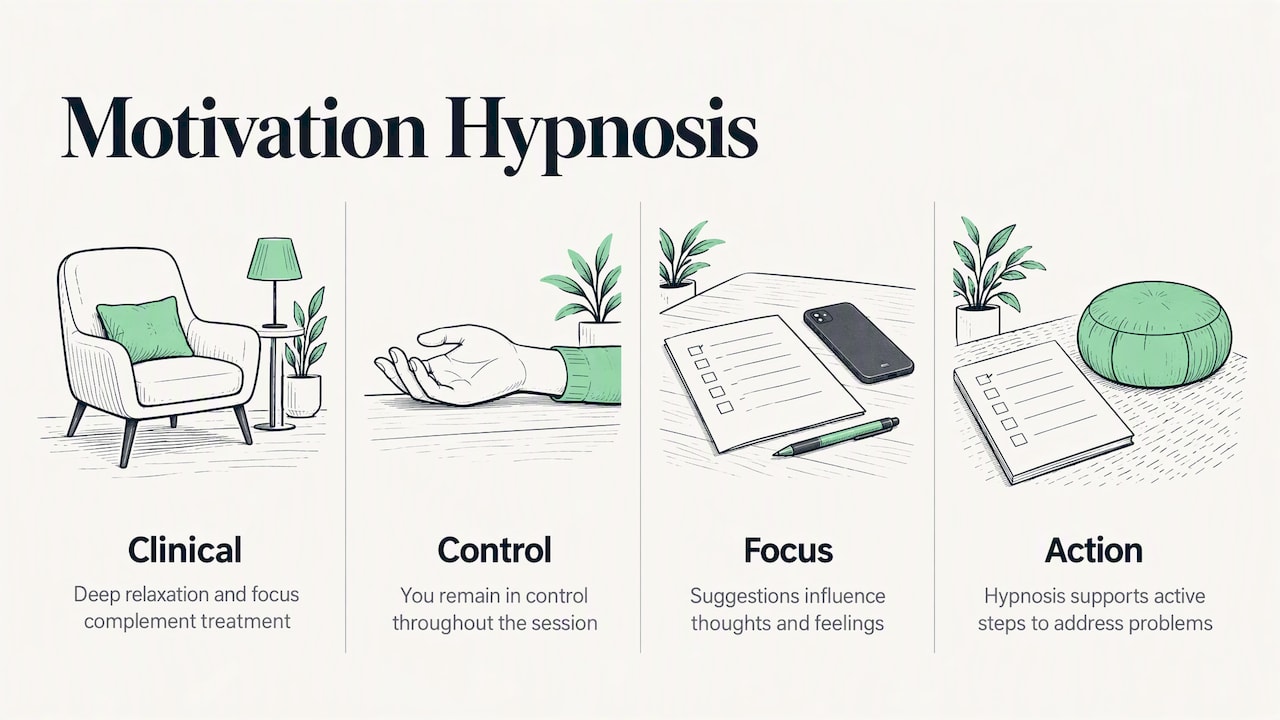
The word “hypnosis” carries a lot of stage-show baggage, so start with the clinical definition. The Cleveland Clinic describes hypnosis, also called hypnotherapy, as a state of deep relaxation and focused concentration used as a complementary therapy alongside typical medical or psychological treatment. The same page is clear that it is an active process: you remain in control of your mind and thoughts for the whole session.
What makes it useful for motivation is the focus. In a normal day your attention is split between the task, your phone, your worries and the voice that says you will do it later. In hypnosis, attention narrows. The Royal College of Psychiatrists calls hypnotherapy a form of top-down regulation, where verbal suggestions influence how a person thinks and feels. For someone stuck at the starting line, that means a chance to imagine the task differently, feel what it is like to begin, and hear a more helpful internal script.
Researchers are also getting more specific about why this may work. In coverage of current research by the American Psychological Association, Stanford’s Dr. Afik Faerman notes that the brain edits conscious experience based on environment and beliefs, and hypnosis gives a facilitator a context to guide that editing. The same article reports that hypnosis can make actions feel more automatic and shift your sense of authorship over them, which is a plausible route to changing habits.
It also differs from meditation in a way that matters here. Dr. Guy Montgomery of the Icahn School of Medicine at Mount Sinai says that meditation helps people accept a problem, while hypnosis lets them take active steps to address it. Motivation is an action problem, so that active quality is the point.
What the evidence supports, and what it does not
Honest framing matters, because the top search results for this topic are mostly audio tracks promising instant drive. Here is what the research can reasonably back.
- Focus, self-direction and persistence. The Cleveland Clinic says self-hypnosis can help people focus, motivate themselves, use their innate skills and persevere through setbacks.
- Commitment and adherence. A 2017 paper in the International Journal of Clinical and Experimental Hypnosis argued that hypnotic suggestions can enhance motivation, behavioral commitment and treatment adherence within a smoking-cessation program. That is a different goal from finishing a report, but the mechanism, strengthening commitment to a change, is the same one you are after.
- More than placebo for some uses. An article in The American Journal of Medicine describes hypnosis as a technique the patient can enter or end at will and as more powerful than placebo for certain applications.
The evidence base for hypnosis varies a lot by outcome. A 2019 U.S. Department of Veterans Affairs review found low-confidence evidence for a few outcomes and low or insufficient evidence for many others. The practical conclusion is to treat hypnosis as one tool inside a larger plan, not a switch. That is also how we use it with clients.
Why procrastination is rarely a motivation problem alone
People search for procrastination hypnosis expecting a fix for laziness. In our experience with clients, procrastination is more often an avoidance strategy. The task is linked to a feeling, and putting it off relieves that feeling for a while. Common sources include:
- Fear of judgment or failure. The work might not be good enough, so not starting protects you.
- Fear of success. Success brings new expectations, visibility or change.
- Overwhelm. The task has no clear first step, so your mind slides away from it.
- Low energy or low mood. What looks like procrastination can be a sign of depression or anxiety.
- Attention differences. Starting and sequencing tasks can be hard for reasons that have nothing to do with character. If that sounds familiar, our guide to ADHD coaching for adults explains what structured support looks like.
This is why a generic motivation recording often disappoints. If the block is fear of judgment, a track about energy and drive does not touch it. A good session starts by identifying what the task means to you. Our session goals and beliefs worksheet is a quick way to do that before you ever sit down with a practitioner or a recording.
What happens in a hypnotherapy session for motivation
The Cleveland Clinic explains that a trained, certified hypnotist or hypnotherapist guides the session with verbal cues, repetition and imagery to help you focus and make healthy changes to habits or behaviors. It also describes four stages: induction, deepening, suggestions and emergence.
Here is how that looks in a motivation-focused session.
- Conversation first. You describe what you keep putting off, when it started, what you feel when you picture starting, and what you want instead. A concrete goal beats a vague one. “Send the first draft by Friday” beats “be more productive.”
- Induction. Usually a breathing or relaxation exercise that settles your body and narrows your attention.
- Deepening. The practitioner guides you further into focus, often with counting, imagery or progressive relaxation.
- Suggestions and imagery. This is the working part. You might picture yourself starting the task calmly, notice what changes in your body when you do, or imagine a future version of yourself who has finished it and what that person would tell you. Suggestions are phrased around what you want, in your own language.
- Emergence. You are brought back to full alertness, usually with a short debrief and an action step.
You hear everything and can open your eyes and end the session at any point. Many people describe it as pleasantly absorbed rather than “under.”
How to pair hypnosis with a plan that sticks
A session can shift how a task feels. A plan makes sure you act on the shift. Treat the hour after a session as the most valuable window you have.
Build an if-then plan
Name the trigger, the place and the action: “If it is 9:00 and I have poured my coffee, then I will open the document and write for ten minutes.” The specificity removes the daily negotiation with yourself. We go deeper on this in our piece on how accountability coaching and hypnosis turn if-then plans into action.
Shrink the first step
If the task feels heavy, make the start almost embarrassingly small: open the file, write one sentence, put on your running shoes. In a session we often use imagery to rehearse exactly that moment, so the first step feels familiar when it arrives.
Use a recording to repeat it
The VA Office of Patient Centered Care notes that hypnosis sessions are often recorded so a person can use them repeatedly, which makes self-hypnosis a portable skill. A short recording of your own session can carry the work into the mornings when you most need it.
Add a person
Some people follow through easily alone. Many do not. A coach who checks in on the plan each week makes the difference between a good intention and a finished project.
A simple self-hypnosis routine to try
The Cleveland Clinic outlines a 12-step self-hypnosis process that includes finding a quiet place, relaxing your muscle groups, setting a clear goal, visualizing a calm place and affirming the goal. Here is a condensed version for motivation, in the same spirit.
- Choose one task and write its first step on a card.
- Sit somewhere quiet and silence your phone.
- Take several slow breaths, longer on the exhale, and relax your muscles from forehead to feet.
- Picture a calm place for a minute.
- Bring the task to mind. Imagine the first step, then notice how you feel as you begin: steady, curious, capable.
- Repeat one short phrase in the present tense, such as “I begin, and it gets easier.”
- Count up from one to five, open your eyes, and do the first step within five minutes.
That last step is the one most people skip, and it is the one that matters.
Is motivation hypnosis safe?
For most people, yes. The Cleveland Clinic says self-hypnosis and hypnotherapy are safe for most people, but those with schizophrenia, dissociative disorders, a history of seizures, extreme emotional distress, recent trauma or PTSD should consult a healthcare professional or licensed practitioner first, and hypnosis should not replace appropriate medical or psychological treatment. The VA Office of Patient Centered Care cites a 2018 review that found no adverse event reports, while cautioning that working through past events can bring up emotional reactions.
A few practical points follow from that:
- If your lack of drive comes with persistent low mood, loss of interest, changes in sleep or appetite, or hopelessness, talk to a doctor or licensed mental health professional. Hypnotherapy can be part of care, and our page on hypnotherapy for depression explains how we work alongside it.
- If the block is tied to a traumatic event, begin with a practitioner who is trained for it. See our approach to hypnosis for trauma and PTSD.
- If you are already in treatment, tell your clinicians. We describe how that fits together in combining hypnotherapy with traditional healthcare.
- Never use a self-hypnosis recording while driving or doing anything that needs full alertness.
The Royal College of Psychiatrists adds that, as with any therapy, the aim is to reach a point where you can cope on your own rather than depending on hypnotherapy. Good practitioners work toward making themselves unnecessary. Hypnosis also does not suit everyone, and we explain why hypnosis isn’t for everyone openly so you can decide with clear eyes.
Perspective: why we combine hypnosis with coaching
We built MindShift around one observation: insight alone rarely changes behavior, and a plan alone rarely survives the moment you feel resistance. Hypnosis works on that moment. Coaching works on everything around it.
When someone comes to us stuck, we do not start by asking for more discipline. We start by asking what starting would cost them emotionally. Once that is named, hypnosis gives them a way to rehearse a different response, and life coaching gives them the strategy, the small steps and the accountability to repeat it all week.
That is why our programs are customized rather than scripted. A performer who freezes before auditions, a manager who avoids difficult emails and a parent who cannot start taking care of themselves each need a different plan, even though all three would type the same search into Google. We work with individuals, couples, families and teams, in person and online, and we build the plan around the person in the room.
If you want motivation that holds up on a Tuesday morning, pair the state of focus with a specific action and someone who expects you to do it. That combination is what we offer.
Rachael
Who benefits most from motivation hypnosis
Motivation is not one problem, so the work looks different depending on the context.
- Professionals and teams. Chronic avoidance of a certain kind of task, such as presentations, difficult conversations or admin. Our corporate and group sessions put hypnosis and coaching in a workplace setting, and our article on emotional intelligence coaching at work shows one practical tool.
- Athletes and performers. Training consistency, pre-event nerves and the mental side of showing up. See our sport hypnosis for peak performance page.
- People rebuilding after a hard stretch. When energy has been drained by stress, resilience tools plus guided sessions can restart momentum. Our resilience coaching tools are a gentle place to begin.
- Anyone anxious about starting. When dread is the real obstacle, working on the anxiety often unlocks the task. We offer hypnotherapy for anxiety in Riverside and Corona, and we also work online.
How to choose a practitioner
Whatever route you take, look for these signs.
- They ask about your goal and history before any hypnosis begins.
- They explain the process in plain words, including what you will feel and how you end a session.
- They talk about a plan and follow-up, not only a single session that is meant to change everything.
- They are open about when to see a doctor or licensed therapist instead of, or alongside, hypnosis.
- They do not promise guaranteed results or instant transformation.
It is also worth deciding what you want from the work. A single session with a recording suits a defined, narrow block. A series with coaching suits a pattern that has followed you for years.
Work with MindShift on motivation
We offer hypnotherapy, life coaching, or a combination of both, for individuals, couples, families, groups and corporate teams, in person and online. For motivation, most clients choose the combined approach: hypnosis to shift the resistance, coaching to build the plan and keep you on it. Pricing is not published online, so the quickest route is to look at the options and get in touch.
See our hypnosis and life coaching services to find the format that fits your goal, or start on our home page and tell us what you keep putting off.
FAQ
Can hypnosis help with procrastination?
It can help when the cause is something hypnosis can work with, such as fear, overwhelm or a habit of avoidance. A session lets you rehearse starting and change the internal script that pushes you to delay. Results are strongest when you follow the session with a small, scheduled action.
How many sessions does motivation hypnosis take?
This varies with the goal and the person, and no honest practitioner can promise a number in advance. A narrow block may shift in a few sessions, while a long-standing pattern usually takes longer and benefits from coaching between sessions. We set the plan with you after the first conversation.
Is a motivation hypnosis recording enough, or do I need a practitioner?
A recording can be a good daily reinforcement, particularly one made from your own session. It cannot ask you questions or find out why you are stuck. If the block is tied to anxiety, low mood or trauma, start with a licensed professional or a trained practitioner.
Will I lose control during hypnosis?
No. The Cleveland Clinic describes hypnosis as an active process in which you stay in control of your mind and thoughts. You can hear the practitioner, and you can end the session whenever you choose.
Can I combine hypnosis with therapy or medication?
Often yes, as a complement, but tell your doctor or therapist you are doing it. Hypnosis should not replace appropriate medical or psychological treatment, and it is best coordinated with the clinicians already caring for you.
Sources
- Hypnosis: What It Is, How It Works, Benefits & Risks, Cleveland Clinic
- What Is Self-Hypnosis and How Do I Do It?, Cleveland Clinic
- Hypnosis and hypnotherapy, Royal College of Psychiatrists
- Uncovering the new science of clinical hypnosis, American Psychological Association
- Clinical Hypnosis, U.S. VA Office of Patient Centered Care
- Guided Imagery, Biofeedback, and Hypnosis: A Map of the Evidence, U.S. Department of Veterans Affairs
- A Multifaceted Hypnosis Smoking-Cessation Program, International Journal of Clinical and Experimental Hypnosis
- Hypnosis: The Most Effective Treatment You Have Yet to Use, The American Journal of Medicine