Hypnosis for procrastination works on the cause of the delay, not on the to-do list. Many people put things off to avoid a feeling: dread, pressure, or fear of getting it wrong. In a hypnotherapy session, you enter a state of focused attention and work with suggestions and imagery that change how starting feels. That makes starting easier. Early research on hypnosis, stress and procrastination is encouraging. It is also small, so we describe it as support for change, not a guaranteed fix.
Below, you’ll find why procrastination happens, what a session involves, what the studies say, how a live hypnotherapist differs from a recording, and how to start.
TL;DR
- Procrastination is usually about managing a feeling, not managing time, so hypnosis targets the stress or avoidance attached to the task.
- A session uses a guided induction, suggestions and mental imagery, and you can learn self-hypnosis to rehearse between visits.
- Early studies link hypnosis with lower stress, anxiety and procrastination scores, and with better executive function in stressed students.
- Hypnotherapy from a qualified professional has few, if any, side effects. Persistent low mood, panic or trauma deserve a mental health professional’s attention.
- One-on-one work lets the hypnotherapist tailor suggestions to your reasons for avoiding, which a generic recording cannot do.
Table of Contents
- Why people procrastinate
- How hypnosis can help you stop procrastinating
- What the research says
- What a hypnosis session for procrastination involves
- One-on-one hypnotherapy or a recording?
- When procrastination is a sign of something more
- Our perspective
- Work with us on procrastination
- A simple way to start today
- FAQ
- Sources
Why people procrastinate
Researchers define procrastination as voluntarily delaying an intended action even though you expect to be worse off for it. That last part matters. This is not laziness or poor planning. You know the delay will cost you, and you delay anyway.
The most useful explanation for most people is mood regulation. People often put tasks off to escape the stress or anxiety a task brings up in the moment. Opening the tax folder or the thesis draft feels bad right now, and closing it feels like relief right now. The relief teaches your brain to repeat the move.
A large meta-analysis found that the strongest and most consistent predictors of procrastination include how unpleasant the task is, how far away its reward or deadline is, self-efficacy (your belief you can do it), impulsiveness and conscientiousness. Notice how many of those are about feelings and beliefs, not skills.
The anxiety loop
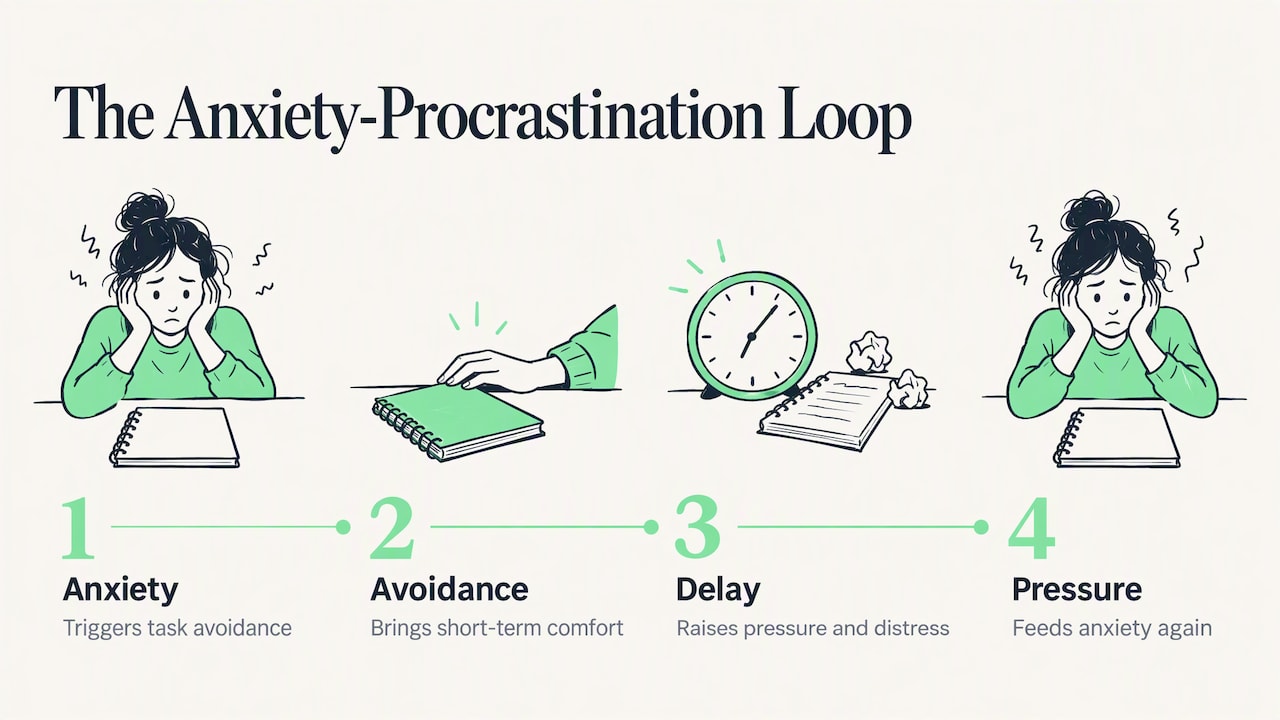
Anxiety and procrastination feed each other. Research on students describes a two-way relationship: anxiety triggers avoidance, avoidance brings short-term comfort, then the delay produces more pressure and more negative emotion. The loop tightens each time.
This is why “just use a planner” fails so often. If the task itself triggers a threat response, a better schedule doesn’t change what happens in your body when you sit down to start.
How hypnosis can help you stop procrastinating
Clinical hypnosis is a procedure in which a trained professional guides you into a trance state marked by focused attention and inner absorption to support helpful cognitive, emotional or physical responses. In plain terms, you are relaxed, awake, and unusually receptive to the ideas you and the practitioner have agreed to work on.
If procrastination is a self-regulation problem, as researchers describe it, then building emotion-regulation skills can reduce it. Hypnosis is a natural fit for that. In a session, we can work on a few things:
- Changing the feeling attached to starting. You rehearse beginning a task while feeling calm, so the first five minutes stop registering as a threat.
- Replacing the relief reward. The goal is for action, not avoidance, to bring the sense of relief.
- Strengthening self-efficacy. Imagery of yourself finishing a step builds a sense that you can do it.
- Clarifying what you really want. Sometimes the delay protects a goal you aren’t sure you hold. Better to find that out than to fight it.
If you have come across “productivity hypnosis” or hypnosis to help with student focus, it’s the same toolkit pointed at attention and follow-through: calming the stress response so focus can do its work.
What the research says
The evidence is promising and still developing. Here is what exists, stated carefully.
| Study | Who | What it found |
|---|---|---|
| University of Padua, 2026 | Stressed medical students, controlled study | One personalized hypnosis session produced greater improvements in executive functions and lower anxiety than a control group |
| Romanian study, 2012 | 60 patients with generalized anxiety disorder | Ericksonian hypnosis techniques were associated with lower stress, anxiety and procrastination scores |
| VA fact sheet, 2017 | U.S. veterans’ health system | Clinical hypnosis is treated as an evidence-based complementary approach, covered when clinically necessary, with evidence of positive effect for anxiety disorders |
Executive functions are the mental skills you use to plan, start, switch tasks and stay on course, which is exactly the territory procrastination lives in. The Padua researchers suggest hypnosis may help by shifting the body from a stress-reactive state to a more adaptive, challenge-like profile.
To be straightforward about the state of the field: the VA’s own review of the literature notes that sample sizes are small and study quality varies across hypnosis applications. No study we know of promises that a set number of sessions ends procrastination for everyone. What the research does support is a sensible plan: reduce the stress and anxiety that drive avoidance, and practice a calmer way of starting.
What a hypnosis session for procrastination involves
If you have never tried hypnosis, the reality is less dramatic than the stage version. You stay aware, and you stay in control. According to the VA’s clinical guidance, people are guided into trance through induction procedures, with suggestions and mental imagery used to support the goals of the session.
A typical first visit with us follows this shape:
- Conversation. We talk through what you are putting off, when it started, and what you notice in your body and thoughts when you think about starting. Work tasks, studying, creative projects and life admin each have different triggers.
- Goal setting. We agree on a concrete target, such as sending the proposal by Friday or working on the dissertation for 30 minutes a day. Our session goals and beliefs worksheet helps you sort out what you want and which beliefs are in the way.
- Induction. A guided relaxation brings you into a focused, absorbed state.
- Suggestions and imagery. We use language and mental pictures tailored to your pattern, for instance feeling steady as you open the document, or noticing relief after the first step instead of after avoiding it.
- Return and review. You come back to full alertness, and we discuss what you noticed and what to practice before the next visit.
If you want a fuller picture of the experience, read what to expect from hypnotherapy.
Self-hypnosis between sessions
One practical benefit is that you can take the skill home. Self-hypnosis can be learned during hypnotherapy and rehearsed without a recording. Sessions are also often recorded for repeated use, and self-hypnosis can be shaped around your own concerns. Many clients use a short routine before the hardest part of their day: a few slow breaths, the calm cue from the session, then the first small action.
One-on-one hypnotherapy or a recording?
Recorded sessions are easy to find, and they can help you relax. The limit is that a recording speaks to everyone and therefore to nobody in particular. Procrastination has different engines in different people: fear of judgment, perfectionism, overwhelm, boredom, a goal that isn’t really yours.
Skilled therapists can adapt suggestions to specific problems and measure progress across sessions. That is the core of what we offer. If session one shows that your delay is really perfectionism, session two can look different. A recording can’t make that adjustment.
| Recorded session | One-on-one hypnotherapy | |
|---|---|---|
| Tailoring | Same script for every listener | Built around your triggers and goals |
| Feedback | None | Review and adjustment each session |
| Underlying causes | Not explored | Explored in conversation, including anxiety |
| Accountability | Self-driven | A set plan and a person who follows up |
| Self-hypnosis skills | Listening only | Taught so you can practice on your own |
When procrastination is a sign of something more
Sometimes avoidance is the visible part of something larger. If you also notice constant worry, panic, low mood that doesn’t lift, loss of interest in things you used to enjoy, or trouble that began after a difficult event, speak with a licensed mental health professional or your physician. Those patterns deserve proper assessment. Hypnotherapy can then work alongside that care, which is how we like to work. See how we approach combining hypnotherapy with traditional healthcare.
Where anxiety or low mood is at the root, we have dedicated pages on hypnotherapy for anxiety, hypnotherapy for depression and stress relief hypnosis. If you suspect attention difficulties are part of the picture, our guide to ADHD coaching for adults explains how coaching can support you.
Is it safe?
When it is performed by a qualified health professional, hypnotherapy is considered to have few, if any, side effects, apart from possible temporary drowsiness. Don’t do a self-hypnosis recording while driving or operating machinery, and tell your practitioner about any mental health history before you start.
Our perspective
We see the same thing again and again: people arrive describing themselves as lazy or undisciplined, and within a few minutes of conversation it’s clear they are tired, anxious, or stuck in a pattern that once protected them. Procrastination is rarely a character flaw. It is a learned response, and learned responses can be retrained.
That is why we pair hypnotherapy with life coaching. Hypnosis works on the feeling underneath the avoidance. Coaching turns the new calm into a plan: what to do first, how long, what to do when the old urge returns. Neither one is as strong alone. Our approach is built around a customized plan, because the student who freezes before an exam and the manager who delays a hard conversation need very different work.
Our clients’ testimonials describe real changes in behavior after just a few sessions. We would rather you judge that for yourself in a first conversation than take our word for it.
— Rachael
Work with us on procrastination
We offer personalized hypnotherapy, life coaching, and a combined hypnosis and life coaching option, in person and online, for individuals, couples, families, groups and corporate teams. For procrastination, most people start with the combined approach so the calm they build in hypnosis turns into a routine they can keep. Browse everything on our services page, or see how online sessions work if you’d rather not travel.
Teams that lose time to avoidance and deadline stress can also look at our corporate and group programs. Pricing isn’t published online, so reach out through the services page for details.
A simple way to start today
While you decide about sessions, try this short routine. It borrows from the mood-regulation research above: lower the discomfort first, then act.
- Name the task and the feeling it brings up. “Writing the report makes me feel inadequate” is more useful than “I’m lazy.”
- Take three slow breaths, longer on the exhale.
- Picture yourself five minutes into the task, calm and already moving.
- Shrink the first step until it feels almost silly: open the file, write one sentence.
- Set a timer for ten minutes and start.
- When the timer ends, notice that the dread was bigger than the task. That observation is what retrains the loop.
If this works partly, that is a good sign that a guided, personalized version will go further.
FAQ
Does hypnosis really work for procrastination?
Early evidence is encouraging. A controlled study of stressed medical students found that one personalized session improved executive function and reduced anxiety, and a small study of anxiety patients linked hypnosis to lower procrastination scores. The research base is still small, so we present hypnosis as a way to support change alongside a practical plan.
How many sessions will I need?
It depends on what is driving the delay and how long the pattern has been in place. Some clients notice shifts within a few sessions. We set a plan after the first conversation and adjust it as we see your progress.
Can I use self-hypnosis instead of seeing a hypnotherapist?
Self-hypnosis can be learned and practiced without a recording, and many people use it for daily follow-through. Learning it with a hypnotherapist first means the suggestions fit your triggers, and progress can be reviewed and adjusted across sessions.
Will I lose control or fall asleep?
No. You stay aware and can end the session whenever you choose. Many people describe it as deep relaxation with focused attention. Temporary drowsiness afterward is the main side effect noted for sessions with a qualified professional.
Is hypnosis for procrastination also useful for students?
Yes, the same approach applies to studying and exam stress. The main work is calming anxiety around the task and building a repeatable way to start, and the Padua study above involved stressed students.
Sources
- Understanding and Treating Procrastination: A Review (2014)
- Procrastination and Stress: A Conceptual Review
- The nature of procrastination: a meta-analytic review (2007)
- Exploring the interplay between anxiety and academic procrastination (2025)
- Clinical Hypnosis in VA Fact Sheet (2017)
- Clinical Hypnosis, VA Whole Health Library (2023)
- Hypnosis and hypnotherapy, Royal College of Psychiatrists (2021)
- Hypnosis reshapes multilevel stress response (2026)
- Efficiency of Ericksonian hypnosis in anxiety disorder (2012)
- Guided Imagery, Biofeedback, and Hypnosis: A Map of the Evidence (2019)