
Accountability coaching is a structured process that helps you turn stated goals into completed action through scheduled check-ins, documented commitments, and course correction when you drift off track. It draws on tools like implementation intentions, the if-then plans that behavioral researchers link to stronger follow-through, and follows guidance from bodies like the ICF on how coaching relationships should work. Our hypnotherapy and life coaching services aim to provide this kind of structured support.
TL;DR:
- A 2016 review of 29 studies and 1,636 participants found a large goal attainment effect from if then plans after excluding one outlier.
- Choose cadence around your needs: research found no strong outcome difference between in person and remote coaching; consistency and structure matter more than format.
- Before signing, confirm written terms cover measurable goals, confidentiality, contact channels, fees, cancellation rules, and referral steps if clinical or medical needs arise.
- By week four, review whether commitments have become more specific and missed tasks less frequent; if not, adjust the plan or cadence rather than waiting.
- Coaching supports follow through rather than treating mental health conditions, so a coach should refer you to clinical care when your needs exceed coaching’s scope.
Table of Contents
- What accountability coaching looks like week to week
- Program structures and what belongs in your coaching agreement
- What the research says about coaching and if-then planning
- How to choose the right accountability coach
- What your first month typically looks like
- Pricing and value: how to think about cost
- How accountability coaching integrates with hypnosis and hypnotherapy
- Customizing accountability coaching for mental health and trauma recovery
- Accountability coaching for peak performance and sports hypnosis
- What combined hypnosis and accountability coaching has looked like for clients
- Why structure alone isn’t enough
- Getting started with accountability coaching at MindShift Hypnosis
- FAQ
- Sources
What accountability coaching looks like week to week
A coach’s job is less about motivation speeches and more about process. According to the 2023 workplace coaching meta-analysis, effective goal-achievement coaching follows a repeatable pattern: clarify what you actually want, convert that into specific commitments, schedule a check-in, review what happened, dig into any obstacles, then revise and recommit. That cycle repeats for as long as the coaching relationship lasts.
In practice, this takes a few recognizable forms:
- Video calls for deeper weekly or biweekly sessions where you set the next round of commitments.
- Phone or text check-ins for lighter, faster accountability between full sessions.
- Voice memos for clients who want to report progress on the go without scheduling a call.
Cadence varies by client and goal. Some people need a weekly rhythm to stay on track; others do well with biweekly sessions inside a 30-day container built around one specific outcome. A typical weekly ritual might look like this: Monday morning you name three commitments for the week, Thursday you send a two-line text update on where things stand, and the following Monday’s session opens with a quick review before setting the next round.
When a commitment gets missed, a good coach treats it as information rather than failure. The question shifts from “why didn’t you do it” to “what got in the way, and what needs to change about the plan.” That reframes accountability as a feedback loop instead of a scorecard.
Program structures and what belongs in your coaching agreement
Accountability coaching generally comes in one of three shapes:
- Ongoing retainer coaching, billed monthly, for clients working on evolving goals without a fixed end date.
- Fixed containers, often 30, 60, or 90 days, built around one defined outcome with a clear start and finish.
- Intensive sprints, shorter and more concentrated, for a specific deadline or decision point.
Whichever structure you choose, the coaching agreement itself matters more than the label. The ICF Code of Ethics calls for clear agreements, confidentiality, defined professional boundaries, and a referral process when a client’s needs fall outside coaching’s scope. Before you start, confirm the agreement covers:
- The specific goals and how progress will be measured.
- Confidentiality terms and how your information is stored or shared.
- Session frequency and what channels are used for between-session contact.
- Fees, billing cycle, and cancellation terms.
- What happens if a clinical or medical issue surfaces that falls outside coaching, including the referral process.
Between sessions, expect homework: a worksheet, a short written reflection, or a specific if-then plan you agreed to test before the next call. Coaches who skip this step tend to produce weaker results, because accountability depends on something concrete to check in against.
What the research says about coaching and if-then planning
The case for accountability coaching rests on two separate bodies of evidence: how well coaching works in general, and how well a specific technique, implementation intentions, works for execution.
A 2014 meta-analysis of organizational coaching interventions found positive effects on performance, skills, and well-being, with effect sizes ranging from g=0.43 to g=0.74 for individual outcomes, and a later workplace meta-analysis found no strong difference between face-to-face and e-coaching formats. That second finding matters for anyone deciding between in-person and remote coaching: the format itself isn’t the deciding factor, the structure and consistency of the relationship is.
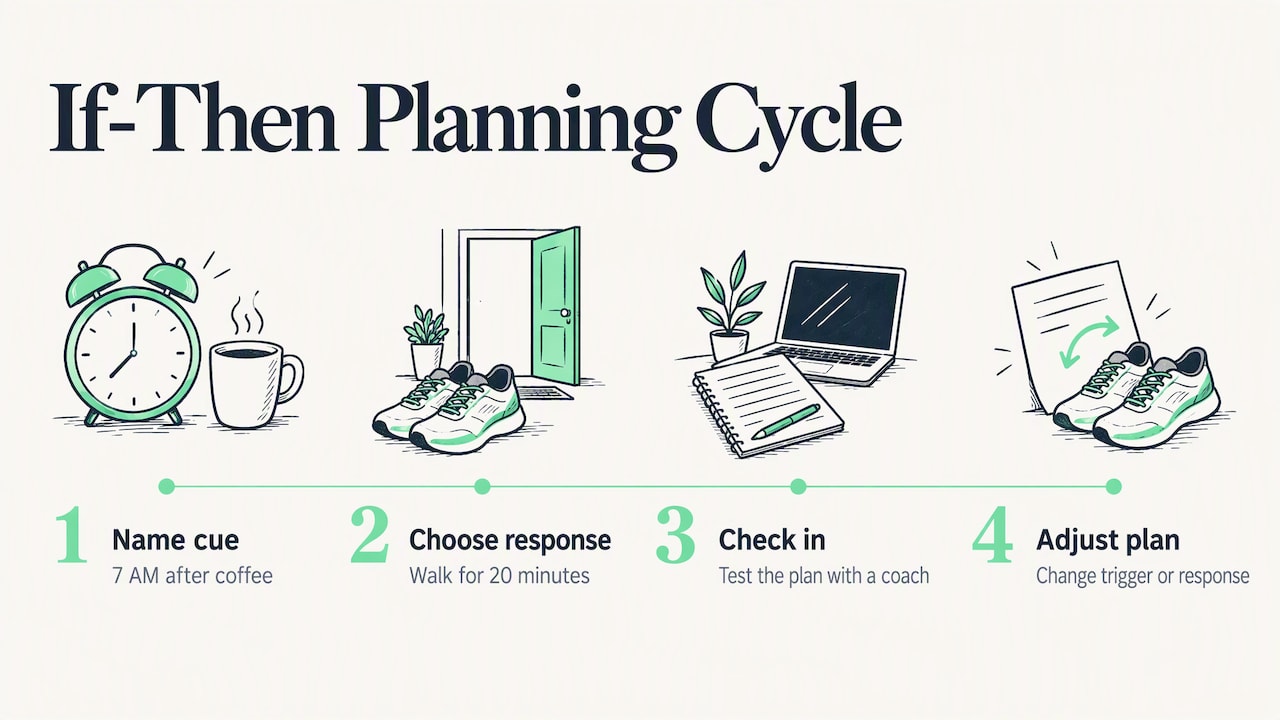
That’s the practical mechanism behind if-then planning, and it’s backed by a 2016 meta-analysis of 29 studies and 1,636 participants, which found a large effect for implementation intentions on goal attainment after excluding one outlier. Instead of “I’ll exercise more,” an if-then plan sounds like “If it’s 7 AM and I’ve had coffee, I’ll put on my shoes and walk for 20 minutes.” Coaches build these specific plans with you and test them at each check-in, adjusting the trigger or the response when something isn’t sticking.
On scope: coaching is not psychotherapy, and the ICF’s guidance is explicit that accountability means supporting a client’s follow-through on their own agreed commitments, not pressuring or penalizing them. A coach who notices signs of a clinical issue should refer out rather than attempt to treat it within the coaching relationship.
How to choose the right accountability coach
Picking a coach is easier when you treat it like evaluating any other professional service: ask specific questions and watch for specific answers.
- Ask how they document commitments and measure progress between sessions.
- Ask what happens, step by step, when you miss a commitment.
- Ask about check-in frequency and whether text, email, or calls are included between sessions.
- Ask about confidentiality practices and what the cancellation and refund terms are.
- Ask whether and when they refer clients to another professional.
A short discovery call can cover most of this directly: “What does a typical first month look like?” “How do you handle it when a client falls behind?” “What’s included between sessions, and what costs extra?” The answers tell you whether the coach runs a structured process or just shows up for calls.
Pro Tip: Watch for a coach who lets you set the goals and the accountability method. If a coach is dictating what you should want, that’s a boundary issue, not a strength.
Red flags include vague answers about measurement, no written agreement at all, and pressure to commit to a long package before a single trial session.
What your first month typically looks like
The first few weeks set the pattern for everything after, so most structured programs follow a predictable arc.
- Session one establishes a baseline: where you are now, what’s not working, and what outcome you actually want.
- Session two turns that outcome into specific commitments and a signed agreement covering frequency, fees, and confidentiality.
- Weeks two and three build your first implementation-intention plans and test them against real days, not hypothetical ones.
- Week four reviews what held up, what didn’t, and adjusts cadence or goals based on what you learned.
Early signs of good momentum include commitments getting more specific over time and missed items becoming less frequent. If neither is happening by week four, that’s the signal to adjust the plan rather than wait it out.
Pricing and value: how to think about cost
Accountability coaching is priced a few different ways, and the shape matters as much as the number.
- Per-session pricing suits clients who want flexibility without a long commitment.
- Monthly retainers suit ongoing work with evolving goals.
- Packaged containers (a fixed number of sessions over a set period) suit a single defined outcome with a deadline.
Rather than comparing lowest price alone, compare what’s actually included: how commitments get documented, whether progress is measured against anything concrete, and how much time per week the format realistically requires from you. A cheaper plan with no structure often costs more in wasted months than a pricier plan with a tight process. Before committing, ask directly what’s included between sessions, what the cancellation terms are, and how the coach defines success for your specific goal.
How accountability coaching integrates with hypnosis and hypnotherapy
Accountability coaching and hypnotherapy address two different parts of the same problem. Coaching handles the structure: the commitments, the check-ins, the if-then plans. Hypnotherapy works on the resistance underneath, the habitual thought patterns and emotional associations that make a commitment hard to keep even when the plan is sound.
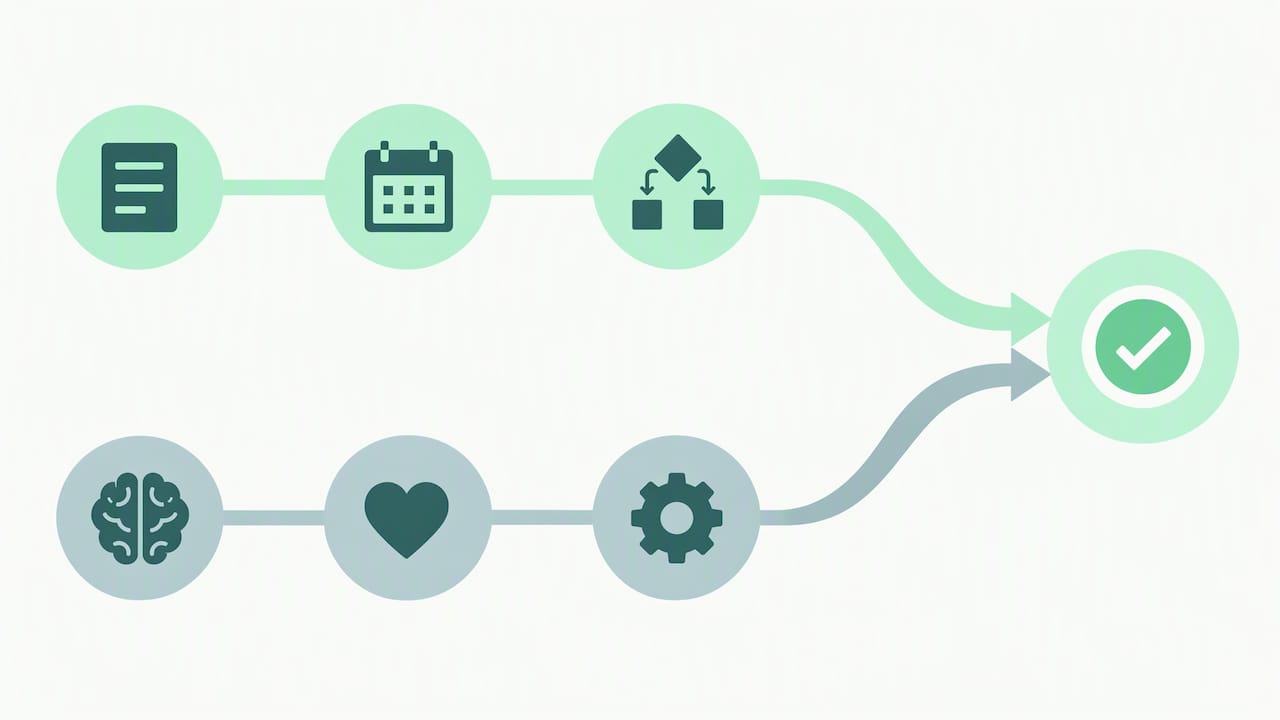
In our hypnosis life coaching sessions, we pair the two deliberately. A client might set a concrete weekly commitment in a coaching check-in, then use a hypnotherapy session to work through the anxiety or avoidance that’s been quietly undermining that same commitment for months. The coaching keeps the plan specific and measurable, while the hypnotherapy addresses why the plan hasn’t held in the past.
This blended structure tends to help most when someone has tried accountability tools before, a habit tracker, a planner, a friend checking in, and still finds themselves stalling at the same point. That stall is often less about willpower and more about an unexamined pattern that straightforward goal-setting doesn’t reach.
Customizing accountability coaching for mental health and trauma recovery
Not every client arrives with a straightforward productivity goal. Some are managing depression, anxiety, or the aftereffects of trauma, and standard accountability structures need real adjustment to work for them without becoming another source of pressure.
For these clients, we build check-in formats around capacity rather than rigid output. A commitment on a difficult week might be “rest without guilt” rather than “complete the task list,” and the coaching relationship stays flexible enough to hold that. Our trauma and PTSD work and depression-focused hypnotherapy sessions run alongside coaching check-ins specifically so that accountability never becomes another demand a struggling client has to meet alone.
This is also where the referral principle in the ICF’s guidance matters most. When a client’s needs extend beyond what structured accountability and hypnotherapy can address, we treat referral to additional care as part of responsible practice, not a failure of the coaching relationship. Coaching supports follow-through; it doesn’t replace clinical treatment when that’s what’s needed.
Accountability coaching for peak performance and sports hypnosis
Athletes and performers face a specific version of the follow-through problem: the training plan is rarely the issue, consistency and mental state under pressure are. Accountability coaching applied to performance goals works the same way it does elsewhere, defining specific commitments and reviewing them regularly, but the content shifts toward practice consistency, pre-event routines, and recovery habits.
Our sport hypnosis for peak performance sessions combine that accountability structure with hypnotherapy aimed at the mental side of performance: narrowing focus before competition, reducing the grip of performance anxiety, and reinforcing the specific routines an athlete has already committed to in coaching check-ins. The coaching keeps the training plan honest; the hypnotherapy addresses the mental interference that often derails it on competition day itself.
This combination suits performers who already know what they need to do and have the technical plan in place, but find that nerves, inconsistent practice, or a mental block are the actual barrier between preparation and results.
What combined hypnosis and accountability coaching has looked like for clients
Clients seeking blended hypnotherapy and coaching sometimes describe a pattern of a clear goal, a history of partial progress, and a stall they find hard to explain. The combined approach addresses both halves of that stall at once.
A client working through anxiety that was interfering with a work goal might spend coaching sessions building specific weekly commitments while using hypnotherapy sessions to work through the anxiety response that kept derailing follow-through under pressure. A couple working on relationship goals might pair joint accountability check-ins with individual hypnotherapy sessions addressing old patterns neither partner could name on their own. Coaching generally provides the structure while hypnotherapy addresses deeper patterns that structure alone may not resolve.
The specific combination varies by client, which is the point: a generic accountability framework and a generic hypnotherapy protocol both tend to underperform compared to a plan built around what’s actually keeping one person or one couple stuck.
Why structure alone isn’t enough
Most advice about staying accountable focuses entirely on the external scaffolding: more check-ins, stricter deadlines, a stronger penalty for missing a commitment. That misses something important. The clients who struggle most with follow-through usually aren’t missing structure. They’re missing a plan that accounts for what happens in their mind the moment the commitment gets hard.
An if-then plan is powerful precisely because it removes a decision point, but it only works if the underlying resistance to the behavior has been addressed, not just scheduled around. That’s the gap a purely administrative accountability system leaves open, and it’s the gap we built our approach to close: customized plans, strategic check-ins, and hypnotherapy aimed at the specific pattern underneath a specific stall, rather than a one-size-fits-all tracking system layered on top of it.
— Rachael
Getting started with accountability coaching at MindShift Hypnosis

If you’ve tried accountability tools before and still find yourself stalling at the same point, a blended approach addresses both the structure and what’s been quietly working against it. There are a few possible starting points depending on client needs:
- Life Coaching for structured goal-setting and ongoing accountability check-ins.
- Hypnosis Life Coaching for clients who want the coaching structure paired directly with hypnotherapy in the same relationship.
- Hypnosis Only for clients focused specifically on the patterns underneath a stall.
- Online Services for remote clients who want the same structure without an in-person requirement.
- Corporate And Group sessions for teams building shared accountability practices.
Whether you’re working through a personal goal, a performance block, or a pattern that’s resisted every planner and tracker you’ve tried, our services page outlines each option in detail, and booking a first session is the direct next step toward a plan built around what’s actually keeping you stuck.
FAQ
What does an accountability coach do?
An accountability coach helps you define specific goals, turn them into documented commitments, and schedule regular check-ins to review progress and adjust course. Coaches use techniques like implementation intentions, the if-then plans that behavioral researchers link to stronger follow-through, to help clients convert broad intentions into specific, trigger-based actions.
What are the five C’s of accountability?
Definitions of the “five C’s” vary across coaching and business sources, and no single version is standardized across the field. Rather than relying on a fixed acronym, look for the core elements that matter in any accountability relationship: clear goals, documented commitments, consistent check-ins, honest review of obstacles, and a plan to recommit.
How much does an accountability coach cost?
Pricing varies by format, including per-session rates, monthly retainers, and packaged containers over a fixed period. Our own services page lists available service types; specific pricing is available on request when you reach out directly.
What is the 70/30 rule in coaching?
This isn’t a standardized or widely sourced coaching principle, and definitions of it vary depending on where it’s cited. If you come across it, treat it as one coach’s framing rather than an established industry standard, and ask any coach using it to explain exactly what they mean by it.
Does accountability coaching replace therapy?
No, accountability coaching supports follow-through on goals you’ve already set, while therapy addresses clinical mental health treatment. Coaches following ICF guidance are expected to refer clients to a mental health professional when a need falls outside coaching’s scope.
Sources
- Workplace coaching meta-analysis (Frontiers in Psychology, 2023)
- Organizational coaching meta-analysis (2014)
- Implementation intentions meta-analysis (2016)
- ICF Code of Ethics (2025)